 Barres de chocolat
 Dragées
 Gâteaux et muffins
 Bonbons et gommes
 Biscuits
 Sauces dessert
 Gaufrettes
 Pâtes à tartiner
 Barres de muesli
 Cadeaux sans culpabilité
 Ventes et Promotions

What Is Acesulfame K? The E950 Sweetener Explained
Acesulfame K, or E950 on an ingredient list, is a sweetener about 200 times sweeter than sugar. The body absorbs it and then passes it out in urine unchanged, so it supplies no energy. It also keeps its sweetness through an oven, which is why it shows up in sugar free cakes and muffins next to maltitol.
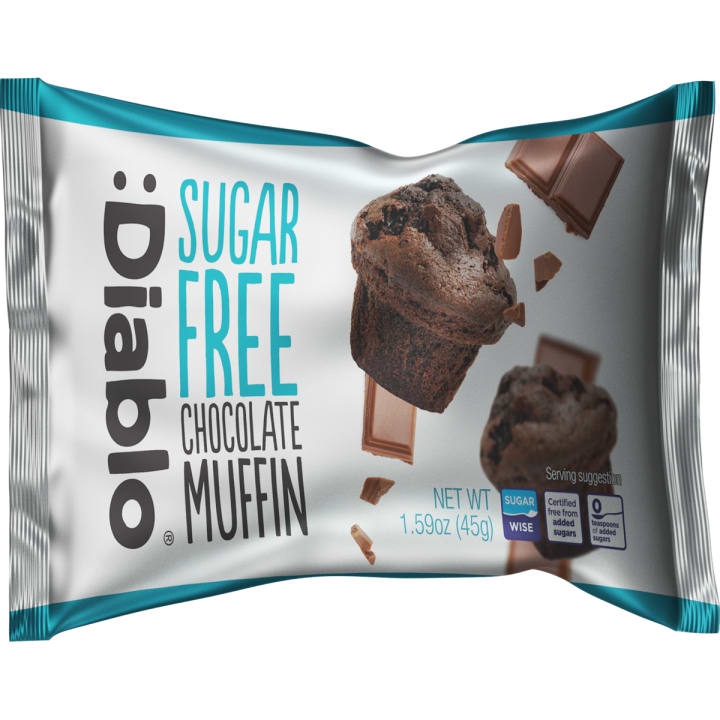
Two of ours that list it, if you would like to see it on a real label:

On this page: what it is made of · how sweet it is · why it is paired · calories · safety
What is acesulfame K made of?
Acesulfame K is a potassium salt made by chemical synthesis. It does not come from a plant. The K in the name is the chemical symbol for potassium. You will see it written as acesulfame K, acesulfame potassium or Ace-K. In Great Britain it carries the additive number E950 on the approved list of sweeteners.
It is a white powder that dissolves easily in water. Nobody bakes with it by the spoonful, because a recipe needs only a trace.
How sweet is acesulfame K compared with sugar?
The US Food and Drug Administration puts it at about 200 times sweeter than table sugar. A gram of it does the sweetening work of roughly 200 grams of sugar.
Because so little is needed, it often sits at the tail of an ingredient list. On our Butter Sweets the list runs isomalt, water, butter, milk cream, flavouring, salt, soya lecithin, whey powder and E150 colouring, then acesulfame K, last of all.
Why is acesulfame K paired with other sweeteners?
A sweet or a sponge needs bulk as well as sweetness. A few milligrams of powder give no bulk at all. So in sweets and cakes acesulfame K works alongside a polyol, the family of sweeteners that includes maltitol and isomalt. Most of what you eat in a sugar free sweet is the polyol; the acesulfame K is there in milligrams, to bring the sweetness up to what you expect.
Isomalt is about half as sweet as sugar, so in our Butter Sweets the acesulfame K makes up the difference. In our muffins the pairing is printed in one bracket: Sweeteners (Maltitol syrup, Acesulfame K). Those muffins are baked, which suits it: the FDA notes that acesulfame K stays sweet at baking temperatures.
| Acesulfame K | Maltitol | Isomalt | |
|---|---|---|---|
| E number | E950 | E965 | E953 |
| Sweetness next to sugar | About 200 times | About 90 percent | About half |
| Job in the recipe | Sweetness in tiny amounts | Bulk, sweetness, melt | Bulk, a hard clear set |
| On the nutrition panel | Not a sugar, not a polyol | Polyols line, 2.4 kcal per g | Polyols line, 2.4 kcal per g |
Sources: GB approved additives list; FDA; polyol energy factor from Annex XIV of the assimilated Food Information Regulation.
Does acesulfame K have calories?
No energy reaches you from it. In the human studies reviewed by JECFA, the joint FAO and WHO expert committee on food additives, absorption was rapid and virtually complete and over 99 percent of the dose left in urine, with only the original substance found (JECFA monograph).
It does not count as a sugar either. The panel on our 45 g Chocolate Muffin reads 0 g sugars and 19 g polyols per 100 g. Acesulfame K is not a polyol, so none of that 19 g is acesulfame K. It has no line of its own.
Is acesulfame K safe to eat?
Yes. The European Food Safety Authority published a full re-evaluation of E950 in April 2025 and raised its acceptable daily intake from 9 to 15 mg per kg of body weight. It found the highest exposure estimates in Europe generally below that figure and concluded there was no safety concern (EFSA Journal, 2025).
The FDA uses the same 15 mg per kg. It permitted acesulfame K in specific foods in 1988 and as a general purpose sweetener in 2003, after reviewing more than 90 studies, including work on reproduction, cancer and metabolism. For a 70 kg adult, 15 mg per kg works out at 1,050 mg a day.
Acesulfame K brings no digestive warning of its own. The line "excessive consumption may produce laxative effects" on our muffin and sweet packs comes from the polyols, which UK law requires on any food with more than 10 percent added polyols. More on that family in our guide to sugar alcohols.
Frequently asked questions
Is acesulfame K bad for you?
No. EFSA re-evaluated it in 2025, raised the acceptable daily intake to 15 mg per kg of body weight and found no safety concern at European intakes. The FDA applies the same 15 mg per kg figure.
Is acesulfame K natural?
No. It is made by chemical synthesis and does not occur in plants, unlike steviol glycosides, which are extracted from the stevia leaf.
Is acesulfame K the same as aspartame?
No. They are separate sweeteners with separate numbers on the GB list, E950 for acesulfame K and E951 for aspartame, and each one was assessed on its own evidence.
Why does a sugar free sweet need two sweeteners?
The polyol gives the sweet its bulk and texture but is less sweet than sugar. A trace of acesulfame K tops up the sweetness without changing the texture.