 Schokoladentafeln
 Dragees
 Kuchen & Muffins
 Süßigkeiten & Fruchtgummis
 Cookies
 Dessertsaucen
 Waffeln
 Aufstriche
 Müsliriegel
 Geschenkkörbe
 Verkauf & Sonderangebote

Eating Sweet with Diabetes: The Practical Guide
UK guidance does not strike sweet food off the menu for people living with diabetes. Diabetes UK's advice centres on the total carbohydrate you eat rather than sugar alone, alongside portion size and your own numbers. This guide covers what that means at the sweet end of the diet, how to read the labels that matter and what a sugar free label does and does not tell you.
One thing before anything else: this is an editorial guide, not personal advice. Your diabetes care team knows your numbers and your medication, and they are the right people to turn any label into a decision for you.
What does UK guidance actually say about sweet foods?
Diabetes UK is direct about it: all the carbohydrate you eat affects blood glucose, not just the sugars, and managing intake is about the whole eating pattern rather than a banned list. The NHS adds a number that applies to everyone: free sugars should stay under 30 g a day for adults.
That reframing matters for anyone who likes sweet things. The useful question is not whether a food tastes sweet. It is how much carbohydrate the portion carries, what kind and what that does in your own readings.
The three label lines worth reading
A UK nutrition table answers the carbohydrate question in three lines. Carbohydrate is the total, and the figure UK guidance points you to first. of which sugars shows how much of that total is sugars. And on sugar free confectionery a third line appears: of which polyols, the plant based sweeteners that replace sugar. Polyols are part of the carbohydrate total but they are not sugars, and they behave differently.
How differently is something UK law only allows to be said one way, with the authorised wording from the Great Britain nutrition and health claims register:
Consumption of foods containing maltitol instead of sugar induces a lower blood glucose rise after their consumption compared to sugar-containing foods.
Authorised wording, GB nutrition and health claims register. Equivalent entries cover isomalt, sorbitol and the other polyols.
The mechanism behind that sentence: polyols like maltitol are absorbed slowly and only in part, so they change what arrives in the bloodstream and when. Our guide to sugar alcohols walks through the whole family.
What the numbers look like on real packs
The honest way to weigh up any sweet product is the nutrition table, so here are two of ours with the figures that matter. Sugar Free on a Diablo pack means no more than 0.5 g of sugars per 100 g. No Added Sugar means none added, with any sugars occurring naturally in ingredients like milk or cocoa. The distinction has its own guide in sugar free vs no added sugar.

0.5 g sugars and 42 g polyols per 100 g, with 8.1 g fibre from the cocoa. The trace sugars occur naturally
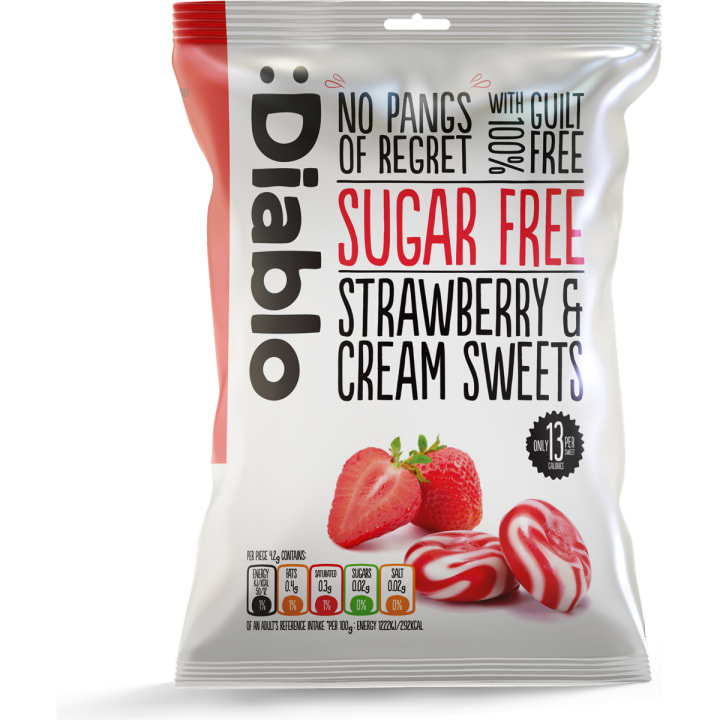
Sugar Free Strawberry and Cream Sweets
0.5 g sugars per 100 g in a boiled sweet, sweetened with isomalt and maltitol syrup
Not a low calorie food. See nutrition information for sugar and calorie content.
Read those the way UK guidance suggests reading anything: the carbohydrate total for the portion you will actually eat, then the sugars line, then let your care team and your own readings tell you how a product lands for you.
Portion habits that keep sweetness workable
Three habits do most of the work. First, decide the portion before you open the pack, using the portion size printed on it, rather than negotiating with the bag mid film. Second, sweet things tend to sit better alongside a meal than alone on an empty stomach, a pattern Diabetes UK notes for managing the overall glucose picture. Third, ease into any polyol sweetened product: packs carrying more than 10 percent polyols state that excessive consumption may produce laxative effects, and the practical translation is to treat a new product like a high fibre food. A few pieces at a time, and your gut adjusts.
None of this is deprivation. It is the same portion sense that applies to any confectionery, applied with better label information.
Can you eat sweets with type 1 or type 2 diabetes?
Yes, within the same 30 g a day free sugars limit the NHS sets for every adult. Diabetes UK's answer for type 1 is one word, anything, with the carbohydrate counted and the insulin matched to it. For type 2 the charity's advice is healthier choices more often, with treats occasionally and in small portions. Neither says never.
Carbohydrate counting sits under both answers. The NHS carbohydrate counting page puts it plainly for insulin users: knowing how many carbohydrates you are eating and drinking lets you match your insulin dose to your food, which means more flexibility in what you eat. A sweet goes into that count from its label like any other carbohydrate portion. Diabetes UK's type 1 page adds the frequency: your normal treats, occasionally, with an eye on the portion size.
How do you build a dessert when you live with diabetes?
Start from the portion. Diabetes UK's rule for a dessert is one portion, with thought given to what it is served with, and its snack list supplies the example: 125 g of natural yoghurt with 80 g of raspberries, 119 calories. The same page swaps ice cream for a frozen banana or frozen unsweetened yoghurt with berries.
The pairing matters. Diabetes UK's glycaemic index page notes that protein lowers the GI of a food, fat does the same and high fibre foods slow the absorption of carbohydrate. Yoghurt and berries bring protein and fibre with them; a plain slab of sponge brings neither.
Can you eat cake, ice cream and pastry with diabetes?
You can, and the carbohydrate differs sharply between them. The government's CoFID tables put retail sponge cake with jam and buttercream at 55.1 g of carbohydrate per 100 g, 37.6 g of it sugars. Dairy vanilla soft scoop ice cream comes in at 22 g per 100 g, all of it sugars. A croissant carries 43.3 g per 100 g but only 5.3 g of sugars: pastry's carbohydrate is mostly starch, and starch counts in full.
Weigh your usual slice once and the per 100 g figure does the rest: a 60 g slice of that sponge is about 33 g of carbohydrate. Diabetes UK's advice on cake is a small piece of your favourite kind.
Can you eat sugar free biscuits and sweets with diabetes?
Yes, and the label tells you what you are counting. Sugar free means no more than 0.5 g of sugars per 100 g. The carbohydrate line still carries the polyols that do the sweetening, shown beneath it as of which polyols, and they count. Diabetes UK's sweeteners page draws the distinction: polyols contain carbohydrates and calories, but they have fewer calories and less of an effect on blood glucose levels than sucrose.
Polyols are absorbed slowly and only in part, which is why the same page says it is not exactly clear how they should be counted by people adjusting insulin to carbohydrate. If you carb count, agree a convention with your care team and apply it to the printed figure. Packs over 10 percent polyols state that excessive consumption may produce laxative effects. Treat them like any new food: a few biscuits or sweets at a time, then the tin goes back in the cupboard.
What can we say about Diablo chocolate and diabetes?
No everyday food can be described as suitable for a medical condition under UK rules, ours included, so the honest answer is the label. Article 7 of the assimilated food information regulation bars food information that suggests a food has special characteristics when all similar foods have them. The advertising regulator applied exactly that in March 2023 to an ice cream presented as made for people with the condition, and ruled it misleading.
What our No Added Sugar Dark Chocolate (85 g) label says, per 100 g: 47 g carbohydrate, of which 0.5 g sugars and 42 g polyols, plus 8.1 g fibre. The sugars occur naturally in the cocoa and nothing is added. Those are the numbers to carry into your carbohydrate count, with whichever polyol convention your team agrees. Anyone managing a health condition should lean on their healthcare team for personal advice.
Frequently asked questions
Can you eat chocolate if you have diabetes?
UK guidance treats no single food as automatically off the menu. What matters is the carbohydrate the portion carries and how it fits your overall day, which is a conversation for you and your diabetes care team. The nutrition table on any bar, ours included, gives you the figures to take into that conversation.
What does sugar free actually mean on a pack?
In UK law a food can only be labelled sugar free when it carries no more than 0.5 g of sugars per 100 g. It does not mean carbohydrate free or calorie free: the carbohydrate line on the nutrition table still tells the full story, including polyols.
Do polyol sweeteners affect blood glucose?
The wording UK law authorises says it precisely: consumption of foods containing maltitol instead of sugar induces a lower blood glucose rise after their consumption compared to sugar-containing foods. Polyols still count within the carbohydrate total on the label, so include them in anything you track with your care team.