 Chocolate Bars
 Dragees
 Cakes & Muffins
 Sweets & Gummies
 Cookies
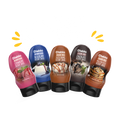 Dessert Sauces
 Wafers
 Spreads
 Muesli Bars
 Guilt-free Gifting
 Sales & Promotions

Sugar-Free Chocolate: The Ultimate Guide for 2026
Complete UK Guide
What the UK claims legally mean, how the sweeteners behave, how to compare two bars on the shelf, and the verified figures for the Diablo range.
Sugar free chocolate is one of the few categories where the front of the pack is regulated and the back of the pack still holds the answer. Learn four lines of a nutrition panel and you can judge any bar in about ten seconds, ours included.
What Is Sugar Free Chocolate?
Quick Answer
Definition
Sugar free chocolate is chocolate holding no more than 0.5 g of sugars per 100 g, with the sweetness coming from polyols such as maltitol or isomalt, or from high intensity sweeteners such as steviol glycosides. The sweetener used, and the polyols line on the panel, tell you the rest.
Manufacturing barely changes. Beans are fermented, roasted and ground to cocoa mass, cocoa butter goes in for flow and melt, and the sweetener replaces sugar during conching. What changes is that sweetener, and the swap drives the taste, the texture and most of the nutrition panel.
Sugar Free, No Added Sugar and Low Sugar
These are separate regulated claims under the assimilated nutrition and health claims regulation, and mixing them up is the most common mistake in the aisle. Diablo runs two of them as distinct ranges and never blurs the line.
| Claim | UK legal definition | What to check on the panel |
|---|---|---|
| Sugar Free | Maximum 0.5g sugars per 100g | The of which sugars line, which should read 0.5g or less per 100g |
| No Added Sugar | No sugars or sweetening foods added in manufacture | The sugars figure, which reflects sugars occurring naturally in milk or fruit |
| Low Sugar | Maximum 5g sugars per 100g | Ten times the sugar free ceiling, so read the figure rather than the words |
| Reduced Sugar | At least 30% less than a comparable product | What it is being compared against, since the base product may be very sweet |
The Sweeteners and What They Do
Maltitol (E965) is the workhorse of the category because it behaves like sugar in the factory. It occupies the same bulk, tempers the same way and gives a bar its snap and melt, at roughly 90 percent of sugar's sweetness.
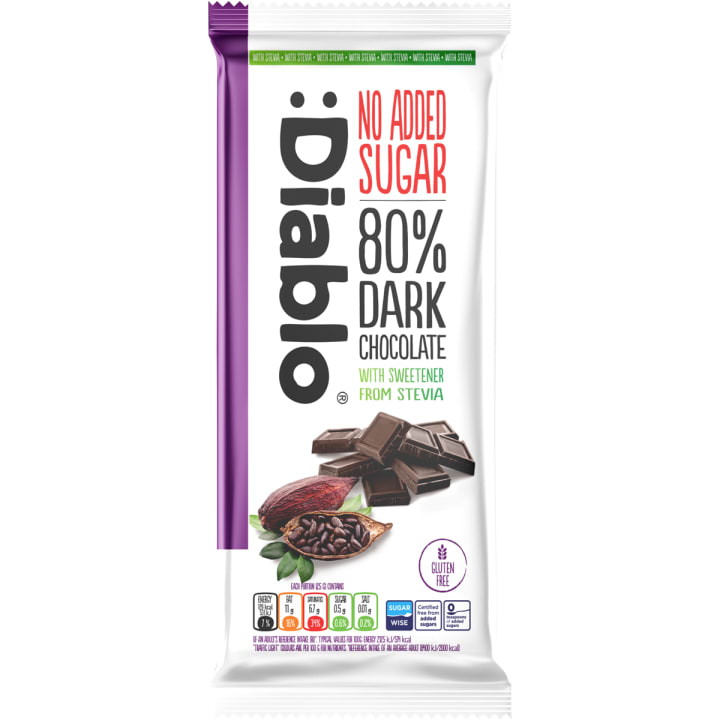
Steviol glycosides (E960) come from the leaves of Stevia rebaudiana and sweeten a few hundred times more strongly than sugar, at zero calories. They add no bulk, so they appear in small percentages alongside a polyol: in the Diablo 80% dark bar, 0.02 percent.
Isomalt (E953) suits boiled sweets, where a hard, slow dissolving structure matters more than melt. Erythritol (E968) and xylitol (E967) turn up mainly in baking blends and gum, and xylitol is worth keeping away from dogs.
Where maltitol replaces sugar, the GB nutrition and health claims register authorises one statement: consumption of foods containing maltitol instead of sugar induces a lower blood glucose rise after their consumption compared to sugar-containing foods. Everything else worth knowing sits on the nutrition panel.
Polyols are absorbed slowly and only in part, which is exactly why they contribute less energy than sugar does. Packs containing over 10 percent polyols carry the note that excessive consumption may produce laxative effects. Two or three squares to start, and most people adjust quickly.
How to Compare Two Bars on the Shelf
Brand names tell you little here, because two bars carrying the same front of pack claim can be built completely differently. The comparison that works takes four numbers, all per 100 g so pack size cannot distort the picture.
- Sugars per 100g. This is the regulated number. At or under 0.5g the sugar free claim holds; anything higher belongs to a different claim.
- Polyols per 100g. A high figure means a bulk sweetener is doing the work, which usually means a texture closer to conventional chocolate.
- Carbohydrate per 100g. Polyols sit inside this figure, so it is the honest total. In our own range it runs from 26g for the 80% dark bar to 58g for the milk bar.
- Cocoa percentage and ingredient order. If cocoa mass or paste comes before the sweetener, cocoa is the dominant ingredient, and that tells you more about flavour than any front of pack wording.
The Diablo Range, With the Figures
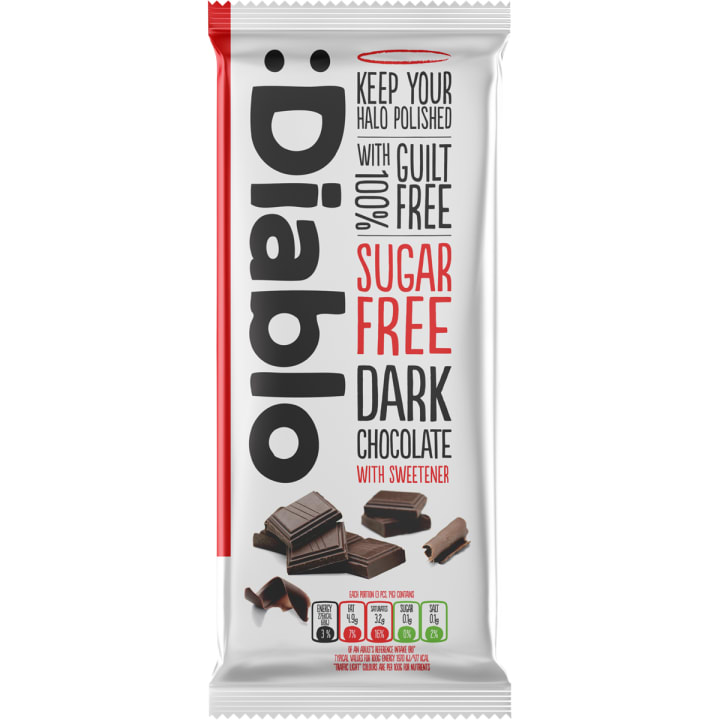
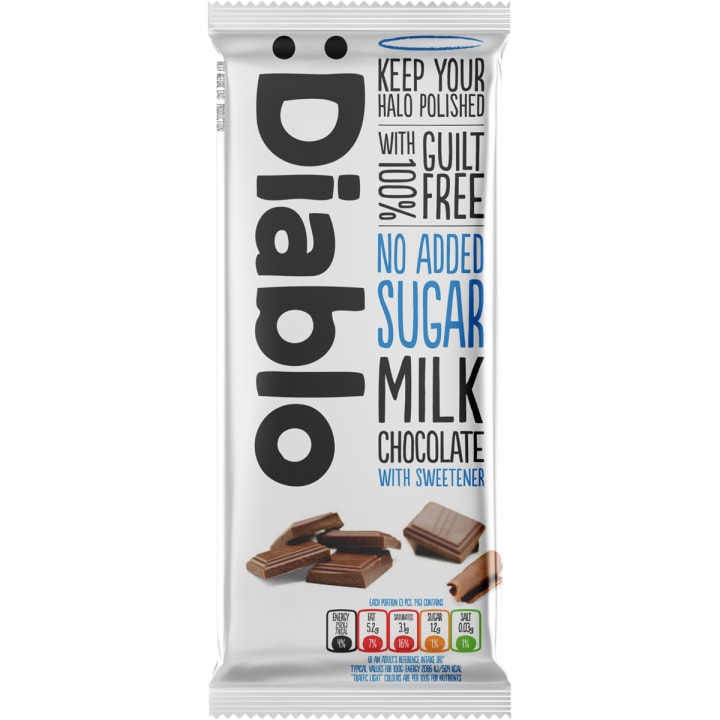
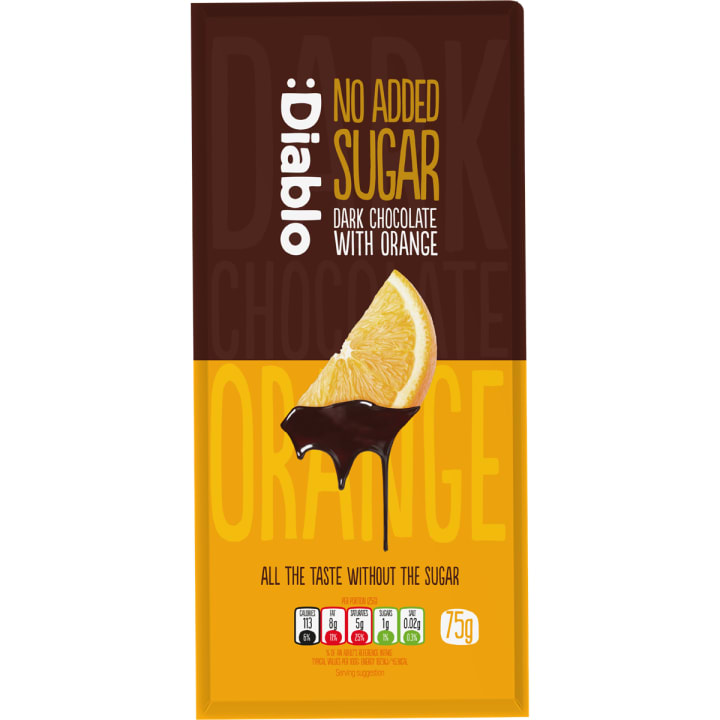
Every figure below is per 100 g, from our own product specifications. No Added Sugar bars have nothing sweet added, so the sugars shown occur naturally in the milk or the cocoa.
A Note on Old-Style Labels
Chocolate marketed specifically at people with diabetes was once sold in UK pharmacies, usually sweetened with fructose. Food Standards Agency guidance now advises against that style of labelling. Modern products sit under the regulated Sugar Free and No Added Sugar claims instead.
How to Read a UK Label
- Start with the front of pack claim, and treat it as a question rather than an answer.
- Read the ingredient list in order. Ingredients are listed by weight, so whatever comes first is what you are mostly eating.
- Find the of which sugars line per 100g, and compare it against the 0.5g and 5g thresholds.
- Find the of which polyols line underneath it. Polyols are not sugars and are reported separately.
- Identify sweeteners by E number: E953 isomalt, E960 steviol glycosides, E965 maltitol, E967 xylitol, E968 erythritol.
- Check for the polyol note. Packs over 10 percent polyols carry the laxative effects wording, a sign of a label doing its job.
Frequently Asked Questions
Sugar free means no more than 0.5g of sugars per 100g. No added sugar means no sugars were added during manufacture, while sugars occurring naturally in ingredients such as milk or fruit remain. Diablo No Added Sugar Milk Chocolate shows 6.7g of sugars per 100g, all of it from the milk powder.
Yes. Fat supplies most of the energy in any chocolate, and taking the sugar out does not change that. Diablo No Added Sugar Dark Chocolate carries 477 kcal per 100g and the 80% dark bar carries 514 kcal per 100g. Sugar free is a claim about sugar, not about energy.
Because they are absorbed slowly and only in part, which is exactly what keeps their sugar and energy contribution low. The portion that reaches the colon is fermented there. UK labelling requires the note on packs containing more than 10 percent polyols, and a few squares at a time is the practical answer.
Portion size is the thing to watch, since a smaller body reaches the polyol threshold sooner. Several Diablo packs state they are not suitable for children under 3 years, so check the pack in front of you.
Key Facts at a Glance
- Assimilated Regulation (EC) No 1924/2006, annexed conditions for sugar free, no added sugar, low sugar and reduced sugar claims. legislation.gov.uk
- Great Britain nutrition and health claims register. gov.uk
- Food Standards Agency. Food labelling, sugar and sweetener claims. food.gov.uk
- Diablo Sugar Free product specifications and certification records, August 2026.
All the Figures, on Every Bar
Every Diablo chocolate bar names its sweetener and publishes its full panel, so you can compare sugars, polyols and carbohydrate before you buy.