 Chocolate Bars
 Dragees
 Cakes & Muffins
 Sweets & Gummies
 Cookies
 Dessert Sauces
 Wafers
 Spreads
 Muesli Bars
 Guilt-free Gifting
 Sales & Promotions

What Are Natural Sweeteners?
Natural sweeteners are plant- or animal-derived substances that provide sweetness with fewer calories and a lower blood sugar impact than refined table sugar. Here is what the evidence shows:
- +Stevia and monk fruit have a glycaemic index of zero and zero calories, the lowest scores of any sweetener category
- +Polyols (sugar alcohols) such as maltitol, erythritol, and isomalt provide sweetness with 0 to 2.6 kcal/g compared to sugar's 4 kcal/g
- +Artificial sweeteners including stevia, sucralose, and aspartame all have a GI of zero and are approved by the UK Food Standards Agency
- !Not all sugar-free products are equal: honey, maple syrup, and coconut sugar are natural but still raise blood sugar
- !Maltitol, the most widely used polyol in sugar-free confectionery, has a GI of approximately 35, roughly half that of table sugar at 65
- +The global natural sweeteners market was valued at USD 29.32 billion in 2024 and is projected to reach USD 49.54 billion by 2033
Two of ours sweetened with maltitol and steviol glycosides:
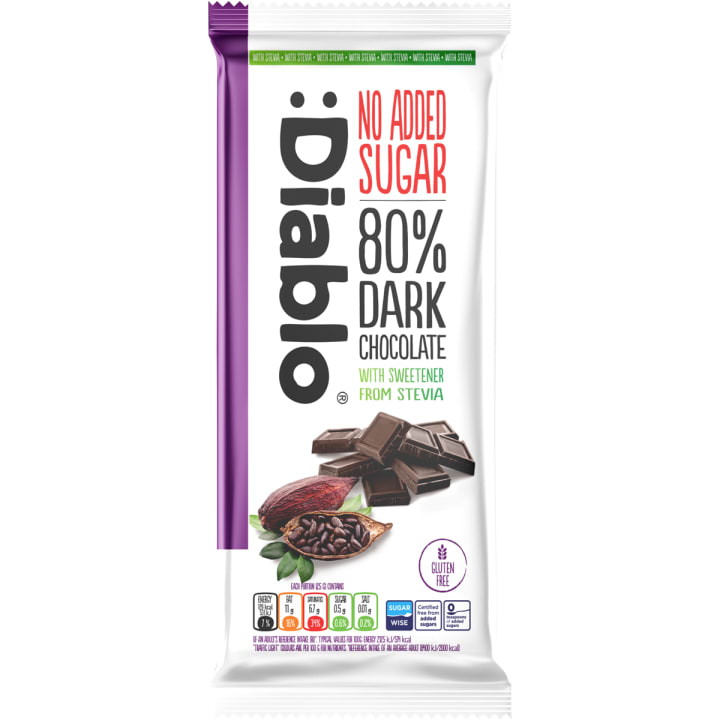
No Added Sugar 80% Dark Chocolate with Stevia 75 g
1.1 g naturally occurring sugars per 100 g, sweetened with maltitol and steviol glycosides

No Added Sugar Milk Chocolate with Crispy Rice 75 g
6.5 g naturally occurring sugars per 100 g, sweetened with maltitol and steviol glycosides
You are standing in the supermarket aisle, trying to decode a label that lists maltitol, steviol glycosides, erythritol, and sucralose all in the same product. Which one is actually safe? Which one will spike your blood sugar? And what does any of this mean in practice?
This guide answers every one of those questions. You may be managing diabetes, following a keto or low-carb diet, reducing your calorie intake, or simply looking for cleaner ingredients in the food you enjoy. In every case, the choice of sweetener matters far more than most people realise.
We cover every major natural and artificial sweetener, where it comes from, how it behaves in the body, what the research says about safety and blood sugar impact, and how Diablo Sugar Free uses this science to create confectionery you can actually enjoy without compromise.
This guide references peer-reviewed research and guidance from Diabetes UK, the UK Food Standards Agency, the International Diabetes Federation, PMC-indexed clinical trials, and published systematic reviews. It is intended for educational purposes. Always consult your physician or registered dietitian for personalised dietary advice.
In This Guide
- What Are Natural Sweeteners and What Are Not
- The Four Types of Sweeteners
- Natural Sweeteners: Stevia, Monk Fruit and More
- Polyols and Sugar Alcohols: The Full Picture
- Artificial Sweeteners Compared
- Glycaemic Index Master Reference Table
- Natural vs Artificial: Key Differences
- Which Sweetener Is Best for Your Goal
- Practical Baking Conversion Guide
- UK Regulatory Context
- Frequently Asked Questions
What Is a Natural Sweetener and What Is Not
The word "natural" is one of the most misused terms in the food industry. A working definition based on food science is this: a natural sweetener is any sweetening substance derived from a plant, fruit, root, or other biological source that provides sweetness without heavy chemical synthesis of its core sweet compound.
The complication is that "natural" and "safe" are not the same thing, and neither are "natural" and "low-GI." Honey is entirely natural and will raise your blood sugar as fast as table sugar. Stevia, extracted and refined from leaves, is classified as natural but is still heavily processed before it reaches a product label.
Diabetes UK notes that some stevia-based products are marketed as natural even though they are processed and refined. Sucralose, meanwhile, is classified as an artificial sweetener even though it is derived from sucrose. The terms overlap and the label alone is not a reliable guide to blood sugar impact. Always check the GI score and the full ingredient list.
For the purposes of this guide, sweeteners are grouped into four categories: high-intensity natural sweeteners (stevia, monk fruit), polyols and sugar alcohols (the bulking sweeteners used in most sugar-free confectionery), naturally occurring sugars from whole food sources (honey, maple syrup, coconut sugar), and approved artificial sweeteners (aspartame, sucralose, saccharin, acesulfame-K).
What Are the Types of Sweeteners?
A UK ingredient list can carry four types of sweetener: sugars and syrups, polyols, natural high-intensity sweeteners and artificial high-intensity sweeteners. What separates them is how much goes in: polyols are used in bulk, like sugar, while high-intensity sweeteners work in tiny amounts.
| Type | Examples | Sweetness vs sugar | Energy per gram | On the label |
|---|---|---|---|---|
| Sugars and syrups | Table sugar, honey, maple syrup, coconut sugar | The benchmark | 4 kcal (17 kJ) for the sugars they contain | Counted in the "of which sugars" line |
| Polyols (sugar alcohols) | Maltitol (E965), isomalt (E953), sorbitol (E420), erythritol (E968) | Used in bulk, replacing the weight and texture of sugar | 2.4 kcal (10 kJ); erythritol 0 | "Sweetener (maltitol)", often with an "of which polyols" line |
| Natural high-intensity | Steviol glycosides from stevia | 200 to 400 times sweeter | Next to none at the doses used | "Sweetener: steviol glycosides" |
| Artificial high-intensity | Sucralose (E955), acesulfame K (E950), aspartame (E951) | Sucralose about 600 times; acesulfame K and aspartame about 200 times | Next to none at the doses used | The name or E number after "sweetener" |
Sources: FDA, sweeteners in food (sweetness); FSA approved additives and E numbers; Regulation 1169/2011, Annex XIV (energy factors).
Across the 92 products in our range, maltitol appears in 85, acesulfame K in 20, steviol glycosides in 14 and sucralose in 2. For glycaemic index figures side by side, see our natural sweeteners glycaemic index chart.
Natural High-Intensity Sweeteners
Stevia
Stevia is extracted from the leaves of Stevia rebaudiana, a plant native to the southern Amazon rainforest in South America. Its sweet compounds, called steviol glycosides, are 200 to 300 times sweeter than table sugar, yet contain zero calories and have a glycaemic index of zero.
The UK Food Standards Agency has approved stevia (listed as steviol glycosides) for use in food products. It is heat stable, which means it works in baking and hot drinks. Clinical studies have found that 12 weeks of daily stevia consumption had no significant effect on body weight, fasting glucose, or insulin levels in healthy adults.
Diablo Sugar Free uses stevia alongside polyols in a number of its recipes, including its stevia chocolate bars and its sweets and gummies, with cookies completing the range. No added sugar in any of them.
Shop Diablo Stevia Chocolate


- Calories: zero
- Glycaemic index: 0
- Blood sugar impact: none
- Heat stable: yes
- FSA approved: yes
- Best for: baking, hot drinks, keto and low-carb eating plans
- Watch out for: some people notice a mild bitter or liquorice-like aftertaste at high concentrations; some blended stevia products contain bulking agents that add small amounts of carbohydrate
Monk Fruit (Luo Han Guo)
Monk fruit extract comes from the Siraitia grosvenorii fruit, a small round melon native to southern China and northern Thailand. Its active sweet compound, mogroside V, provides sweetness that is 150 to 250 times more intense than sugar with a glycaemic index of zero and no caloric content.
Natural High-Intensity Sweeteners, primarily stevia and monk fruit, held a 31.21% share of the global natural sweeteners market in 2024 and are projected to grow at a compound annual growth rate of 10.32% through to 2030, driven by adoption in both diabetes management and mainstream health-conscious eating.
- Calories: zero
- Glycaemic index: 0
- Blood sugar impact: none
- Heat stable: yes
- Best for: people who dislike stevia's aftertaste; keto and low-carb diets
- Watch out for: higher cost than other sweeteners; less widely available in UK supermarkets; some commercial products blend monk fruit with dextrose, which does raise blood sugar
Honey, Maple Syrup and Coconut Sugar: The Natural Sweeteners That Still Raise Blood Sugar
These three sweeteners are often promoted as healthier alternatives to table sugar because they are natural and contain trace minerals and antioxidants. That is true, but it is also misleading when viewed through the lens of blood sugar management.
Raw honey has a glycaemic index of 55 to 70. Maple syrup sits at approximately 54. Coconut sugar, often marketed as a gentler swap, has a GI of 35 to 54. All three will raise blood glucose. All three contain roughly 60 to 64 kcal per tablespoon. For people with diabetes, pre-diabetes, or those following keto or low-carb diets, these are not suitable sugar substitutes.
The word "natural" does not mean "safe for blood sugar." Honey, maple syrup, agave nectar, and coconut sugar all behave similarly to table sugar in the body. If blood glucose management is your goal, these sweeteners should be treated the same way as refined white sugar.
Polyols and Sugar Alcohols: The Sweeteners Inside Sugar-Free Confectionery
Polyols are the category of sweetener that most directly affects what you taste when you eat a Diablo Sugar Free chocolate, wafer, or muesli bar. Understanding how they work is essential if you are managing blood sugar, following a low-carb diet, or simply trying to make sense of a nutrition label.
Polyols are a type of carbohydrate found naturally in certain fruits, vegetables, and plant fibres. They are also manufactured as food additives. Chemically, they sit between sugars and alcohols because they contain hydroxyl groups, but they have no intoxicating effect. The defining feature of polyols is that they are only partially absorbed in the small intestine, which is why they provide fewer calories than sugar and cause a significantly lower blood glucose response.
Polyols contain carbohydrates and calories, but they have fewer calories and less of an effect on blood glucose levels than sucrose. It is not exactly clear how polyols should be counted by people who are adjusting their insulin dose according to carbohydrate intake, as not all of the carbohydrate from polyols is absorbed. People with diabetes should speak to their healthcare team for individual advice. Source: Diabetes UK.
The Seven Most Common Polyols Compared
| Polyol | Sweetness vs Sugar | Calories (kcal/g) | GI (approx.) | Used in Diablo Products | Key Notes |
|---|---|---|---|---|---|
| Erythritol | 60 to 80% | ~0 | 0 | No | Best tolerated Minimal digestive side effects. Zero calories. |
| Xylitol | ~100% | 2.4 | 7 to 13 | No | Good Dental health benefits. Toxic to dogs. |
| Maltitol | ~90% | 2.1 | 35 | Yes, core sweetener | Most sugar-like Closest to sugar in taste and texture. GI of 35 versus 65 for table sugar. |
| Sorbitol | ~60% | 2.6 | 9 | Yes, in gummies | Moderate Common in sugar-free sweets and gum. |
| Mannitol | 50 to 70% | 1.6 | 0 to 2 | No | Good Cooling sensation. Used in confectionery coatings. |
| Isomalt | 45 to 65% | 2.0 | 2 | Selected products | Good Ideal for hard sugar-free candies. Very low GI. |
| Lactitol | 35 to 40% | 2.4 | 6 | No | Good Used in baking and chocolate alternatives. |
Sources: PMC/NCBI peer-reviewed polyol research (2022), Diabetes UK, Diet vs Disease. GI values are approximate and may vary by product and individual response.
Maltitol: The Most Sugar-Like Polyol
Maltitol deserves special attention because it is the most widely used polyol in commercial sugar-free confectionery, and it is the core sweetener in Diablo recipes. It behaves like sugar in manufacturing processes and delivers a texture almost identical to sucrose in chocolate, which is exactly why formulators reach for it.
With a glycaemic index of approximately 35 against table sugar's 65, maltitol produces a lower and slower rise in blood glucose than sugar. The GB nutrition and health claims register states it this way: consumption of foods containing maltitol instead of sugar induces a lower blood glucose rise after their consumption compared to sugar-containing foods. A 2022 PMC review noted that the glycaemic and insulinemic responses of polyols vary, with maltitol the closest of the group to sugar in behaviour as well as taste.
When reading a sugar-free chocolate or confectionery label, the ingredient list tells you which polyol is doing the work, and the nutrition panel tells you how much. Anyone counting carbohydrates or adjusting insulin should ask their care team how to count polyols, as not all of their carbohydrate is absorbed.
Diablo Sugar Free products use polyols, principally maltitol and isomalt, as sweetening and bulking agents, with stevia in a number of recipes. Polyols are absorbed slowly, which is the point. Every nutrition figure on a Diablo label comes from certified analysis, so you can check the sugars and polyols per 100g for yourself.
Shop the Diablo Range


The Laxative Effect: What You Need to Know
All polyols share one important characteristic: consuming large amounts can cause digestive discomfort, including bloating, flatulence, and loose stools. This happens because polyols that are not absorbed in the small intestine travel to the large intestine, where they are fermented by gut bacteria.
The threshold varies by individual and by specific polyol, but as a general guide, most adults notice digestive effects above 15 to 25 grams of polyols in a single sitting. Polyols are absorbed slowly, which is the point, so the practical approach is simple: enjoy a few pieces at a time and most people find their gut adjusts.
UK food labelling regulations require products containing polyols above a certain level to carry the advisory statement: "Excessive consumption may produce laxative effects." This is a legal requirement under EU regulations retained in UK law, and all Diablo Sugar Free products comply with this requirement.
Real Product Example: What Sweetens a Diablo Sugar Free Product?
To see polyol science in action, consider the Diablo NAS Hazelnut Muesli Bar (30g), a No Added Sugar product from the Diablo breakfast bar range. The nutritional profile, verified from Certificate of Analysis data, illustrates exactly what a well-formulated polyol-based product looks like.
| Nutrient | Per 100g | Per 30g Serving |
|---|---|---|
| Energy (kJ) | 1486 kJ | 446 kJ |
| Energy (kcal) | 354 kcal | 106 kcal |
| Fat | 9g | 2.7g |
| of which saturates | 3g | 0.9g |
| Carbohydrates | 68g | 20.4g |
| of which sugars | 4g | 1.2g |
| of which polyols | 22g | 6.6g |
| Fibre | 4g | 1.2g |
| Protein | 7g | 2.1g |
| Salt | 0.65g | 0.2g |
Source: Diablo Sugar Free Certificate of Analysis data. SKU: BRB-030-HZL-P28. The bar is also enriched with vitamin D, folic acid and iron. The 4g sugars per 100g occur naturally in ingredients such as raisins and oats.
The sugars figure of 4g per 100g comes from naturally occurring sugars in ingredients such as raisins and oats, with none added. The polyols at 22g per 100g deliver the sweetness and texture in place of refined sugar. This is the practical difference that well-formulated no added sugar confectionery makes.
Artificial Sweeteners: The Complete Picture
Artificial sweeteners, also called non-nutritive sweeteners or high-intensity sweeteners, are synthesised compounds that deliver intense sweetness at very small doses. They have been part of the food supply since saccharin was discovered in 1879, and they remain the subject of ongoing public debate that often outstrips the available scientific evidence.
The key regulatory fact for UK consumers is this: all artificial sweeteners used in UK food products have been assessed and approved by the Food Standards Agency. The approval process requires evidence that a sweetener does not cause adverse health effects, including cancer, at any realistic level of consumption. As part of the process, an Acceptable Daily Intake (ADI) is set at 100 times below the smallest amount that might cause any health concern. Reaching that level through normal dietary consumption is virtually impossible for any approved sweetener.
| Sweetener | Type | Sweetness vs Sugar | Calories | Heat Stable | ADI (mg/kg/day) | UK Brand Examples |
|---|---|---|---|---|---|---|
| Aspartame | Artificial | 200x | ~0 | No | 40 | Canderel, NutraSweet |
| Sucralose | Derived from sucrose | 600x | ~0 | Yes | 15 | Splenda |
| Saccharin | Artificial | 300 to 500x | ~0 | Yes | 5 | Sweetex, Hermesetas |
| Acesulfame-K | Artificial | 150 to 200x | ~0 | Yes | 9 | Hermesetas Gold, Sweet One |
| Stevia (steviol glycosides) | Natural extract | 200 to 300x | ~0 | Yes | 4 (as steviol equivalent) | Truvia, Stevia |
| Monk Fruit | Natural extract | 150 to 250x | ~0 | Yes | Not set (GRAS status) | Various |
Sources: UK Food Standards Agency, NHS University Hospitals Sussex Dietitian guidance, Diabetes UK. ADI = Acceptable Daily Intake set at 100 times below the safety threshold.
A Note on Aspartame
Aspartame has been subject to the most public controversy of any approved sweetener. In 2023, the International Agency for Research on Cancer classified aspartame as "possibly carcinogenic to humans" in Group 2B. This classification covers substances with limited evidence and includes everyday items such as aloe vera extract and pickled vegetables. The same body that made this classification, the Joint FAO/WHO Expert Committee on Food Additives, simultaneously maintained the existing ADI of 40 mg/kg/day and stated there was no convincing evidence to change safety recommendations. A 60-kg adult would need to consume 9 to 14 cans of diet soda every day to approach the ADI. People with phenylketonuria must avoid aspartame because it contains phenylalanine.
Glycaemic Index Master Reference
The Glycaemic Index measures how quickly a food raises blood glucose on a scale of 0 to 100, where pure glucose equals 100. For anyone managing blood sugar, GI is one of the most useful single metrics for comparing sweeteners. Foods with a GI below 55 are classified as low GI.
| Sweetener | GI Score | Calories (kcal/g) | Keto Carb Counting |
|---|---|---|---|
| Stevia | 0 | 0.0 | Zero net carbs |
| Monk Fruit | 0 | 0.0 | Zero net carbs |
| Erythritol | 0 | 0.0 | Zero net carbs |
| Isomalt | 2 | 2.0 | Partial net carbs |
| Mannitol | 0 to 2 | 1.6 | Partial net carbs |
| Sorbitol | 9 | 2.6 | Partial net carbs |
| Xylitol | 7 to 13 | 2.4 | Partial net carbs |
| Lactitol | 6 | 2.4 | Partial net carbs |
| Maltitol | 35 | 2.1 | Counted in full |
| Coconut Sugar | 35 to 54 | 3.8 | No |
| Honey | 55 to 70 | 3.0 | No |
| Maple Syrup | 54 | 2.6 | No |
| Table Sugar (sucrose) | 65 | 4.0 | No |
Sources: PMC/NCBI peer-reviewed polyol research (2022), Diabetes UK, NHS University Hospitals Sussex, GoodRx. GI values are approximate reference figures and vary by brand, processing method, and individual metabolic response.
Shop Diablo Confectionery


Natural vs Artificial Sweeteners: Key Differences
| Factor | Natural Sweeteners | Artificial Sweeteners |
|---|---|---|
| Origin | Plants, fruits, sap, root extracts | Synthesised chemically, some from natural precursors |
| Calories | 0 to 4 kcal/g depending on type | 0 kcal in all approved types |
| Glycaemic Index | 0 (stevia, monk fruit) to 35+ (maltitol) | 0 for all approved types |
| Taste profile | Varies; some polyols closely mimic sugar | Very intense; some have aftertaste |
| Heat stability | Most polyols and stevia are heat stable | Aspartame is not; sucralose and acesulfame-K are |
| FSA approved (UK) | Yes (polyols, stevia, thaumatin) | Yes, with ADI established for each |
| Consumer perception | Preferred for clean-label products | More scrutinised; some consumer avoidance |
| Best suited for | Baking, confectionery, drinks | Beverages, tabletop sweeteners, ready meals |
Which Sweetener Is Best for Your Goal
If You Count Carbohydrate
Stevia and monk fruit both score zero on the glycaemic index and contribute no calories. Among polyols, erythritol and isomalt have the lowest GI values. Maltitol, with a GI of 35, is still far lower than table sugar. Polyols sit inside the carbohydrate figure on a UK label, so take that figure from the pack, and if you follow a carbohydrate counting plan ask your care team how they want polyols counted.
The International Diabetes Federation reported in 2024 that approximately 589 million adults aged 20 to 79 are living with diabetes, with over 81% in low- and middle-income countries. The demand for sweeteners with less effect on blood glucose is both a public health topic and a growing commercial reality.
Diablo Sugar Free was formulated specifically for people who want to reduce or avoid sugar while still enjoying real confectionery. The range includes sugar-free chocolate bars, cookies and wafers, sweets and gummies, and no added sugar breakfast bars, all sweetened with polyols and stevia in place of refined sugar.
For Weight Management
Zero-calorie sweeteners including stevia, monk fruit, and approved artificial sweeteners are the most effective tools for reducing calorie intake. The evidence on whether sweeteners support long-term weight loss is mixed. Some research suggests that consuming very sweet-tasting products without caloric content may increase overall appetite for sweet foods. The practical consensus among dietitians is that sweeteners are a useful tool for calorie reduction when used as part of a broadly balanced diet rather than as a justification for increased intake of sweet foods overall.
For Keto and Low-Carb Diets
Most keto communities count erythritol as zero net carbs due to its negligible metabolic impact. Stevia and monk fruit are zero net carbs by definition. Isomalt, xylitol, sorbitol, and lactitol are typically counted as partial net carbs, roughly 50% of their total carbohydrate value. Maltitol is counted as full net carbs by most keto practitioners given its GI of 35. Allulose, where available, is considered zero net carbs under FDA labelling rules, though it is not yet widely available in UK products pending EU novel food authorisation.
For Parents Choosing Treats for Children
The point for parents is a simple one: polyols are not sugars. A well-formulated sugar-free sweet contains a fraction of the sugars of a conventional one, and the per-100g sugars figure on the nutrition panel tells you exactly how much. Because polyols are absorbed slowly, keep portions appropriate for the child's size: a few pieces at a time is the sensible pattern.
Practical Baking Conversion Guide
Sugar performs multiple functions in baking: sweetness, structure, moisture retention, browning via the Maillard reaction, and bulk. No single alternative sweetener replicates all of these simultaneously. Understanding what each sweetener can and cannot do is essential for successful sugar-free baking.
| Sweetener | Swap Ratio (vs 1 cup sugar) | Browning | Moisture Retention | Best Used For | Limitation |
|---|---|---|---|---|---|
| Erythritol | 1:1 | Poor | Poor (can dry out) | Cookies, frostings, icings | Can have cooling sensation on tongue; may crystallise |
| Xylitol | 1:1 | Moderate | Good | Cakes, cookies, muffins | Toxic to dogs; keep away from pets |
| Maltitol | 1:1 | Good | Good | Chocolates, pastry, biscuits | About 90% as sweet as sugar, so quantities may need slight adjustment |
| Isomalt | 1:1 | Yes (at higher temp) | Moderate | Hard candies, sugar work, decorations | Sets differently from sucrose; requires practice |
| Stevia (pure extract) | 1 tsp = 1 cup | No | No | Drinks, light sauces, yoghurt | Does not provide bulk or structure; needs a bulking agent |
| Monk Fruit blend | 1:1 (blend with erythritol) | Moderate | Moderate | General baking, pancakes, waffles | More expensive; availability varies in UK |
Note: Conversion ratios apply to blended commercial sweetener products formulated for baking. Pure high-intensity extracts require significantly smaller quantities. Always follow manufacturer guidance for the specific product.
The most reliable approach for sugar-free baking is to use a blend: a zero-calorie high-intensity sweetener such as stevia or monk fruit for sweetness, combined with a polyol such as erythritol for bulk and texture. This combination mimics the functional properties of sugar more closely than either sweetener alone and avoids the cooling sensation that pure erythritol can produce.
UK Regulatory Context
In the UK, sweeteners must be approved by the Food Standards Agency before they can be used in food products. The approval process includes comprehensive toxicological review, consumer exposure assessment, and the establishment of an Acceptable Daily Intake. ADIs are set at 100 times below the smallest amount that any study has found to cause any health concern, which is why it is effectively impossible to consume unsafe amounts of any approved sweetener through normal dietary use.
The sweeteners currently approved for use in UK food products include: acesulfame K, aspartame, cyclamic acid and its salts, saccharin, steviol glycosides, sucralose, thaumatin, and the polyols sorbitol, mannitol, isomalt, maltitol, lactitol, xylitol, and erythritol.
EU regulations retained in UK law require products containing polyols to carry the advisory statement that excessive consumption may produce laxative effects. This is required above specified usage thresholds and must appear on the product label.
One important distinction relevant to UK consumers is the difference between "Sugar Free" and "No Added Sugar" on product labels. Sugar Free means no more than 0.5g of sugars per 100g. No Added Sugar means no sugar has been added during manufacture, but naturally occurring sugars from ingredients may still be present. Both claims are legally defined and regulated. Diablo Sugar Free products use both designations accurately: Sugar Free products (SF) meet the 0.5g per 100g threshold, while No Added Sugar products (NAS) may contain naturally occurring sugars from ingredients such as fruit or oats.
These are not interchangeable claims. Sugar Free means the product contains no more than 0.5g of sugars per 100g. No Added Sugar means no sugar has been added to the recipe, but ingredients themselves may contain naturally occurring sugars. Always check the per-100g sugars figure on the nutrition panel rather than relying on the front-of-pack claim alone.
Frequently Asked Questions
References and Sources
- Diabetes UK. Sugar, Sweeteners and Diabetes. diabetes.org.uk
- UK Food Standards Agency. Sweeteners Approval List and Guidance. food.gov.uk
- NHS University Hospitals Sussex. Food Fact: Sweeteners. Leaflet produced by University Hospitals Sussex Dietitians. uhsussex.nhs.uk
- International Diabetes Federation. Diabetes Around the World in 2024. idf.org
- Benucci I., Lombardelli C., Esti M. (2024). A comprehensive review on natural sweeteners: impact on sensory properties, food structure, and new frontiers for their application. Critical Reviews in Food Science and Nutrition, Vol 65, No 24.
- PMC/NCBI. Peer-reviewed review of sugar alcohols in the diet (2022). PMC9261844
- Mordor Intelligence. Natural Sweeteners Market Report 2024 to 2030. mordorintelligence.com
- Frontiers in Nutrition. Artificial Sweeteners and Type 2 Diabetes: A Review (2024). DOI: 10.3389/fnut.2024.1411560
- GoodRx Health. 13 Best Natural Sweeteners That Are Healthier Than Sugar. goodrx.com
- Virta Health. Best Sugar Substitutes for Diabetes. virtahealth.com
- Diet vs Disease. Your Complete Guide to Polyols and Health. UK Registered Dietitian authored. dietvsdisease.org
Try Sugar-Free Confectionery Made the Right Way
Diablo Sugar Free uses stevia and carefully chosen polyols across its full range of chocolates, cookies, wafers, sweets, and breakfast bars. No added sugar in any of them. Just genuine flavour, made for people who refuse to compromise on what they enjoy.
Shop Diablo Sugar FreeNo added sugar. Real confectionery, done right.