 Chocolate Bars
 Dragees
 Cakes & Muffins
 Sweets & Gummies
 Cookies
 Dessert Sauces
 Wafers
 Spreads
 Muesli Bars
 Guilt-free Gifting
 Sales & Promotions

What Is Stevia? How It Sweetens Chocolate and Candy
Stevia is a sweetener made from the leaves of the Stevia rebaudiana plant. The sweet compounds in the leaf, called steviol glycosides, are 200 to 400 times sweeter than table sugar, so they are used in tiny amounts. US labels show them as steviol glycosides, stevia leaf extract or Reb A.
Stevia almost never works alone in a chocolate bar. On the ingredients list another sweetener nearly always comes first.
What are steviol glycosides?
Stevia comes from a shrub in the daisy family, native to Paraguay and Brazil. The sweetness sits in a group of molecules in its leaves called steviol glycosides, best known among them stevioside and rebaudioside A, shortened to Reb A on technical sheets.
The dried leaves are steeped in water, the sweet compounds separated out, then the extract purified until it is almost entirely steviol glycosides. What reaches a chocolate factory is a fine white powder, not a green leaf.
What does stevia look like on a US ingredients list?
The United States does not use E numbers, so you will see the ingredient written out: steviol glycosides, stevia leaf extract, rebaudioside A or Reb A. Which name appears depends on the supplier and the form used.
The Food and Drug Administration has assessed high purity steviol glycoside preparations, at least 95 percent pure. It states that it "has not questioned the notifiers' GRAS conclusions for these high-purity stevia derived sweeteners". GRAS stands for Generally Recognized as Safe, the route by which an ingredient enters the US food supply.
On a US ingredient list, stevia leaf extract means the purified extract. The raw leaf material is treated separately:
"The use of stevia leaf and crude stevia extracts is not considered GRAS, and their import into the U.S. is not permitted for use as sweeteners."
Our guide to sugar alcohols and how they appear on labels covers the other big sweetener family you will meet on a package.
Why does chocolate blend stevia with another sweetener?
Sugar does two separate jobs in a chocolate bar. It makes the bar sweet. It also makes up a large share of the bar by weight, which is what gives chocolate its body, its snap and the way it melts.
Steviol glycosides handle the first job at a fraction of a percent and cannot touch the second. A bar made with that little powder would have a large hole in the recipe where the sugar used to be. So a bar is built with a bulk sweetener that fills the space and behaves like sugar in the tempering tank, with stevia added on top to lift the sweetness.
In our own 80 percent dark bar the ingredients list reads sweetener (maltitol and steviol glycosides (0.02%)). Maltitol carries the bulk and the melt, while stevia, at two hundredths of one percent, lifts the sweetness. We cover the maltitol side in its own guide to what maltitol is and how it behaves in chocolate.
Which Diablo products contain stevia?
We use stevia in both of our ranges, in products as far apart as the 80% Dark Chocolate bar and the Gummy Bears.
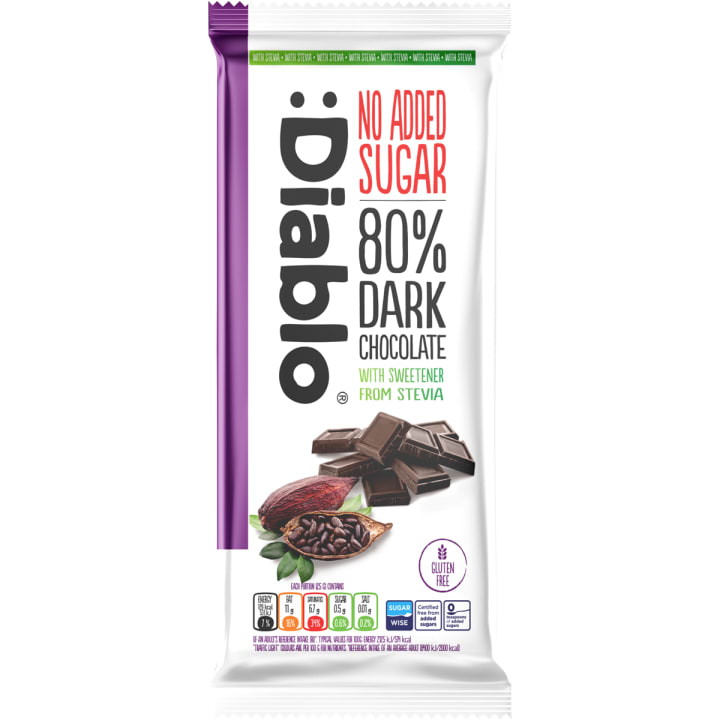
80% Dark Chocolate 75g
No Added Sugar range. 1.1 g sugars per 100 g, naturally occurring in the cocoa.
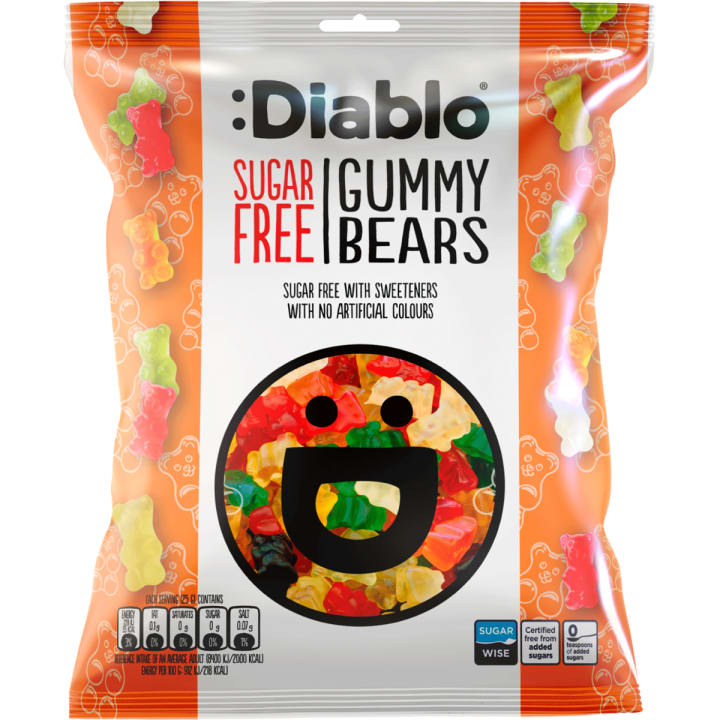
The bar sits in our No Added Sugar range, which means no sugar is added during making. It contains naturally occurring sugars from the cocoa itself, which is where the 1.1 g per 100 g comes from. The gummies sit in our Sugar Free range, at 0.1 g of sugars per 100 g. Stevia is in both products, so the sweetener tells you nothing about which claim a package carries. In the gummies the steviol glycosides are the final ingredient on the list.
Not a low calorie food. See nutrition information for sugar and calorie content. Diablo Sugar Free products are not for weight control.
Is stevia regulated the same way in the US and the UK?
In the US the deciding line is purity, which is why you will never see an American label declaring whole stevia leaf as a sweetener.
Great Britain draws the line differently, with a permitted additives list. The same purified material carries an E number there: E960a for glycosides from stevia, E960b from fermentation and E960c produced enzymatically, per the GOV.UK register of approved additives.
Is stevia safe to eat?
The FDA is not the only regulator to have reviewed the toxicology. In 2010 the European Food Safety Authority ran its own and concluded that steviol glycosides meeting the international purity specification "are not carcinogenic, genotoxic or associated with any reproductive/developmental toxicity". Genotoxic means damaging to DNA.
The limit the FDA lists is an acceptable daily intake of 4 mg per kg of body weight per day, expressed as steviol equivalents, set by the Joint FAO/WHO Expert Committee on Food Additives. For rebaudioside A the agency gives the matching figure as 12 mg per kg a day. For a 60 kg (132 pound) adult, the body weight the FDA uses in its own worked examples, that comes to 240 mg a day.
Steviol equivalents count only the steviol core of each molecule and leave out the glucose units attached to it. Our 80% dark bar declares its steviol glycosides at 0.02 percent, which is 15 mg in a 75 g bar. That 0.02 percent is the glycoside weight as declared on the pack, which is why it sits in brackets inside the sweetener entry on the ingredients list.
Frequently asked questions
Does stevia have any calories?
Steviol glycosides provide sweetness without calories. Because they are used at fractions of a percent, they contribute nothing meaningful to the energy value of a finished product. The calories in a chocolate bar or a bag of gummies come from the cocoa butter, the milk solids, the starches and the bulk sweetener, not from the stevia.
Why is stevia listed at the end of an ingredients list?
Ingredients are listed in descending order of weight. Steviol glycosides are used at fractions of a percent, so they tend to fall near the bottom. In our Gummy Bears they are the final ingredient on the list. In our 80 percent dark bar they are declared inside the compound sweetener instead, in brackets after the maltitol they are blended with.
Is stevia the same as the stevia plant sold at a garden center?
They share a species, Stevia rebaudiana, but not a legal status. Food manufacturers use a purified extract of the leaf, which the FDA has assessed at 95 percent purity or above. Whole leaves and crude extracts are not permitted as sweeteners in the United States.
Is stevia bad for you?
No. The FDA has not questioned the GRAS conclusions for high purity steviol glycosides, and Europe's food safety authority found them neither genotoxic nor carcinogenic. The acceptable daily intake is 4 mg per kg of body weight per day, expressed as steviol equivalents, and our 80% dark bar declares stevia at 0.02 percent.