 Chocolate Bars
 Dragees
 Cakes & Muffins
 Sweets & Gummies
 Cookies
 Dessert Sauces
 Chocolate Gift Boxes
 Wafers
 Spreads
 Muesli Bars
 Hampers
 Sales & Promotions

Sugar free is a defined US claim: a food qualifies at less than 0.5 g of sugars per serving, measured both per reference serving and per labeled serving. Low sugar has no FDA definition, so it is not an approved claim. No sugar added is a third claim, about the recipe rather than the number.
Three phrases do most of the work on an American sugar label: sugar free, no sugar added and reduced sugar. A fourth, low sugar, turns up constantly in conversation yet is not allowed on a package. The rules live in one section of the food labeling regulations, and each claim has its own test. Here is what each one has to prove.
What does the FDA mean by sugar free?
A food can be labeled sugar free when it holds less than 0.5 g of sugars per reference amount customarily consumed and per labeled serving, with no sugar ingredient in the recipe unless the label flags that the ingredient adds a trivial amount. The reference amount is set by the FDA per food category rather than by the pack. Chocolate and most candy sit at 30 g, hard candy at 15 g.
Less than 0.5 g of sugars per reference amount customarily consumed and per labeled serving.
Condition of use, 21 CFR 101.60(c).
One more rule applies. Confectionery is not a low calorie food, so every sugar free claim on the package has to be immediately accompanied by one of three set statements: not a low calorie food, not a reduced calorie food or not for weight control. The line is a legal requirement rather than a caveat.
Is low sugar a legal claim in the US?
Not in those two words. The FDA defines low calorie, low fat, low sodium and low cholesterol, each with a number attached to it. It has never written one for low sugar, and a nutrient content claim without an FDA definition is not an approved claim. A brand that wanted one would have to petition the agency to write the definition first.
A label has two other routes. It can simply print the figure. A plain statement of the amount is allowed as long as it stops there and does not characterize the level. Or it can go relative: a food that beats a named reference food by 25 percent may say lower in sugar, which is the nearest lawful neighbor to the phrase people expect.
British rules work differently. Low sugar is a defined claim there, at 5 g of sugars per 100 g for solids, so an imported label can carry words a US label cannot.
How do the US sugar claims compare?
Reduced sugar is the relative claim, and the regulation lets a label say it six ways: reduced sugar, reduced in sugar, sugar reduced, less sugar, lower sugar or lower in sugar. All six need the same proof. At least 25 percent less sugars per reference amount than a named reference food, with the percentage and the comparison printed nearby. Look for that disclosure. A reduced sugar claim with nothing to compare it to is doing no work.
No sugar added is the odd one out, because it sets no number at all. It says no sugars were added during processing, and no sweetening ingredient such as jam or juice concentrate went in. Sweeteners such as maltitol sit outside that test, which is why a no sugar added product can still taste sweet. One condition gets missed: the food has to resemble one that normally comes with added sugars. Nobody adds sugar to plain almonds, so plain almonds cannot carry the claim. Our fuller comparison of those two lives in sugar free vs no added sugar.
Which claim does each Diablo pack carry?
We use two of them. Every pack says either Sugar Free or No Added Sugar, and the nutrition panel backs the words up. Two products show the difference cleanly.
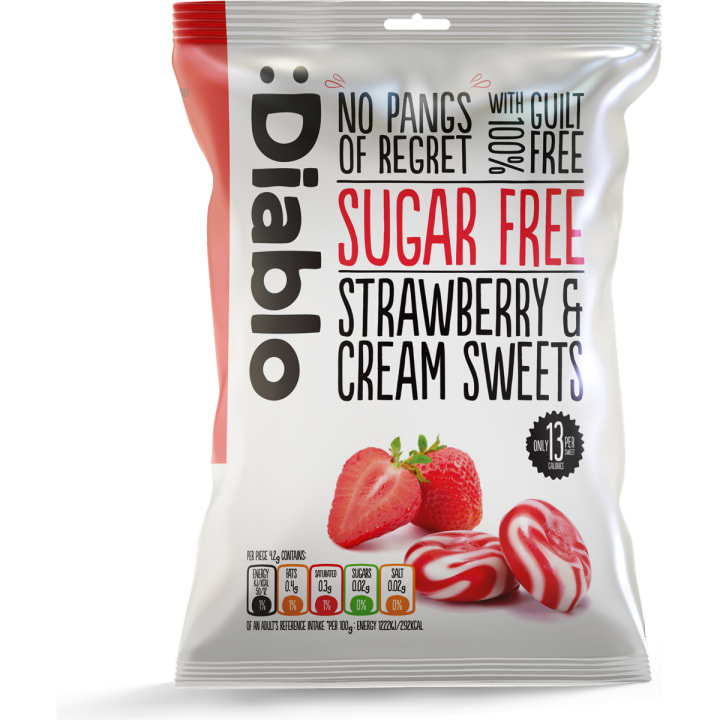
Sugar Free Strawberry and Cream Candy
Carries the strict claim: 0.5 g sugars per 100 g, which is 0.02 g in a 4.2 g piece, with 86.8 g polyols doing the sweetening
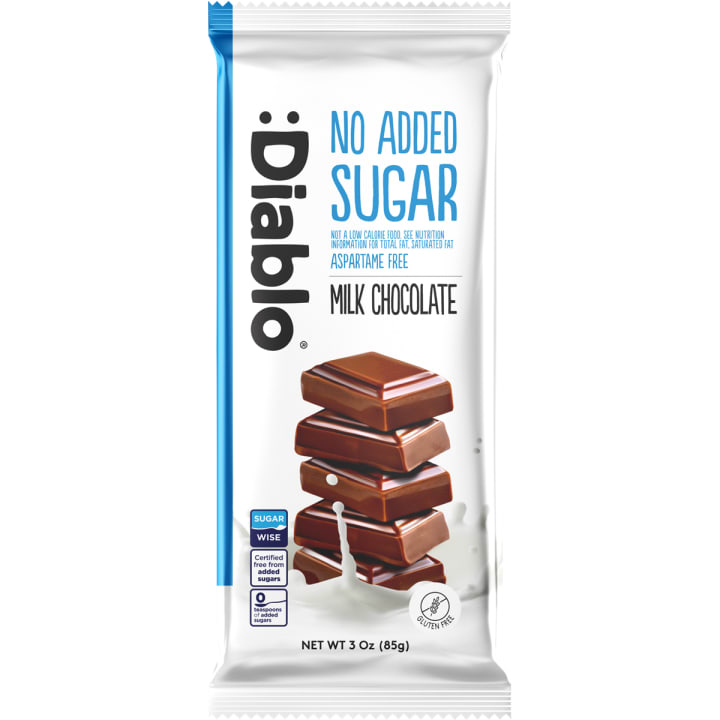
Carries the recipe claim: 6.7 g sugars per 100 g, all of it naturally occurring lactose from the milk
Not a low calorie food. See nutrition information for sugar and calorie content.
Run the candy through the US test and it clears with room to spare. At 0.5 g of sugars per 100 g, a 4.2 g piece carries 0.02 g and a 30 g reference amount carries 0.15 g. Both sit well under the line, so the pack earns the strictest words available. The chocolate is a different story. No sugars were added to it, yet milk brings its own lactose, so the recipe claim is the accurate one and the panel says 6.7 g per 100 g. The 85 g bar's nutrition panel carries the full data, saturated fat included.
The sweetness in both comes from polyols rather than sugar: isomalt with maltitol syrup in the candy, maltitol in the chocolate. You can read maltitol's full story in our guide to what maltitol is. Polyols are absorbed slowly and only in part, which is precisely why they contribute less energy, and it is also why a few pieces at a time suits them best. Our guide to sugar alcohols covers the wider family.
Frequently asked questions
Where do the calories in sugar free candy come from?
Mostly from the polyols that replace the sugar, and partly from the fat in the recipe. Polyols carry energy, just less of it than sugar does. Our Sugar Free Strawberry and Cream Candy runs 294 kcal per 100 g, about 12 kcal in a 4.2 g piece.
Why does a sugar free candy package say it is not a low calorie food?
The statement is required. Where a food is labeled sugar free but is not itself low or reduced in calories, 21 CFR 101.60(c)(1) requires one of three statements immediately alongside the claim: not a low calorie food, not a reduced calorie food or not for weight control. Seeing the line means the label is following the rule.
Does no sugar added mean the food has no sugars at all?
No. It means none were added during processing. Sugars already present in an ingredient still appear on the nutrition panel under total sugars. Our No Added Sugar Milk Chocolate shows 6.7 g per 100 g, all of it lactose from the milk.