 Schokoladentafeln
 Dragees
 Kuchen & Muffins
 Süßigkeiten & Fruchtgummis
 Cookies
 Dessertsaucen
 Waffeln
 Aufstriche
 Müsliriegel
 Geschenkkörbe
 Verkauf & Sonderangebote

Sugar Free Halloween Sweets: What to Buy and What to Check
Sugar free Halloween sweets replace sugar with sweeteners such as maltitol, isomalt or steviol glycosides. In GB the claim means no more than 0.5 g of sugars per 100 g, so the per 100 g column on the pack settles it. Read the allergens in bold as well, and keep every bowl out of a dog's reach.
Two of ours that suit the night:

No Added Sugar Coated Milk Chocolate Buttons 40 g
6.7 g naturally occurring sugars per 100 g, sweetened with maltitol
On this page: what counts as sugar free · our sweets for the night · what to check on a pack · sweets and dogs · FAQ
What makes a Halloween sweet sugar free?
In GB, sugar free is a claim with one fixed condition: no more than 0.5 g of sugars per 100 g, as set out in the GB nutrition and health claims register. Polyols, a family of sweeteners that includes maltitol and isomalt, are not counted as sugars under that rule, which is how a gummy bear can taste as sweet as the usual kind and still qualify.
No added sugar is a different claim, and it is the one on our chocolate buttons. It means no sugars or sweetening foods went into the recipe, while any sugars already present in ingredients such as milk remain. The buttons contain naturally occurring sugars, 6.7 g per 100 g, with none added. Our guide to sugar free vs no added sugar puts the two claims side by side.
Which Diablo sweets suit Halloween?
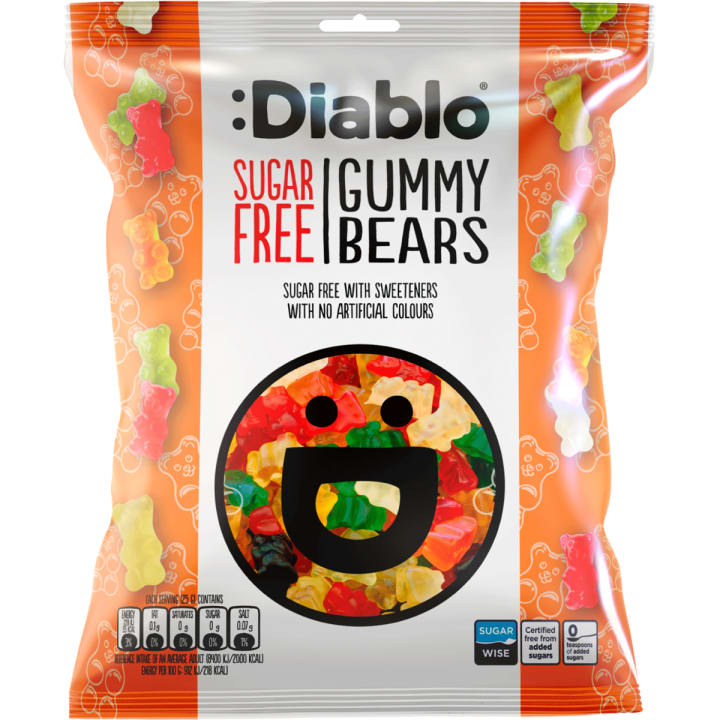
For the night we would put out the Sugar Free gummy bears and two No Added Sugar chocolates, compared below per 100 g.
| Diablo sweet | Claim | Sugars | Sweetened with | Good to know |
|---|---|---|---|---|
| Gummy Bears 75 g | Sugar Free | 0.1 g | maltitol, steviol glycosides | set with gelatine |
| Coated Milk Chocolate Buttons 40 g | No Added Sugar | 6.7 g, naturally occurring | maltitol, sorbitol, steviol glycosides | contains milk and soya, may contain peanuts and nuts; vegetarian, gluten free, halal and kosher |
| Peanut Milk Chocolate Treats 40 g | No Added Sugar | 5.6 g, naturally occurring | maltitol, sorbitol, steviol glycosides | contains peanuts, milk and soya, may contain nuts; gluten free and kosher |
The buttons may contain peanuts and nuts. The treats contain peanuts outright and may contain nuts, so with a nut allergy in the house, read the allergen statement on every pack, ours included.
Working out quantities for a party? Our guide to how many sweets to buy per person does the sums.
What should you check before a sweet goes in the bowl?
Check the sugars line, the allergens, the polyol statement and whether the pack is still sealed.
The sugars line
Look for "of which sugars" in the per 100 g column. A sugar free pack has to show 0.5 g or less there, while a no added sugar pack shows whatever the milk or fruit brought with it.
The allergens
The 14 allergens must be emphasised within the ingredients list of pre-packed food or drink, for example in bold, italic or coloured type, according to the Food Standards Agency. A "may contain" line works differently: the FSA notes there is no specific legal requirement to print one, so a missing line is not an all clear.
The polyol statement
Food with more than 10 percent added polyols carries the words "excessive consumption may produce laxative effects", a requirement set in Annex III of the food information regulation. Polyols are digested slowly, which is also the reason they raise blood glucose less than sugar does. Enjoy them a few pieces at a time.
The whole pack
Put sealed packs in the bowl, so the ingredients and the allergen statement go wherever the sweets do. A handful tipped out of a 75 g bag leaves its label behind in the kitchen.
Why keep Halloween sweets away from dogs?
Xylitol and chocolate can both make a dog seriously ill. Xylitol is a sweetener the US Food and Drug Administration says is often used in sugar free mints, chocolate bars and chewing gum. In dogs it can cause a sudden drop in blood sugar within 10 to 60 minutes, with vomiting, weakness, staggering, collapse and seizures. As for chocolate, the same FDA page reminds owners it can be dangerous to dogs.
No Diablo sweet, gummy or chocolate lists xylitol among its ingredients; ours are sweetened with maltitol, isomalt, sorbitol, steviol glycosides and acesulfame K. They belong out of reach all the same: our chocolate is still chocolate. If a dog does get into something containing xylitol, the FDA's advice is to call a vet or an emergency clinic straight away.
Frequently asked questions
Are sugar free sweets lower in calories?
Not by definition. The claim covers sugars, and the calories depend on what replaces them. UK labels count polyols at 2.4 kcal per gram, other carbohydrates such as sugar at 4 and erythritol at 0, under Annex XIV of the food information regulation.
Why do sugar free sweets carry a laxative warning?
Any food with more than 10 percent added polyols has to carry it, and all three packs above do. It is there because the body absorbs polyols slowly and only partly. The same trait gives them fewer calories per gram than sugar.
Do sugar free sweets raise blood glucose?
For isomalt and maltitol, two of the sweeteners in our range, the GB register carries an authorised claim. For isomalt it reads: "Consumption of foods/drinks containing isomalt instead of sugar induces a lower blood glucose rise after their consumption compared to sugar-containing foods/drinks". The same wording is authorised for maltitol.
Are Diablo gummies vegetarian?
No. Our gummy bears, cola bottles and gummy drops are set with gelatine, so they are not vegetarian or vegan. The No Added Sugar Coated Milk Chocolate Buttons are vegetarian, gluten free, halal and kosher by certificate.
Fill the bowl from our range
Our gummies, toffees and boiled sweets, all in one collection.