 Schokoladentafeln
 Dragees
 Kuchen & Muffins
 Süßigkeiten & Fruchtgummis
 Cookies
 Dessertsaucen
 Pralinenschachteln
 Waffeln
 Aufstriche
 Müsliriegel
 Geschenkkörbe
 Verkauf & Sonderangebote

Low sugar and sugar free are two different legal thresholds. UK law lets a solid food claim low sugar at no more than 5 g of sugars per 100 g, while sugar free is reserved for 0.5 g per 100 g. No added sugar is a third claim, about the recipe rather than the number.
Four phrases do most of the work on a British sugar label: low sugar, sugar free, no added sugar and reduced sugar. Shoppers treat them as rough synonyms. The law treats them as four separate promises with four separate tests, and a brand that fails the test cannot print the words. Here is what each one has to prove.
What does low sugar mean on a UK label?
Low sugar is the looser of the two numerical thresholds. A solid food qualifies at 5 g of sugars per 100 g or under. For a drink the bar drops to 2.5 g per 100 ml. Sugar free makes no such split, sitting at 0.5 g whether the food is solid or liquid. The condition of use sits in the annex of the assimilated nutrition and health claims regulation:
A claim that a food is low in sugars, and any claim likely to have the same meaning for the consumer, may only be made where the product contains no more than 5 g of sugars per 100 g for solids or 2,5 g of sugars per 100 ml for liquids.
Annex to Regulation 1924/2006, as assimilated in Great Britain.
Two things follow from that number. A food at 4.9 g per 100 g is legally low in sugar even though a 100 g portion still carries close to a teaspoon and a quarter of sugars. And the phrase says nothing about how the food was made. A cake reformulated down to 5 g can carry it. So can a food that was never sweet in the first place.
What does reduced sugar have to prove?
Reduced sugar is the only one of the four that is relative. It is not a threshold at all. It requires the food to hold at least 30 percent less sugars than a similar product, which means there has to be a real comparison sitting behind it rather than a general sense of virtue.
One extra condition was added in 2012 to close an obvious loophole. Before it, a manufacturer could strip out 30 percent of the sugars, replace the bulk with fat and sell the result as reduced sugar while the calorie count climbed. The amendment closed it: the energy of the food carrying the claim must be equal to or lower than the energy of the similar product it is measured against.
So a reduced sugar claim is worth reading as a question. Reduced compared with what? A good label answers that on the pack.
How do the four claims compare?
Read across that row and the gap between the first two boxes is the one worth holding onto. Those two phrases sit side by side on a shelf and sound like neighbours, yet one permits ten times the sugars of the other.
No added sugar is the odd one out, because it sets no number at all. It says no sugars were added, and no food was used to sweeten the recipe. Sweeteners such as maltitol sit outside that test, which is why a no added sugar product can still taste sweet. Where sugars occur naturally in an ingredient, the pack must also state that it contains naturally occurring sugars. Our fuller comparison of those two lives in sugar free vs no added sugar.
Which claim does each Diablo pack carry?
We use two of the four. Every pack says either Sugar Free or No Added Sugar, and the nutrition table backs the words up. Two products show the difference cleanly.
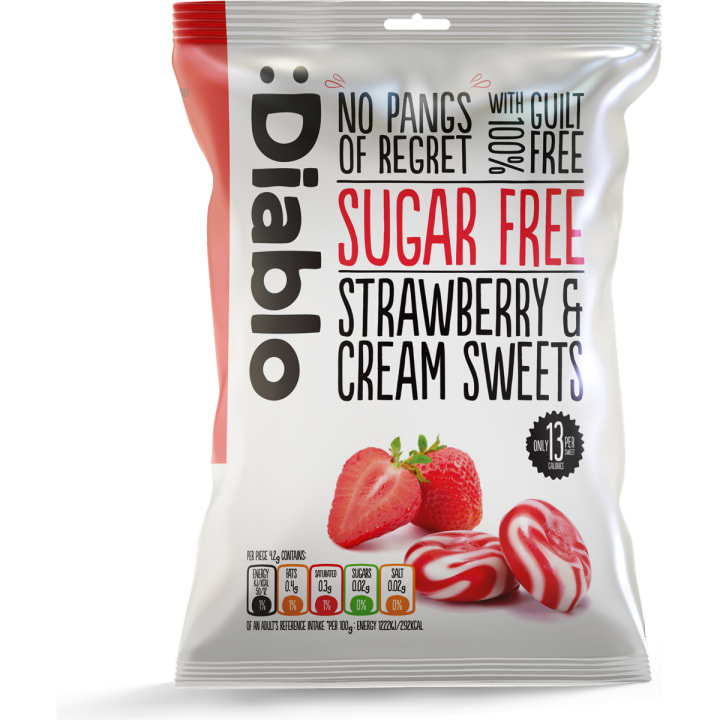
Sugar Free Strawberry and Cream Sweets
Carries the strict claim: 0.5 g sugars per 100 g with 86.8 g polyols doing the sweetening
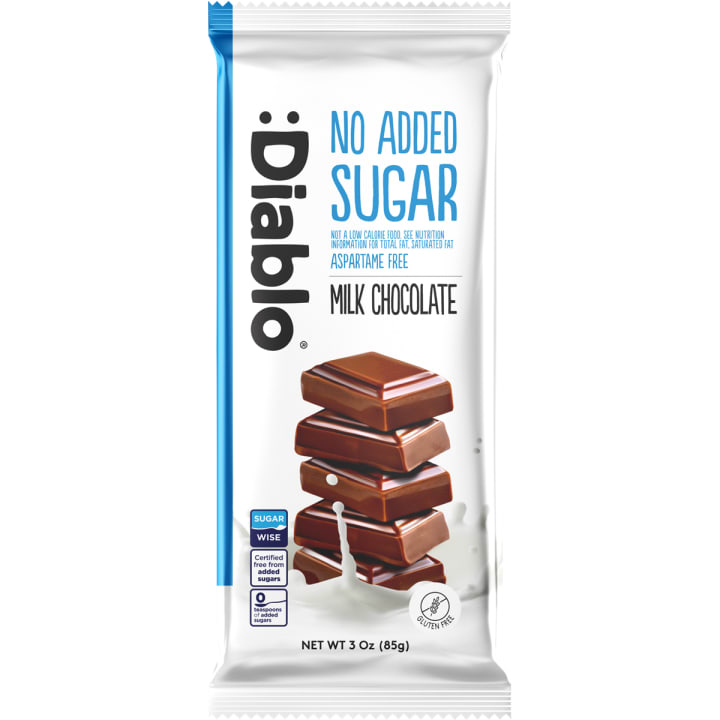
Carries the recipe claim: 6.7 g sugars per 100 g, all of it naturally occurring lactose from the milk
Our No Added Sugar packs state that they contain naturally occurring sugars.
That pair holds the lesson. The sweets meet the tightest of the sugar thresholds, so the pack carries the strictest words available. No sugars were added to the milk chocolate, yet milk brings its own lactose, so the recipe claim is the accurate one and the table says 6.7 g, which is above the 5 g low sugar line on lactose alone.
The sweetness in both comes from polyols rather than sugar: isomalt with maltitol syrup in the sweets, maltitol in the chocolate. You can read maltitol's full story in our guide to what maltitol is. Polyols are absorbed slowly and only in part, which is precisely why they contribute less energy, and it is also why a few pieces at a time suits them best. Our guide to sugar alcohols covers the wider family.
Frequently asked questions
Is low sugar better than sugar free?
They are not ranked, they are measured. Sugar free is the stricter of the two by a factor of ten: 0.5 g of sugars per 100 g against 5 g for low sugar. A food can only print the words it can prove, so the claim on the front tells you which test the recipe passed.
Why do I rarely see low sugar on confectionery?
Because 5 g per 100 g is a hard number for a sweet food to land on by reformulation alone. Most confectionery that removes sugar replaces it with polyols and clears the sugar free threshold outright, so that is the claim the pack carries. Foods that are naturally low in sugars, such as plain dairy, use it more often.
Does no added sugar mean the food has no sugars at all?
No. It means none were added. Sugars already present in an ingredient still appear on the nutrition table, and UK law requires the pack to say that it contains naturally occurring sugars. Our No Added Sugar Milk Chocolate shows 6.7 g per 100 g, all of it lactose from the milk.