 Chocolate Bars
 Dragees
 Cakes & Muffins
 Sweets & Gummies
 Cookies
 Dessert Sauces
 Chocolate Gift Boxes
 Wafers
 Spreads
 Muesli Bars
 Hampers
 Sales & Promotions

The two claims are legally different things. Sugar free means the food carries no more than 0.5 g of sugars per 100 g. No added sugar means no sugars or sweetening foods were added, though sugars that occur naturally in ingredients like milk or fruit can still be on the nutrition table. Both are defined in UK law, and both appear across the Diablo range on different products.
Shoppers use the two phrases interchangeably. Labels cannot. Here is what each claim commits a food to, why a no added sugar product can still show sugars on its table and how to tell in ten seconds which one you are holding.
What does sugar free mean in UK law?
A food can only claim to be sugar free when it contains no more than 0.5 g of sugars per 100 g, a condition set by the assimilated EU rules carried into the Great Britain nutrition and health claims register. That is a fiftieth of the sugar in a standard 45 g bar of regular milk chocolate, close enough to zero that the law treats it as none.
The sweetness has to come from somewhere else. In confectionery that usually means polyols such as maltitol and isomalt, which count on their own line of the nutrition table rather than as sugars. Our guide to sugar alcohols explains that family.
What does no added sugar mean?
No added sugar is a claim about what went into the recipe, not about the final figure. It means no sugars and no sweetening foods were added at any stage. Sugars that walk in naturally with an ingredient still count on the table: the lactose in milk, the fructose in fruit. UK law also requires such products to say that they contain naturally occurring sugars where they do.
Two supermarket examples make it click. A pure orange juice is legitimately no added sugar, yet carries around 8 g of sugars per 100 ml, all naturally occurring. A jar of honey is nothing but natural sugars. Neither could ever claim sugar free. The claim tells you about the recipe; the table tells you about the food.
How Diablo uses the two names
Every Diablo pack carries one of the two names, and the nutrition table backs it up. The Sugar Free range sits at or under the 0.5 g line. The No Added Sugar range adds none, and where sugars appear on the table they arrive naturally, almost always from milk, cocoa or fruit. Compare two bars from the No Added Sugar range:

0.5 g sugars per 100 g, occurring naturally in the cocoa. Dark chocolate runs naturally low
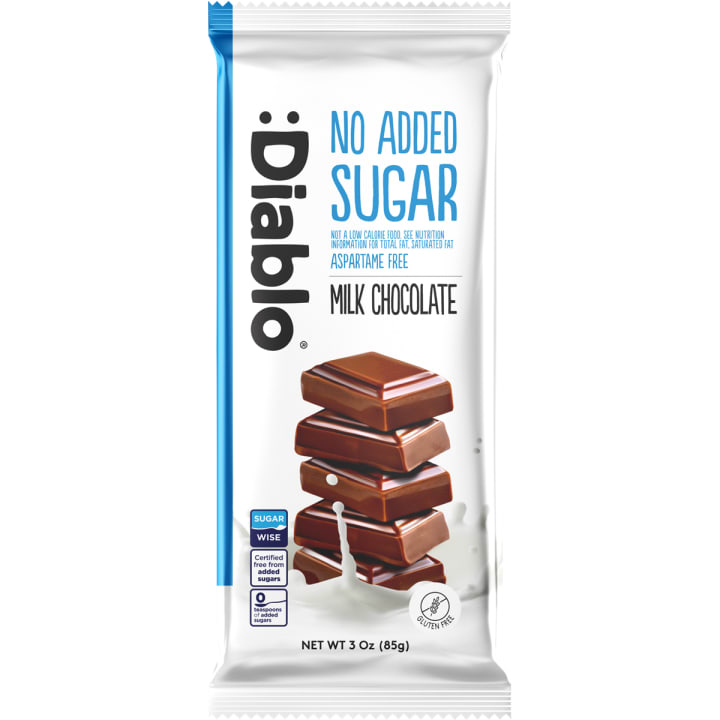
6.7 g sugars per 100 g, all naturally occurring, almost entirely from the milk
Not a low calorie food. See nutrition information for sugar and calorie content.
That 6.7 g is the two claims in one picture. The milk bar adds no sugar at all, yet milk is a naturally sweet ingredient, so the table says so honestly. The dark bar, with cocoa in place of milk, lands at a figure low enough to sit within the sugar free threshold as well. Same range, two truthful labels.
Does the same difference apply on a US label?
Broadly, yes. The US rules run on servings rather than 100 g: sugar free means under 0.5 g of sugars per reference serving and per labelled serving, and no added sugar works much as it does in the UK, with the FDA's added sugars line on the nutrition facts panel doing the disclosure work. The reading habit transfers: claim first, table second, on either side of the Atlantic.
The ten second check in a shop
Flip the pack. Find the "of which sugars" line. At or under 0.5 g per 100 g explains a sugar free claim. A higher figure with a no added sugar claim means the sugars arrived naturally with an ingredient, and the ingredients list will show you which one. Ten seconds, no marketing required.
Frequently asked questions
Is no added sugar the same as sugar free?
No. Sugar free is a promise about the final figure: no more than 0.5 g of sugars per 100 g. No added sugar is a promise about the recipe: nothing sweet was added, though naturally occurring sugars from ingredients like milk or fruit can remain on the nutrition table.
Why does no added sugar milk chocolate show sugars on the table?
Because milk contains lactose, a naturally occurring sugar. Our No Added Sugar Milk Chocolate shows 6.7 g of sugars per 100 g with none of it added, and UK law requires the pack to note that the sugars are naturally occurring.
Which sweeteners replace the sugar?
Mostly polyols. Maltitol does the heavy lifting in our chocolate. Isomalt with maltitol syrup handles the boiled sweets, and the gummies pair polyols with steviol glycosides from the stevia leaf. Each product page lists its sweetener, and our guides to maltitol and stevia go deeper.