 Chocolate Bars
 Dragees
 Cakes & Muffins
 Sweets & Gummies
 Cookies
 Dessert Sauces
 Wafers
 Spreads
 Muesli Bars
 Guilt-free Gifting
 Sales & Promotions

Sugar Free Chocolate and Pregnancy:
What the Guidance Says
What the NHS, EFSA and other published guidance covers on chocolate, caffeine and sweeteners in pregnancy, and why the personal decisions belong with your midwife.
Chocolate and Sweeteners in Pregnancy: The Short Version
Pregnancy questions are personal, and a blog is not where they get answered. Here is what the published guidance and the labels actually say:
- ✦The NHS advises keeping total caffeine below 200mg a day in pregnancy, counting coffee, tea, cola and chocolate together
- ✦Dark chocolate at 70% cocoa or above contains more cocoa flavanols, more theobromine and more caffeine than milk chocolate
- ✦Steviol glycosides, erythritol, sucralose, xylitol, maltitol and sorbitol are all authorised sweeteners in Great Britain and the EU, each assessed by EFSA before authorisation
- ✦The American Pregnancy Association lists saccharin among the sweeteners to avoid in pregnancy, on the basis that it crosses the placenta
- ✦Diablo chocolate is sweetened with maltitol and steviol glycosides. Packs containing more than 10 percent polyols carry the note that excessive consumption may produce laxative effects
- ✦Whether any of it fits your pregnancy is a question for your midwife, obstetrician or dietitian, who have your notes in front of them
Chocolate cravings are one of the most commonly reported experiences in pregnancy. Sugar free and no added sugar chocolate, sugar free chocolate sauce and sugar free salted caramel sauce sit on the same shelves as standard confectionery, and the questions people ask about them tend to be the same three: what is in it, what does the published guidance say, and who should I ask about my own situation.
This guide sets out what is in chocolate, which sweeteners are authorised and what their labels have to declare, what the NHS publishes on caffeine, and what is in the Diablo range. It does not tell you what to eat. That conversation belongs with your midwife or care team.
This guide draws on published guidance from the NHS, NICE, the European Food Safety Authority, Diabetes UK, the International Diabetes Federation and the American Pregnancy Association, plus the Diablo product specifications. It is intended for general information. Always consult your midwife, obstetrician, or registered dietitian for personalised dietary advice during pregnancy.
What the Guidance Covers on Chocolate in Pregnancy
Chocolate does not appear on the NHS list of foods to avoid in pregnancy, and it is not named in the equivalent advice from the American College of Obstetricians and Gynecologists. What both do address is caffeine. Beyond that, the differences between one bar and the next come down to cocoa content and the ingredient list, which is why the label matters more than the category.
What Is Actually in Dark Chocolate
Dark chocolate at 70% cocoa or higher is mostly cocoa solids and cocoa butter, and the cocoa solids are where the interesting compounds sit. Cocoa contains flavanols, a group of plant polyphenols, and they are present in far greater quantity in high cocoa dark chocolate than in milk or white chocolate.
Cocoa also contains theobromine, a naturally occurring stimulant related to caffeine, and caffeine itself. Theobromine and caffeine both track cocoa content, so a 90% bar carries more of each than a 50% bar of the same weight.
Dark chocolate contains iron, magnesium, zinc and potassium. The amounts vary between products, and the pack nutrition panel is the only place to read the figures for the bar in your hand.
Flavanols, theobromine and caffeine all sit in the cocoa solids. Milk chocolate contains fewer cocoa solids than dark chocolate, and white chocolate contains none at all, which is why the same weight of each behaves so differently on a nutrition panel.
The Two Things the Guidance Actually Names
Caffeine is the first. The NHS advises keeping total caffeine intake below 200mg a day in pregnancy, and chocolate counts towards that total alongside coffee, tea and cola. A 30g serving of dark chocolate contains roughly 20mg of caffeine as a reference figure, and milk chocolate contains less, so the arithmetic is usually dominated by drinks rather than by confectionery.
Free sugars are the second. UK dietary guidance puts free sugars at no more than 5 percent of daily energy intake, in pregnancy as at any other time, which works out at around 30g a day for most adults. A standard chocolate bar can account for a large share of that on its own, which is what makes the sugars line on a nutrition panel worth reading.
Understanding Sweeteners: What the Regulators Have Assessed
Sweeteners fall into two broad groups: polyols such as maltitol, sorbitol, xylitol and erythritol, which are bulk sweeteners, and high intensity sweeteners such as steviol glycosides, sucralose, aspartame and saccharin, which are used in tiny amounts. Every one of them is assessed by EFSA and authorised for use before it can appear on a UK or EU label. Here is what each one is.
| Sweetener | Type | Glycemic Index | What the Regulators and Labels Say |
|---|---|---|---|
| Stevia (Steviol Glycosides) | High intensity | 0 | Authorised in GB and the EU as E960 and recognised as safe (GRAS) in the US. Used at very low levels, 0.02% in the Diablo bars that contain it |
| Erythritol | Polyol | 0 | Authorised in GB and the EU as E968. Largely absorbed and excreted unchanged in urine rather than metabolised |
| Sucralose | High intensity | 0 | Authorised in GB and the EU as E955, with an acceptable daily intake set by EFSA. Contributes no energy at use levels |
| Xylitol | Polyol | ~7 | Authorised in GB and the EU as E967. Labelled at 2.4 kcal per gram like other polyols |
| Maltitol | Polyol | 35 | Authorised in GB and the EU as E965. The GB register permits the claim that consumption of foods containing maltitol instead of sugar induces a lower blood glucose rise after their consumption compared to sugar-containing foods |
| Sorbitol | Polyol | 9 | Authorised in GB and the EU as E420. Like all polyols, packs containing more than 10 percent carry the note that excessive consumption may produce laxative effects |
| Aspartame | High intensity | 0 | Authorised as E951. Labels must state that it contains a source of phenylalanine, which people with phenylketonuria (PKU) need to account for |
| Saccharin | High intensity | 0 | Authorised as E954, though the American Pregnancy Association lists it among the sweeteners to avoid in pregnancy because it crosses the placenta. It is not used in the Diablo range |
Sources: European Food Safety Authority (EFSA), GB nutrition and health claims register, American Pregnancy Association. GI values are published reference figures and vary by product formulation.
Stevia in Detail
Steviol glycosides are extracted from the leaves of the Stevia rebaudiana plant. They are intensely sweet, so they are used at very small inclusion rates: the Diablo No Added Sugar 80% Dark Chocolate lists steviol glycosides at 0.02% alongside maltitol. Steviol glycosides are authorised in Great Britain and the EU as E960, are recognised as safe (GRAS) in the United States, and carry a glycemic index of zero. The American Pregnancy Association includes stevia on its published list of sweeteners considered acceptable in pregnancy.
Maltitol in Detail
Maltitol is a polyol made from starch. It delivers around 75 to 90% of the sweetness of table sugar, and GB and EU labelling rules assign polyols an energy value of 2.4 kcal per gram against 4 kcal per gram for sugar. Maltitol is authorised as E965. The GB nutrition and health claims register permits one claim about it: consumption of foods containing maltitol instead of sugar induces a lower blood glucose rise after their consumption compared to sugar-containing foods.
Polyols are absorbed slowly, which is the point of using them. Packs containing more than 10 percent polyols carry the note that excessive consumption may produce laxative effects, so a few pieces at a time is the sensible way in and your gut adjusts. What any of this means for one pregnancy is not something a label or an article can answer. Your midwife, obstetrician or dietitian has your notes and your test results, and that is where the question belongs.
Comparing Chocolate Types: What the Labels Show
| Feature | Regular Milk Chocolate | Maltitol Sweetened Dark | 80% Dark with Maltitol and Stevia |
|---|---|---|---|
| Added sugar | Yes, typically over 50g per 100g | None added | None added |
| Sugars per 100g | Around 50 to 57g | 0.5g in the Diablo 85g dark bar | 1.1g in the Diablo 75g bar |
| Cocoa flavanols | Low to moderate | Moderate | Higher, tracking the 80% cocoa |
| Caffeine per 30g | Around 6mg | Around 15mg | Around 20mg |
| Sweetener declared | Sugar | Maltitol | Maltitol and steviol glycosides (0.02%) |
| Polyol note on pack | Not applicable | Excessive consumption may produce laxative effects | Excessive consumption may produce laxative effects |
Diablo figures are per 100g from the product specifications. Caffeine and flavanol figures are published reference values for chocolate in general and vary by product.
What Is in the Diablo Chocolate Range
Diablo Sugar Free is a specialist confectionery brand that sweetens with maltitol and steviol glycosides instead of adding sugar. Both are authorised sweeteners in Great Britain and the EU. The range splits into two: Sugar Free products contain no more than 0.5g of sugars per 100g, while No Added Sugar products have no sugar added but retain the sugars that occur naturally in ingredients such as milk powder.
Diablo products are sweetened with maltitol and steviol glycosides. Polyols are absorbed slowly, which is the point of using them, and packs containing more than 10 percent polyols carry the note that excessive consumption may produce laxative effects. Enjoy a few pieces at a time and your gut adjusts.
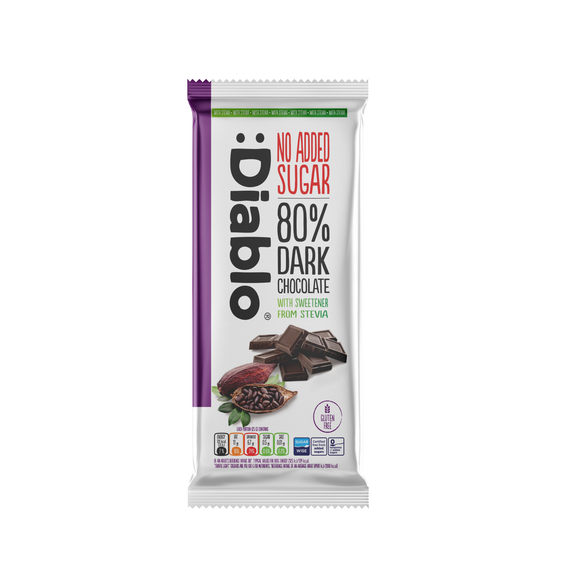
75g No Added Sugar bar. Maltitol and steviol glycosides (0.02%), 80% cocoa, 1.1g sugars per 100g.

85g bar. Maltitol sweetened, 0.5g sugars per 100g. Classic dark chocolate character.

85g No Added Sugar bar. Maltitol sweetened, with whole milk powder at 21.2%. The sugars it contains occur naturally in the milk.

115g No Added Sugar box. Maltitol and steviol glycosides (0.02%). Dark, hazelnut and fruit varieties.
Diablo 80% Dark Chocolate with Stevia
This 75g bar is a No Added Sugar product sweetened with maltitol and steviol glycosides at 0.02%, built on 80% cocoa. Per 100g it contains 1.1g of sugars, 20g of polyols and 514 kcal, and the portion size on the pack is 25g. The high cocoa content is what carries the flavanols and the theobromine, and it is also why this bar contains more caffeine than a milk chocolate one of the same weight.
Diablo No Added Sugar Dark Chocolate Bar
The 85g dark chocolate bar is sweetened with maltitol. Per 100g it contains 0.5g of sugars, which occur naturally in the cocoa and milk ingredients rather than being added, along with 42g of polyols, 8.1g of fibre and 477 kcal, and the portion size on the pack is 14g. Consumption of foods containing maltitol instead of sugar induces a lower blood glucose rise after their consumption compared to sugar-containing foods, which is the one claim the GB register permits for this sweetener. The pack also carries the standard polyol note, so a couple of squares at a time is the sensible way in.
Diablo No Added Sugar Milk Chocolate
The 85g milk chocolate bar is a No Added Sugar product sweetened with maltitol, with whole milk powder at 21.2%, cocoa butter, cocoa mass and soya lecithin. Per 100g it contains 8.9g of sugars, which occur naturally in the milk rather than being added, along with 38g of polyols and 504 kcal. It has more dairy and less cocoa than the dark bars, so fewer cocoa flavanols per gram and a milder flavour.
Diablo No Added Sugar Chocolate Delight
The 115g Chocolate Delights box is a No Added Sugar product sweetened with maltitol and steviol glycosides at 0.02%, with coconut and sunflower fats, cocoa paste, whey powder, hazelnut paste at 3% and freeze dried raspberry at 2%. Per 100g it contains 9.1g of sugars, which come from the milk and fruit ingredients, plus 37.57g of polyols and 494 kcal. It contains milk, soya and hazelnut.
Sugar Free Dessert Sauces and What Is on the Label
The category has expanded well beyond chocolate bars. The Diablo salted caramel and chocolate dessert sauces are Sugar Free products, which means no more than 0.5g of sugars per 100g, and they are used the same way any dessert sauce is used: over yogurt, porridge, fruit or coffee. The strawberry and blueberry sauces sit in the No Added Sugar range instead, at 1.4g and 1.2g of sugars per 100g, and those sugars come from the fruit.
What to Look For on the Label
- Read which sweetener is named. The ingredient list has to declare it, whether that is maltitol, sorbitol, steviol glycosides, sucralose or something else. If you have been given advice about a particular sweetener, this is the line that tells you whether it is in the jar.
- Check for saccharin if you have been told to avoid it. The American Pregnancy Association lists it among the sweeteners to avoid in pregnancy. It appears as "saccharin" or E954 on an ingredient list, and it is not used in the Diablo range.
- Read the polyol note. Any pack containing more than 10 percent polyols must state that excessive consumption may produce laxative effects. That note is a labelling requirement, not a warning about a specific brand.
- Check the stated serving size against the nutrition panel. Sauce figures are usually given per 100g, and a tablespoon is a fraction of that, so the two numbers answer different questions.
How the Sauces Are Usually Used
A spoonful of the salted caramel sauce over full fat Greek yogurt and berries is the most common use people report, and it turns a plain bowl into something closer to a dessert. The sauce is vegan, dairy free and gluten free certified on pack, and it declares no EU 14 allergens.
Chocolate dessert sauce stirred into warm milk makes a hot chocolate with less sugar than most shop bought mixes, and with far less caffeine than an equivalent weight of dark chocolate, since the cocoa content is lower.
Gestational Diabetes: Where the Advice Comes From
The International Diabetes Federation estimates that 16.7% of live births worldwide are affected by hyperglycaemia in pregnancy, most of it gestational diabetes. In the UK, anyone diagnosed is referred into a joint diabetes and antenatal clinic, and NICE guideline NG3 sets out the monitoring and dietary review that follows.
What that plan says about any particular food is individual to the person it was written for. Diabetes UK and the NHS both publish general information on eating with diabetes in pregnancy, and both point readers back to their own team for anything specific.
If you have been diagnosed with gestational diabetes, you will have a named midwife, a diabetes specialist nurse or a dietitian attached to your care. They set your monitoring targets and they know your results. Bring the pack, or a photo of the ingredient list and nutrition panel, to your next appointment and ask them directly. Nothing on this page is a substitute for that conversation.
The Published Numbers Worth Knowing
There is no single quantity that applies to everyone, and nobody writing an article can set one for you. What can be stated plainly are the figures the guidance and the labelling rules already publish.
NHS Daily Caffeine Ceiling
The NHS figure for total caffeine in pregnancy, counting coffee, tea, cola, energy drinks and chocolate together. A 30g serving of dark chocolate contributes roughly 20mg of it.
Free Sugars Guidance
UK dietary guidance puts free sugars at no more than 5 percent of daily energy intake, which works out at around 30g a day for most adults, in pregnancy as at any other time.
Polyol Labelling Threshold
Above 10 percent polyols, a pack must carry the note that excessive consumption may produce laxative effects. It appears on Diablo packs for exactly that reason.
Pack Portion Size
The portion stated on the 75g 80% dark bar. The 85g dark and milk bars state 14g, and the Delights box states 10g. Polyols are absorbed slowly, so a few pieces at a time lets your gut adjust.
Read the ingredient list before the front of pack, because the sweetener has to be named there. Check the sugars line and the polyols line on the nutrition panel, which are separate entries under carbohydrate. Read the label again on a product you bought before, since formulations change and the panel is the only record of what changed. And take anything that concerns your pregnancy specifically to your midwife or care team rather than to a comparison table.
Frequently Asked Questions
References and Sources
- Great Britain nutrition and health claims register. Authorised claim for maltitol and post-prandial blood glucose. gov.uk
- NHS UK. Foods to Avoid in Pregnancy and Caffeine in Pregnancy. nhs.uk
- American Pregnancy Association. Artificial Sweeteners and Pregnancy. americanpregnancy.org
- International Diabetes Federation. Gestational Diabetes. idf.org
- NICE. Diabetes in pregnancy: management from preconception to the postnatal period (NG3). nice.org.uk
- Diabetes UK. Gestational diabetes. diabetes.org.uk
- FDA. Steviol Glycosides (Rebaudioside A) GRAS Notices. fda.gov
- European Food Safety Authority (EFSA). Scientific Opinion on Steviol Glycosides. efsa.europa.eu
- Gaither K (MD, MPH). Weill Cornell Medicine. Clinical guidance on sweetener safety in pregnancy.
Browse the Diablo Chocolate Range
Diablo makes chocolate with maltitol and steviol glycosides in place of added sugar, from the 80% dark bar at 1.1g of sugars per 100g to the No Added Sugar Chocolate Delights box. Every product lists its ingredients and its full nutrition panel.
Shop Diablo Sugar FreePacks containing more than 10 percent polyols note that excessive consumption may produce laxative effects. For advice about your own pregnancy, speak to your midwife or care team.