 Chocolate Bars
 Dragees
 Cakes & Muffins
 Sweets & Gummies
 Cookies
 Dessert Sauces
 Chocolate Gift Boxes
 Wafers
 Spreads
 Muesli Bars
 Hampers
 Sales & Promotions

Gelatin is made from animal collagen, so any candy that lists it is out. It is not the only blocker. Beeswax, shellac, carmine and milk all turn up in confectionery, so five ingredient names are worth scanning for. The candies that do set without gelatin use pectin, agar, carrageenan or starch.
Ours, if you would rather skip the label reading:


What is gelatin, and why is it not vegan?
Gelatin is a protein taken from animals, made by partially breaking down the collagen in animal bones, hides and skins. That puts it outside a vegan diet, and outside a vegetarian one too.
Candy makers keep using it because nothing else behaves the same way. Gelatin sets soft, holds a chew, then melts at close to body temperature, which is the reason a gummy releases its flavor the way it does. Our own gummy bears, cola bottles and gummy drops are set with gelatin for exactly that reason. It is what gives them their bite.
Gelatin also has no category name to shelter under. FDA rules say ingredients must be listed by common or usual name in descending order of predominance by weight, so the word itself appears in the list.
Which candies usually contain gelatin?
Anything with a bounce. Gummies, jelly candies, wine gums, marshmallows, foam candies and a good number of chews and toffees. Our Fruit Flavored Toffees print gelatin eighth on the ingredient list, well below the maltitol syrup at the top, so they sit in the same group.
Hard candies are the usual exception, because a boiled candy needs no setting agent at all. Ours are boiled candies and still dairy: the cream candies are built around real cream, and the cappuccino one brings butter in as well, which makes them lovely.
Where a candy does set without gelatin, the work is done by pectin from fruit, by agar or carrageenan from seaweed or by plain starch.
Does gelatin free mean vegan?
No, gelatin is the name everybody looks for, and four more are worth memorizing.
Beeswax is the shine on a lot of small candies, and it comes from bees. Shellac, sometimes printed as confectioner's glaze, does the same job and is a resin secreted by the lac insect. Carmine, also printed as cochineal extract, is a deep red color made from insects. And then there is the ordinary dairy list: milk, cream, butter, whey powder, plus honey wherever a candy wants a rounder taste.
Our own gummies show why the check has to go past gelatin. Gelatin sets them, and beeswax and carnauba wax give them their shine, with carnauba coming from a palm. So read the glazing agents line as closely as the setting agent.
What does a vegan label actually promise?
Less than most people assume. No FDA rule defines vegan, so the word carries no threshold and no required testing. What it rests on is the general duty that labeling be truthful and not misleading, plus the ingredient list underneath it.
The allergen declaration is the part with law behind it. Milk and eggs are two of the nine major food allergens, and FDA is direct about what that means:
FALCPA requires that foods or ingredients that contain a major food allergen be specifically labeled with the name of the allergen source.
So milk has to be named. Carmine has to be named too, for a different reason: FDA requires it in the ingredient statement as cochineal extract or carmine, in its own right, instead of letting it sit inside a general added color phrase. Beeswax and shellac get no such rule. Beeswax is printed as beeswax, and shellac can sit low in the list as confectioner's glaze, which is why a vegan shopper reads the whole ingredient statement and not only the Contains line.
Which Diablo products are vegan?
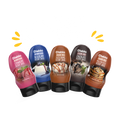
Five of our dessert toppings are labeled vegan: Chocolate, Salted Caramel, Maple Syrup, Strawberry and Blueberry. All five are dairy free as well as gelatin free, which is unusual for something you pour over ice cream.
Four muesli bars are made to a vegan recipe without carrying the wording on the pack: apricot, cranberry and raspberry, hazelnut, lime. The two chia seed jams sit in the same position. If you want the claim printed on the front, the toppings are the ones that have it.
The two fruit toppings sit higher because of how much fruit is in them: strawberry puree is 20 percent of the strawberry topping and blueberry is 10 percent of the blueberry one. In all five, maltitol is the first ingredient on the list, and maltitol is a sugar alcohol rather than a sugar. If chocolate is what you are after, our guide to vegan chocolate covers where the dairy hides in a cocoa recipe.
Common questions
Are Diablo gummy bears vegan?
No. They are set with gelatin and glazed with beeswax, so they suit neither a vegan nor a vegetarian diet. The dessert toppings carry the vegan wording on the pack, and the muesli bars and the chia seed jams are made to a vegan recipe without printing it.
Is there such a thing as plant based gelatin?
No. Agar, pectin and carrageenan set candy in a similar way from seaweed or fruit, but they are different ingredients with different names. Anything printed as gelatin on a label came from an animal.
Does a vegan label mean the candy contains no milk?
Not as a safety promise, because no FDA rule defines the word. Milk is a major food allergen, so it has to be declared by name in its own right. If you are avoiding milk for an allergy, read the allergen line rather than the vegan badge.