 Chocolate Bars
 Dragees
 Cakes & Muffins
 Sweets & Gummies
 Cookies
 Dessert Sauces
 Wafers
 Spreads
 Muesli Bars
 Guilt-free Gifting
 Sales & Promotions

Erythritol vs Xylitol: The Short Version
Both erythritol and xylitol are sugar alcohols (polyols) used as sweeteners in sugar-free products. Here is what the current evidence shows:
- +Erythritol has virtually zero calories and a published glycemic index of 0
- +Xylitol provides approximately 2.4 kcal per gram and has a low glycemic index of 7 to 13, significantly lower than regular sugar
- +Erythritol is 60 to 80 percent as sweet as sugar; xylitol is roughly as sweet, which changes how each behaves in a recipe
- +Erythritol is generally better tolerated digestively; xylitol can cause more gastrointestinal discomfort at higher doses
- +Recent studies have linked high intake of both sweeteners to temporary changes in platelet activity; further research is ongoing
- +Xylitol is toxic to dogs. Erythritol is not considered a risk to pets at typical dietary exposure levels
- +Both are approved as food additives by the FDA, EFSA, and the WHO/FAO Joint Expert Committee on Food Additives (JECFA)
Ours are made with maltitol and isomalt instead:
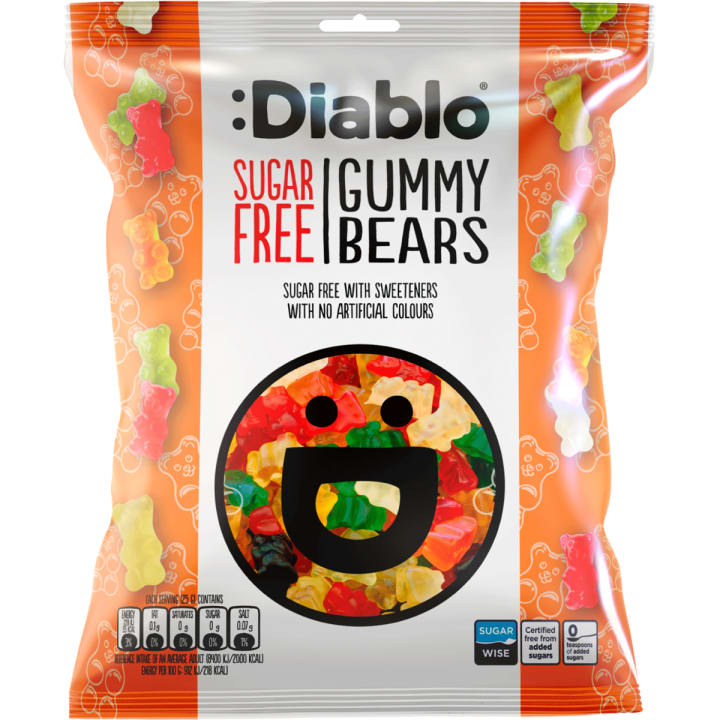

You are standing in a supermarket aisle, scanning the back of a sugar-free chocolate bar. The ingredient list says "erythritol or xylitol," and suddenly, you are not sure which one you would rather be eating. Both sound technical. Both are marketed as sugar alternatives. But are they equally safe, and which one is actually better suited to your lifestyle?
This guide breaks down the erythritol vs xylitol comparison in full: calories, gut tolerance, dental benefits, cooking behaviour, safety research and how each sweetener is used in products like those across the Diablo Sugar Free range. No scare-mongering, no oversimplification. Just a clear, evidence-based look at two of the most widely used polyols in sugar-free food today.
This article draws on peer-reviewed research from PMC/NCBI, Nature Medicine, Cardiovascular Research (Oxford Academic), and regulatory guidance from the FDA, EFSA, and EU Regulation (EC) No 1924/2006. It is intended for informational purposes. It does not constitute medical advice. Always consult a qualified healthcare professional for personalised dietary guidance.
What Are Erythritol and Xylitol?
Before comparing them, it helps to understand what they actually are. Both erythritol and xylitol belong to the family of compounds known as sugar alcohols, or polyols. Despite the name, they contain no ethanol (the type of alcohol found in drinks). The word "alcohol" refers to their chemical structure, which includes multiple hydroxyl groups.
Sugar alcohols occur naturally in fruits, vegetables and other plants. They are used commercially as low-calorie sweeteners because they taste sweet but are metabolised differently from regular sugar, producing a significantly lower impact on blood glucose. They are found in chewing gum, toothpaste, sugar-free confectionery and baked goods across the world.
What Is Erythritol?
Erythritol is a four-carbon polyol found naturally in small quantities in grapes, watermelons, peaches, mushrooms and fermented foods including wine, beer and soy sauce. Commercially, it is produced through the fermentation of glucose, typically derived from corn or wheat starch.
Its most distinctive property is its absorption profile. Around 90 percent of consumed erythritol is absorbed in the small intestine and then excreted largely unchanged in the urine, which is why it contributes virtually no calories. It has been approved for use in foods since 1990 and holds FDA GRAS (Generally Recognised as Safe) status.
What Is Xylitol?
Xylitol is a five-carbon polyol found naturally in small amounts in fruits, vegetables and the fibrous parts of trees. Commercially, it is most often extracted from birch wood or corn cobs and purified for use as a food ingredient.
Unlike erythritol, xylitol is only partially absorbed in the small intestine. The remainder passes to the large intestine where gut bacteria ferment it, which is why high doses can cause digestive discomfort. Xylitol provides around 2.4 kcal per gram compared to 4 kcal per gram for sucrose. It has a low glycemic index of 7 to 13 and is widely used in chewing gums, toothpaste and sugar-free confectionery because it closely mimics the sweetness of sugar.
Erythritol vs Xylitol: Side-by-Side Comparison
| Property | Erythritol | Xylitol | Regular Sugar |
|---|---|---|---|
| Chemical type | 4-carbon polyol | 5-carbon polyol | Disaccharide (sucrose) |
| Calories per gram | ~0 kcal | ~2.4 kcal | 4 kcal |
| Glycemic Index (GI) | 0 | 7 to 13 | 65 to 70 |
| Sweetness vs sugar | 60 to 80% | ~100% | 100% |
| Blood glucose after eating | A lower and slower rise than sugar | A lower and slower rise than sugar | The reference point |
| Gut fermentation | Minimal (mostly excreted unchanged) | Significant at higher doses | N/A |
| Where it is absorbed | Mostly in the small intestine | Partly in the small intestine, the rest ferments in the colon | N/A |
| Safe for dogs? | Not considered harmful at typical dietary levels | No. Toxic to dogs | N/A |
| FDA status | GRAS | GRAS (21 CFR 172.395) | Standard food ingredient |
| Heat stability | Good (stable to ~180 C) | Good (stable to ~200 C) | Good |
| Cooling effect on palate? | Yes, noticeable | Yes, present but milder in baked goods | None |
Sources: FDA GRAS database; JECFA evaluations; PMC absorption studies; OstroVit nutrition analysis. GI values are approximate and may vary by individual response.
Calories and Glycemic Index: How the Two Compare
For anyone watching their sugar intake or following a low-carbohydrate approach, calories and glycemic index are the two numbers that matter most.
Erythritol is the clearer winner on both counts. It provides virtually zero calories and its published glycemic index is 0. For those following a ketogenic diet or closely tracking net carbohydrates, erythritol is typically not counted at all.
Xylitol offers fewer calories than sugar at approximately 2.4 kcal per gram versus 4 kcal per gram for sucrose, but it is not calorie-free. Its glycemic index of 7 to 13 is very low by comparison to table sugar, but not zero. The pancreas does produce a small amount of insulin in response to xylitol, though far less than with regular sugar.
Under Regulation (EC) No 1924/2006, retained in UK law, a sugar replacer claim has to be made in the exact registered form. For maltitol that wording is: "Consumption of foods containing maltitol instead of sugar induces a lower blood glucose rise after their consumption compared to sugar-containing foods." (GB nutrition and health claims register). It has to be used precisely as written, and it may not be turned into a claim about managing or treating any condition.
How Are They Digested? Absorption and Gut Tolerance
Digestive tolerance is one of the most practical considerations for everyday consumers, and one area where erythritol and xylitol behave very differently.
Erythritol Side Effects and Digestive Profile
Erythritol is consistently described in the scientific literature as the most digestively friendly of all the major polyols. Because approximately 90 percent of it is absorbed in the small intestine before reaching the colon, there is very little left for gut bacteria to ferment. Other polyols, maltitol and sorbitol among them, are absorbed more slowly, which is the point: packs over 10 percent polyols note that excessive consumption may produce laxative effects, and eating a few pieces at a time lets the gut settle into them.
At typical serving sizes found in food products, the vast majority of people tolerate erythritol without any discomfort. At very high doses (generally above 50 g per day), some sensitive individuals may experience nausea or mild abdominal discomfort. Erythritol also does not draw significant water into the intestines through osmosis, which is another reason it is less likely to cause loose stools than other polyols.
Xylitol and Digestive Tolerance
Xylitol is only partially absorbed, with roughly 50 to 75 percent passing through the small intestine and the remainder reaching the large intestine where bacteria ferment it. This fermentation process is what produces the laxative effects commonly associated with sugar alcohols consumed in excess.
For most adults, small to moderate amounts of xylitol (up to around 30 to 40 g per day) are well tolerated. People with greater digestive sensitivity, particularly those with irritable bowel syndrome, may experience discomfort at lower doses. Children may also be more sensitive to its effects than adults.
Under EU Regulation 1169/2011 and its UK equivalent, any food product in which polyols exceed 10 percent of total content must carry the statement: "Excessive consumption may produce laxative effects." That line is a labelling rule that applies across the whole category, not a comment on any one product. Products containing sweeteners must also carry the statement "with sweetener(s)" alongside the product name.
Dental Claims: What a Food Brand May and May Not Say
Search results on these two sweeteners are full of statements about teeth. Very few of them are things a food brand is allowed to print.
Under Regulation (EC) No 1924/2006, retained in UK law, only a short list of tightly worded dental claims is authorised, each tied to a named food and a stated condition of use. Wording such as "tooth-friendly", "kind to teeth" or "prevents tooth decay" is not on that list and may not be attached to a sweetener or to a confectionery product by anyone who sells it.
So the neutral fact is the whole of what we say here: polyols are not sugars. Diablo makes no dental claim for any product in its range.
Published research on polyols and oral bacteria exists and is easy to find. Repeating it in brand copy would turn it into an advertising claim, which is the thing the regulation restricts. Put questions about your own teeth to your dentist.
The 2023 and 2024 Cardiovascular Studies: What You Need to Know
Two high-profile studies have generated significant media coverage in recent years, one focused on erythritol and one on xylitol. Understanding both is essential for a complete and balanced picture, and most competing articles only cover one of them.
The Erythritol Study (Nature Medicine, 2023)
In February 2023, Witkowski, Nemet et al. published a study in Nature Medicine that measured blood erythritol levels in approximately 4,000 patients undergoing cardiovascular assessment at the Cleveland Clinic. Patients with the highest erythritol levels at baseline had a roughly two-fold raised risk of major cardiovascular events compared to those with the lowest levels over a three-year follow-up period. Laboratory experiments also found that erythritol appeared to enhance platelet aggregation in blood samples.
This study has significant and widely acknowledged limitations:
- All participants were already undergoing cardiac assessment, meaning they had raised baseline cardiovascular risk. The findings may not be generalisable to healthy adults.
- The study observed an association, not a causal relationship. Raised erythritol in the blood may have been produced endogenously by the body through the pentose phosphate pathway rather than from dietary consumption.
- Dietary erythritol intake was not directly measured. The study could not distinguish between body-produced erythritol and consumed erythritol.
- A Mendelian randomisation analysis, considered a stronger test of causality, did not find a significant link between erythritol and cardiovascular events.
The Xylitol Study (European Heart Journal, 2024)
In 2024, the same research group published a follow-up paper in the European Heart Journal applying a similar methodology to xylitol. They found that raised plasma xylitol levels were also associated with increased cardiovascular risk markers and appeared to enhance platelet aggregation in a similar manner to erythritol.
This study receives significantly less media attention than the erythritol paper, which creates a misleading impression that erythritol is uniquely problematic. The 2024 data suggests the concern, if confirmed in future research, may be a broader class effect across polyols rather than specific to erythritol.
The Current Scientific Consensus
A comprehensive 2025 review published in Cardiovascular Research (Oxford Academic) concluded that while sugar alcohols have been "implicated in increased cardiovascular risk, a direct causal relationship between their use and cardiovascular events is lacking." The review also noted that Mendelian randomisation trials, which offer stronger causal evidence, do not link sugar alcohols to significant cardiovascular risks.
Current regulatory bodies including the FDA, EFSA and WHO/FAO JECFA continue to classify both erythritol and xylitol as safe for use in foods. Neither has been removed from approved food additive lists. For individuals with existing cardiovascular conditions, discussing sweetener choices with a healthcare professional is a sensible precaution given the evolving nature of this research.
The FDA, EFSA and WHO/FAO JECFA classify both erythritol and xylitol as safe at typical dietary intake levels. The 2023 and 2024 studies are observational in nature and have not established direct causation. Major food safety authorities have not changed their regulatory status in response to these studies. Research is continuing.
Cooking and Baking: Which Performs Better?
If you use these sweeteners at home, their practical baking and cooking properties are just as important as their nutritional profiles.
| Property | Erythritol | Xylitol |
|---|---|---|
| Sweetness vs sugar | 60 to 80% as sweet; use more for equivalent sweetness | Approximately equal; 1:1 substitute |
| Recrystallisation | Re-crystallises when cooled; can make baked goods grainy | More stable; less likely to crystallise |
| Cooling effect | Noticeable cooling sensation on the palate | Cooling effect present but milder in baked goods |
| Browning (Maillard reaction) | Does not brown or caramelise like sugar | Better browning behaviour than erythritol |
| Moisture retention | Draws less moisture; products may be slightly drier | Better moisture retention in finished bakes |
| Heat stability | Stable to approximately 180 C | Stable to approximately 200 C |
| Best applications | Icings, mousses, cold desserts, chocolate coatings | Biscuits, cookies, bread, jams, heated applications |
| 1:1 sugar replacement? | No; adjust quantity and consider a binding agent | Generally yes, with minor recipe tweaks |
Sources: Food science literature; manufacturer technical data. Results may vary by recipe and specific product formulation.
Many commercial sugar-free manufacturers blend erythritol with other sweeteners such as stevia, inulin or steviol glycosides to compensate for erythritol's lower sweetness level and to improve overall texture and mouthfeel in the finished product.
Is Xylitol Safe for Pets?
This is arguably the most important practical safety note in this article. Xylitol is toxic to dogs and potentially other companion animals.
Even small amounts of xylitol can cause life-threatening hypoglycaemia (a rapid and severe drop in blood sugar) and acute liver failure in dogs. The toxic dose is relatively low at approximately 0.1 g per kilogram of body weight for hypoglycaemia. A single piece of xylitol-sweetened chewing gum contains enough xylitol to cause serious harm to a small dog.
Symptoms of xylitol toxicity in dogs include vomiting, loss of coordination, lethargy, weakness and in severe cases seizures and liver failure. If you suspect a dog has consumed any product containing xylitol, contact a veterinarian immediately. Time is critical.
Erythritol is not considered harmful to dogs at the levels typically found in food products. This is a meaningful practical distinction for households with pets when selecting sugar-free products and sweeteners.
Never give xylitol-containing products to dogs. This includes sugar-free chewing gum, certain peanut butters, sugar-free confectionery, some toothpastes and any other product listing xylitol as an ingredient. If in doubt, check the label before sharing any food with a pet.
Which Should You Choose? A Practical Framework
Choose Erythritol If
You want virtually zero calories and the lower of the two published glycemic index figures, you are following a strict keto approach, you have digestive sensitivity, or you have dogs at home and want to minimise household risk.
Choose Xylitol If
You want a 1:1 sugar substitute for baking, you want better browning and moisture in baked goods, and you do not have pets at risk.
Neither Is Universal
The better choice depends on your specific health goals, digestive tolerance and how you plan to use the sweetener. Speak with a healthcare professional if you have any underlying conditions.
- For the lower published glycemic index: Erythritol is rated 0, against 7 to 13 for xylitol.
- For baking versatility: Xylitol performs closer to sugar in most standard recipes and handles heat better.
- For digestive comfort: Erythritol is better tolerated by most people, particularly at larger amounts.
- For households with dogs: Erythritol is the safer choice. Xylitol must be stored securely away from pets at all times.
- For keto and very low carbohydrate eating: Erythritol is the one most often chosen, because it is generally not counted toward net carbohydrates.
Sugar Alcohols in Diablo Sugar Free Products
If you enjoy treats from the Diablo Sugar Free range, you have already been consuming polyols as the primary sweetening system in many of the products. Common sweeteners used across the Diablo range include maltitol, isomalt, sorbitol, and maltitol syrup, alongside other ingredients such as steviol glycosides.
These sweeteners are chosen because they carry sweetness without added sugar, and because they allow qualifying products to carry Sugar Free or No Added Sugar designations where applicable under EU and UK food law.
Where maltitol is the sweetener, one authorised sentence exists and it is used here exactly as registered: "Consumption of foods containing maltitol instead of sugar induces a lower blood glucose rise after their consumption compared to sugar-containing foods." (GB nutrition and health claims register).
Diablo Sugar Free products are made with sweeteners instead of sugar, making them a treat for those watching their sugar intake. The full range includes chocolate bars, cookies, wafers, sweets and gummies, spreads and more. Products in which polyols exceed 10 percent carry the mandatory "excessive consumption may produce laxative effects" notice, in line with UK and EU labelling rules for polyol-containing foods.
Shop Diablo Sugar Free


As required by EU Regulation 1169/2011 and its UK equivalent, any Diablo product in which polyols exceed 10 percent of total content carries the mandatory notice: "Excessive consumption may produce laxative effects." This is a standard legal requirement across the category, not unique to the Diablo range, and is designed to help consumers manage their intake.
Frequently Asked Questions
References and Sources
- Witkowski M, Nemet I, et al. (2023). The artificial sweetener erythritol and cardiovascular event risk. Nature Medicine, 29(3), 710-718.
- Witkowski M, et al. (2024). Xylitol is prothrombotic and associated with cardiovascular risk. European Heart Journal.
- Wolnerhanssen B, et al. (2025). Sweeteners: erythritol, xylitol, and cardiovascular risk, friend or foe? Cardiovascular Research. Oxford Academic. DOI: 10.1093/cvr/cvaf091.
- Wolnerhanssen B, et al. (2022). Absorption and Metabolism of the Natural Sweeteners Erythritol and Xylitol in Humans: A Dose-Ranging Study. International Journal of Molecular Sciences. PMC9456049.
- FDA. (2023). An evaluation of the article: The artificial sweetener erythritol and cardiovascular event risk. fda.gov/media/182122.
- NOW Foods. (2025). Erythritol vs. Xylitol: Benefits, Safety, and How They Compare. nowfoods.com.
- EU Regulation (EC) No 1924/2006 on nutrition and health claims made on foods (retained in UK law post-Brexit).
- EU Regulation No 609/2013 on foods for specific groups. The former category of foods marketed to people with diabetes was prohibited in 2016.
- EU Regulation 1169/2011 on food information to consumers; UK Food Information Regulations 2014.
- Healthline. (2023). Xylitol vs. Erythritol: What's Healthier? healthline.com.
- OstroVit. (2026). Which sweetener is better, erythritol or xylitol? ostrovit.com.
A Treat for Those Watching Their Sugar Intake
Diablo Sugar Free crafts chocolates, cookies, wafers, sweets and spreads using sweeteners instead of sugar. Made for everyone who refuses to give up life's sweet moments while being mindful of their sugar intake.
Shop Diablo Sugar FreeMade with sweeteners instead of sugar. Excessive consumption may produce laxative effects.