 Chocolate Bars
 Dragees
 Cakes & Muffins
 Sweets & Gummies
 Cookies
 Dessert Sauces
 Wafers
 Spreads
 Muesli Bars
 Guilt-free Gifting
 Sales & Promotions

What Is Polydextrose? The E1200 Fibre in Sugar Free Cakes
Polydextrose, or E1200 on an ingredient list, is a fibre made from about 90 percent glucose and 10 percent sorbitol with a little citric or phosphoric acid, heated until the glucose forms branched chains digestive enzymes can barely break down. It tastes only faintly sweet and does the bulking in sugar free cakes, where labels count it as fibre.
Both of these carry it, in the dietary fibres bracket on the back of the pack:
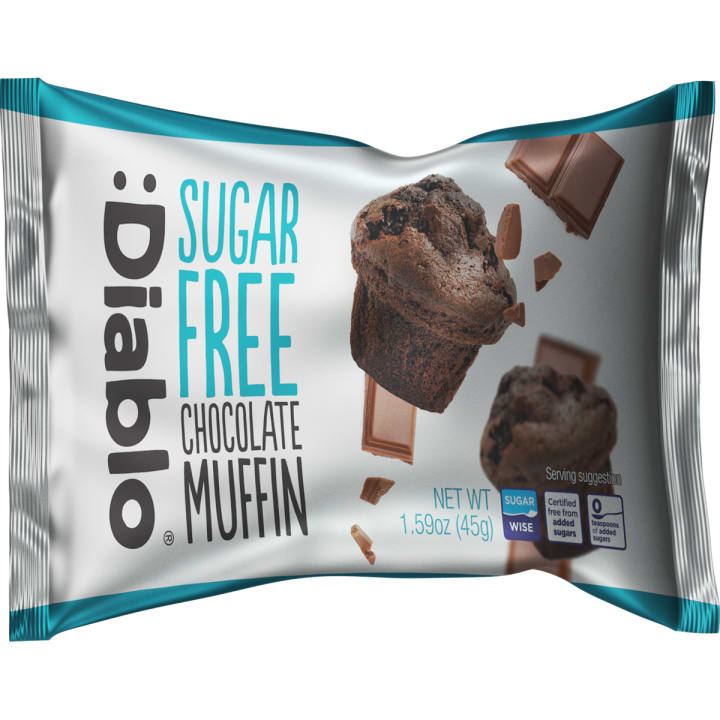
Sugar Free Chocolate Muffin 45g
Polydextrose and cellulose as its dietary fibres, 5.7 g fibre per 100 g

On this page: what it is made of · why cakes use it · sugar or fibre · calories · safety
What is polydextrose made of?
The US regulation that permits it, 21 CFR 172.841, describes a melt of about 89 percent glucose, 10 percent sorbitol and 1 percent citric acid (a second recipe uses 0.1 percent phosphoric acid instead), condensed under heat. The glucose units join to each other in every direction, so the result is a branched chain rather than the neat straight chains found in starch.
Human digestive enzymes are built for the regular bonds in starch and sugar, and most of these random ones are beyond them. In Great Britain it sits on the approved additives list as E1200.
Why do sugar free cakes use polydextrose?
In a sponge, sugar is a large share of the batter by weight, and it holds on to water, which keeps the crumb soft. Take it out and you need something to fill that space.
In our cakes the sweetness comes from a polyol topped up with a trace of acesulfame K. The bulk comes from fibre. On our 45 g Chocolate Muffin the two brackets sit a few places apart: Sweeteners (Maltitol syrup, Acesulfame K), then further down, Dietary fibres (Polydextrose, Cellulose). The FDA lists the jobs polydextrose may do in food as bulking agent, formulation aid, humectant and texturiser, and a humectant is simply an ingredient that keeps moisture in.
Is polydextrose a sugar?
No, and it is not a polyol either. It is a fibre, so on a UK nutrition panel it belongs on the fibre line, with nothing added to the sugars or polyols figures. It has a faint taste and almost no sweetness, which is why it is never the sweetener in a recipe.
Our Chocolate Muffin reads 0 g sugars, 19 g polyols and 5.7 g fibre per 100 g. That fibre figure covers everything in the muffin, the flour and cocoa included, so the panel does not tell you how much of it is polydextrose.
How many calories are in polydextrose?
Fewer than sugar, and the figure depends on which label you are reading. UK and EU labels count every fibre at 2 kcal per gram under Annex XIV of the assimilated Food Information Regulation, against 4 kcal for sugar. The FDA's 2018 guidance lets US labels count polydextrose as dietary fibre at 1 kcal per gram.
| Polydextrose | Maltitol | Sugar | |
|---|---|---|---|
| E number | E1200 | E965 | None, it is a food |
| Line on a UK panel | Fibre | Polyols | Sugars |
| Energy on a UK label | 2 kcal per g | 2.4 kcal per g | 4 kcal per g |
| Job in a cake | Bulk and moisture | Sweetness and bulk | Both |
Sources: GB approved additives list; energy factors from Annex XIV of the assimilated Food Information Regulation; uses from 21 CFR 172.841.
Is polydextrose safe to eat?
Yes. The European Food Safety Authority re-evaluated E1200 in January 2021 and concluded there was no need for a numerical acceptable daily intake and no safety concern for the reported uses and use levels (EFSA Journal, 2021).
In the US, a food must carry a note about laxative effects in sensitive people only when one serving holds more than 15 g of polydextrose. The line "excessive consumption may produce laxative effects" on our cake and muffin packs comes from the polyols in the recipe, maltitol first among them on the ingredient list, because UK law asks for it on any food with more than 10 percent added polyols.
Polydextrose is one of several fibres you will meet on a sugar free label. Some of our chocolate bars use a different fibre, covered in our guide to inulin.
Frequently asked questions
Is polydextrose bad for you?
No. EFSA re-evaluated it in 2021 and found no need to set a numerical acceptable daily intake. In the US it is permitted as a bulking agent, humectant and texturiser in most foods.
Is polydextrose a sugar alcohol?
No. It is made with a little sorbitol, which is a sugar alcohol, but the finished ingredient is a fibre. It sits on the fibre line of the panel, not the polyols line.
Is polydextrose natural?
It is made, not extracted. Glucose, sorbitol and a little citric or phosphoric acid are heated together until the glucose forms new chains that do not occur in nature in this form.
Does polydextrose taste sweet?
Barely. It is used for bulk and texture, so a sugar free cake still needs a sweetener alongside it. In ours that is maltitol with a trace of acesulfame K.