 Chocolate Bars
 Dragees
 Cakes & Muffins
 Sweets & Gummies
 Cookies
 Dessert Sauces
 Chocolate Gift Boxes
 Wafers
 Spreads
 Muesli Bars
 Hampers
 Sales & Promotions

Sugar-Free Dark Chocolate UK:
What to Know and the Best Bars to Buy
A clear, plain-English guide to what the label claims mean, how the sweeteners differ, and how to pick a bar.
What Should You Know Before Buying Sugar-Free Dark Chocolate?
Choosing well comes down to three things: the label claim, the cocoa percentage, and the sweetener. Here is what matters most:
- 1"Sugar free" is a legal UK claim meaning no more than 0.5g of total sugars per 100g, counting both added and naturally occurring sugars.
- 2"No added sugar" is different; it means no sugar was added, but the product can still contain naturally occurring sugars, so it is not the same as sugar-free.
- 3A higher cocoa percentage (70%+) means a more intense flavour and less room for bulk sweeteners.
- 4Most sugar-free and no-added-sugar chocolate is sweetened with maltitol, a polyol; some also use steviol glycosides (stevia).
- 5Because these bars are high in polyols, excessive consumption may produce a laxative effect; stick to a sensible portion of around 20g to 30g.
- 6Always check the "of which sugars" line on the back of the pack rather than the claim on the front.
You have cut back on sugar, read every nutrition label twice, and still found yourself standing in the chocolate aisle wondering whether "sugar-free" actually means what it says. It is a fair question, and the honest answer is that the label tells you less than you think, unless you know exactly what each phrase is legally required to mean.
The good news is that you do not have to give up dark chocolate to follow keto, cut added sugar, or simply eat less of it. What matters is the label claim, the cocoa percentage, the sweetener, and the portion you eat, not the marketing on the front of the pack.
This guide walks through what UK sugar-labelling law actually requires, how the common sweeteners differ, how to read a pack properly, and which bars are genuinely worth buying in 2026.
This is a general information and buying guide. It references UK food-labelling and nutrition-claim regulation enforced by the Food Standards Agency and Trading Standards. It does not offer medical or dietary advice, and it is not aimed at treating or managing any medical condition. If you have specific dietary needs, speak to your GP, pharmacist, or a registered dietitian.
What Counts as Sugar-Free Dark Chocolate in the UK?
The phrase "sugar-free" is not vague marketing language in Britain. It is a legally defined nutrition claim under assimilated EU Regulation (EC) No 1924/2006, and knowing the definition is the most useful thing you can do before you buy.
Sugar-Free vs No Added Sugar vs Unsweetened
These three labels look similar on a shelf but mean genuinely different things under UK food law.
- Sugar free: no more than 0.5g of total sugars per 100g, counting both added and naturally occurring sugars combined. This is a strict, enforceable content guarantee.
- No added sugar: no sugar or sugar-containing ingredient was added during manufacturing, but the product can still contain naturally occurring sugars, for example from cocoa or milk solids. Where natural sugars are present, the pack must state "contains naturally occurring sugars."
- Unsweetened: nothing was added at any stage to make the product taste sweeter, sugar or otherwise.
A bar can legitimately say "no added sugar" on the front while still containing a gram or two of natural sugar per 100g. A genuinely "sugar free" bar cannot. The habit worth building: ignore the front of the pack and check the "of which sugars" line under Carbohydrates on the back. That figure is the regulated one.
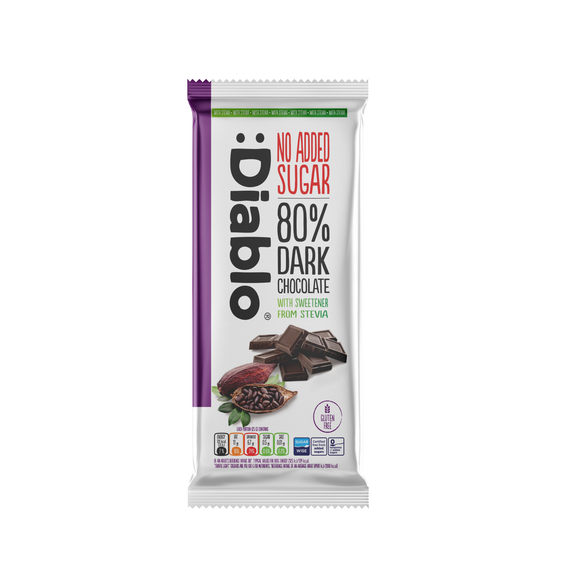
Diablo's dark chocolate range includes both types. Some bars, such as the Diablo SF Dark Chocolate 85g, qualify as sugar-free (0.5g sugars per 100g or less). Others, such as the Diablo NAS 80% Dark Chocolate 75g, are correctly labelled no added sugar because the higher cocoa content brings a little more naturally occurring sugar. Both are valid claims; they simply are not interchangeable.
Why Cocoa Percentage Matters
The cocoa percentage tells you how much of the bar is actual cocoa mass and butter versus sweetener and other ingredients. Higher percentages, typically 70% and above, mean a more intense, less sweet flavour and less room for bulk sweeteners. Most no-added-sugar and sugar-free dark chocolate sits between 50% and 100% cocoa, with the 70% to 85% range giving the best balance of flavour and lower sweetness for most people moving away from sugary milk chocolate.
The Sweetener Guide: Maltitol, Stevia, and Erythritol Compared
Not all sugar-free or no-added-sugar chocolate is sweetened the same way, and the sweetener used matters almost as much as the cocoa percentage. The figures below describe the sweeteners themselves, they are ingredient facts, not claims about any finished product.
Maltitol: Sugar-Like Texture
Maltitol is a polyol, or sugar alcohol, derived from starches. It delivers around 75% to 90% of sugar's sweetness with roughly half the calories, and it closely mimics sugar's texture, which is why it dominates UK no-added-sugar chocolate manufacturing. Being a polyol, it is absorbed slowly, which is the point, and which is why polyol-rich foods carry the statement described below. The GB nutrition and health claims register permits one wording on this subject: "Consumption of foods containing maltitol instead of sugar induces a lower blood glucose rise after their consumption compared to sugar-containing foods."
Stevia (Steviol Glycosides): Zero-Calorie, Used in Small Amounts
Steviol glycosides are extracted from the leaves of the Stevia rebaudiana plant. They contribute no calories and are many times sweeter than sugar, so only a tiny amount is needed, around 0.02% in Diablo's formulations. Because they add sweetness but not bulk or texture, they are typically paired with a bulk sweetener like maltitol to recreate sugar's mouthfeel. Diablo's NAS 80% Dark Chocolate uses exactly this combination.
Erythritol: Very Low Calorie
Erythritol is another polyol, with almost no calories because the body absorbs most of it without metabolising it for energy. It is used where a very low calorie bulk sweetener is wanted, though it gives less of the sugar-like body that maltitol provides. Diablo's dark bars use maltitol, and in the 80% bar a maltitol and stevia blend, rather than erythritol.
| Sweetener | Type | Calories / g | Texture / Bulk | Notes |
|---|---|---|---|---|
| Maltitol | Polyol | ~2.1 | Sugar-like | Most common in UK no-added-sugar chocolate. Carries mandatory laxative-effect warning at higher intake. |
| Steviol glycosides (stevia) | High-intensity | ~0 | None (no bulk) | Used in tiny amounts; paired with a bulk sweetener. In Diablo's 80% dark bar. |
| Erythritol | Polyol | ~0.2 | Partial | Very low calorie, with less sugar-like bulk than maltitol. Not used in Diablo's dark bars. |
| Sucrose (table sugar) | Sugar | 4 | Sugar | The reference point. Reducing it is the whole reason these products exist. |
Figures describe the sweeteners as ingredients and are reference values that vary by source and formulation.
Polyols are absorbed slowly, which is the point. UK law requires products where polyols exceed 10% of the total to carry the statement "excessive consumption may produce a laxative effect." Diablo's dark bars contain 38g to 42g of polyols per 100g, so that line appears on the pack. Enjoy a few squares at a time, around 20g to 30g, and your gut adjusts.
How to Choose the Best Sugar-Free Dark Chocolate in the UK
Use this simple framework whenever you are standing in front of a shelf or scrolling through a product page.
- Check the label claim. "Sugar free" means ≤0.5g sugars per 100g. "No added sugar" means none was added but some natural sugar may remain. Both are legitimate, just know which one you are buying.
- Read the "of which sugars" line, not the front-of-pack claim. The nutrition panel on the back is the regulated figure.
- Check the cocoa percentage. Aim for 70%+ if you prefer a more intense, less sweet bar with fewer bulk sweeteners.
- Identify the sweetener in the ingredients list. Maltitol is the norm; a stevia (steviol glycosides) and maltitol blend is common in higher-cocoa bars. If you are sensitive to polyols, watch your portion size.
- Match the bar to your goal. If you count carbohydrate, compare the "carbohydrates" figure per 100g across the bars you are considering; if you are simply cutting added sugar, you have more flexibility.
Diablo Sugar-Free Dark Chocolate: The Range at a Glance
Here are three of Diablo's most widely available dark chocolate bars in the UK, with figures taken directly from the current product data. Note the claim on each, two are sugar free, one is no added sugar.
Diablo SF Dark Chocolate 85g
SKU: CHK-085-DKM-P15 · with sweetenersPer 14g portion: 68 kcal · 0.1g sugars · 5.8g polyols
Also per 100g: Fat 35g (sat 23g) · Carbs 47g · Protein 6.8g · Salt 0.3g
Allergens contain: Milk, Soya. May contain: Peanuts, Tree Nuts, Sesame.

Diablo NAS 80% Dark Chocolate 75g
SKU: CHK-075-DKS-P15 · with sweetenersPer 25g portion: 129 kcal · 0.3g sugars · 5g polyols
Also per 100g: Fat 43g (sat 27g) · Carbs 26g · Salt 0.06g
Allergens contain: Soya. May contain: Milk, Tree Nuts.
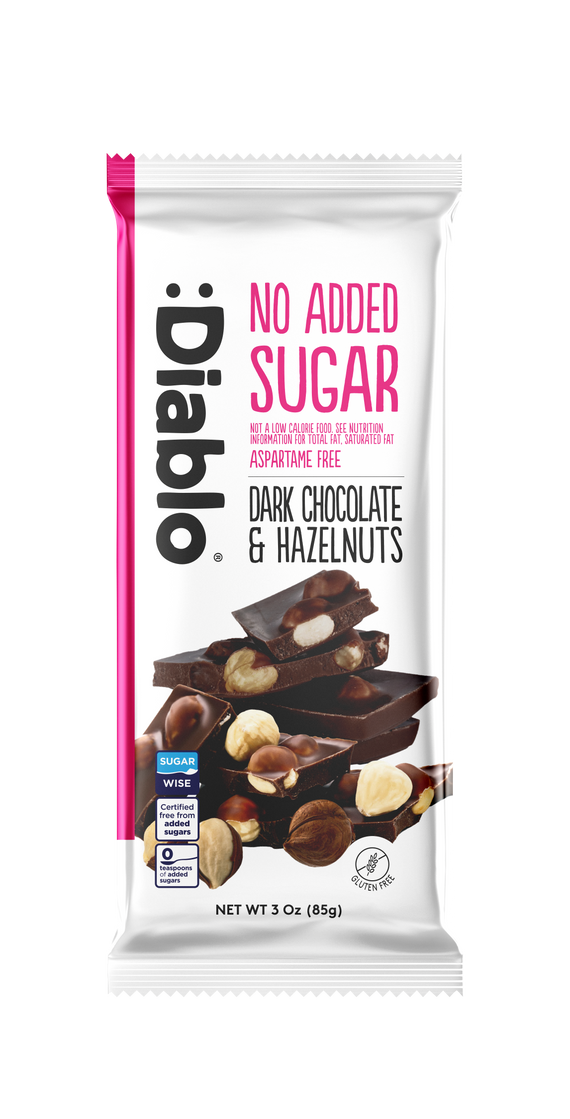
Diablo SF Dark Chocolate & Hazelnuts 85g
SKU: CHK-085-HZM-P15 · with sweetenersPer 14g portion: 70 kcal · 0.1g sugars · 5.3g polyols
Also per 100g: Fat 38g (sat 22g) · Carbs 43g · Protein 7.7g · Salt 0.15g
Allergens contain: Milk, Soya, Tree Nuts (Hazelnuts). May contain: Peanuts, Tree Nuts, Sesame.
Diablo is one of the most consistently available no-added-sugar and sugar-free confectionery ranges across UK supermarkets and online retailers, covering both ends of the sweetener spectrum: a maltitol-sweetened everyday dark bar and a higher-cocoa 80% bar using a maltitol and stevia blend. The full range is available at diablosugarfree.com.
The Diablo Dark Bars, Side by Side
Three dark bars, three different jobs. Claim type, cocoa content, sweetener and the sugars figure, all from current Diablo product data.
| Bar | Cocoa | Claim | Sweetener | Sugars /100g |
|---|---|---|---|---|
| Diablo SF Dark Chocolate 85g | 57% min | Sugar Free | Maltitol | 0.5g |
| Diablo NAS 80% Dark Chocolate 75g | 80% min | No Added Sugar | Maltitol + stevia | 1.1g |
| Diablo SF Dark Chocolate & Hazelnuts 85g | 49% min | Sugar Free | Maltitol | 0.4g |
Figures are from current Diablo product data and match the panel printed on each pack. The 1.1g of sugars per 100g in the NAS 80% bar occurs naturally in the cocoa; no sugar is added.
Worth knowing when you compare these with anything else on the shelf: a very high cocoa bar at 90 or 100 percent is not the same thing as a sugar free one. Unsweetened bars carry only the trace sugars in the cocoa, but most high-cocoa bars still contain added sugar, and the front of the pack will not always say so. The sugars line on the back settles it.
Where to Buy Sugar-Free Dark Chocolate in the UK
Availability has improved considerably in recent years. Tesco, Sainsbury's, Morrisons, and Holland & Barrett now stock dedicated no-added-sugar dark chocolate lines as standard rather than as a niche "free from" shelf item. Diablo's full range is also available directly through diablosugarfree.com and Amazon UK, which is useful if your local supermarket has limited stock. Health-food stores and specialist online retailers tend to carry a wider variety of formulations than mainstream supermarkets, which is worth knowing if you want a specific sweetener profile.
How Much Sugar-Free Dark Chocolate Should You Eat?
First-Try Portion
One or two small squares. A good starting point when trying a new bar for the first time, especially if you are sensitive to polyols.
Everyday Portion
Roughly four to six squares. A sensible everyday amount that keeps polyol intake comfortable for most people.
Upper Guide
Beyond this, calories and polyol intake add up, and the laxative-effect warning becomes more relevant. Best kept to occasional treats.
A simple rule of thumb: enjoy it as a small treat after a meal rather than a large amount on an empty stomach, and keep to a portion you can eat comfortably. Because these bars are polyol-rich, moderation is about digestive comfort as much as calories.
Frequently Asked Questions
References and Sources
- Food Standards Agency: food labelling and nutrition claims guidance (GOV.UK).
- Assimilated Regulation (EC) No 1924/2006 on nutrition and health claims made on foods (UK-retained).
- Regulation (EU) No 1169/2011 on the provision of food information to consumers (UK-retained), including mandatory polyol and sweetener statements.
- Harvard Health Publishing. How healthy are sugar alcohols? Updated 2023 to 2024.
- Diabetes UK: position on the withdrawal of foods labelled for people with diabetes (2016).
- Diablo Sugar Free current product data (Certificate of Analysis figures): CHK-085-DKM-P15, CHK-075-DKS-P15, CHK-085-HZM-P15.
Real Chocolate Taste, Made With Sweeteners Instead of Sugar
Diablo Sugar Free's dark chocolate range is made with maltitol instead of sugar, and the 80% bar uses a maltitol and stevia blend. Read the pack for the full figures.
Shop Diablo Dark ChocolateMade with sweeteners. Contains polyols; excessive consumption may produce a laxative effect. Always read the label.