 Chocolate Bars
 Dragees
 Cakes & Muffins
 Sweets & Gummies
 Cookies
 Dessert Sauces
 Chocolate Gift Boxes
 Wafers
 Spreads
 Muesli Bars
 Hampers
 Sales & Promotions
Inulin is a dietary fibre taken from chicory root. Your body cannot break it down, so it reaches the large intestine intact. In chocolate it adds fibre to the label and gives the bar body where sugar used to sit.
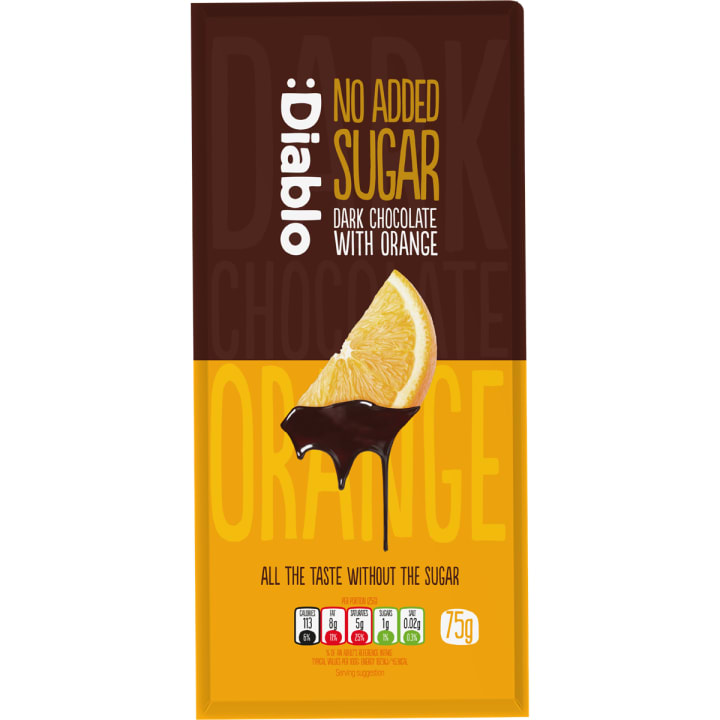
Ours, if you would rather read it on a real ingredients list:

What is inulin made from?
Chicory root, in almost every case. Chicory stores its energy as inulin the way a potato stores it as starch, and the fibre is drawn out of the root with hot water. The chains are built from fructose units, which is why inulin is classed as a fructan rather than a starch or a sugar.
Great Britain defines native chicory inulin as a non-fractionated mixture with a mean degree of polymerisation of 9 or more, meaning an average of at least nine linked units per chain. The definition is that tight because the one authorised claim was assessed on that material alone.
What does inulin do in a chocolate bar?
Take sugar out of chocolate and you lose more than sweetness. Sugar is roughly half the weight of a normal bar, so something has to fill the gap or the chocolate turns thin and greasy. Inulin is one of the ingredients that fills it, and it brings fibre with it.
Food scientists have measured what that swap does. A study in the International Journal of Food Science and Technology tested inulin as a sucrose replacer in dark chocolate and found that raising the inulin share increased viscosity and hardness, while melting behaviour barely moved. In plain terms: the bar sets firmer and still melts on the tongue like chocolate should.
In our bars inulin takes a back seat. The bulk sweetener is maltitol, and inulin sits behind it adding fibre and structure. On our Dark Chocolate with Orange it is the fifth of nine ingredients, after the maltitol, cocoa mass, cocoa butter and dried orange.
For the other half of the picture, we have a full explainer on what maltitol is and how it sweetens.
How much fibre is in a no added sugar chocolate bar?
Enough to show up clearly on the panel. Our Dark Chocolate with Orange declares 8 g of fibre per 100 g, which clears the 6 g per 100 g that GB law sets as the threshold for a high fibre claim. The Milk Chocolate Bubble Bar declares 5.3 g per 100 g, above the 3 g threshold for a source of fibre.
Not all of that fibre is inulin. Cocoa carries fibre of its own, and in a dark bar it carries most of it.
For scale, the NHS puts the adult target at 30 g of fibre a day and notes that most adults manage about 20 g. A bar of chocolate is not going to close a 10 g gap on its own. It is simply a bar that brings some fibre along with it.
Both bars are no added sugar rather than sugar free, and they contain naturally occurring sugars: 2 g per 100 g in the dark bar, from the cocoa and the dried orange, and 9.8 g per 100 g in the bubble bar, from the milk. Nothing sweet is added on top.
What is anyone allowed to claim about inulin?
One sentence, and only one. Great Britain authorises a single health claim for chicory inulin, and the wording is fixed:
Chicory inulin contributes to normal bowel function by increasing stool frequency.
The authorised GB wording. It describes the ingredient, not any one product.
That wording comes with a condition: it applies where a daily intake of 12 g of chicory inulin is reached, which is supplement territory rather than confectionery. So you will not find that sentence on our wrappers. Only claims listed in the Great Britain nutrition and health claims register may be used here at all.
Is inulin a sugar or a sweetener?
Neither. Inulin is built from fructose units, so it is related to sugar by chemistry, but the chains pass through the small intestine undigested and the sugars line on the panel does not count them. On a UK label its contribution lands in the fibre figure instead.
It is also a different thing from a polyol. Maltitol, sorbitol and isomalt are sugar alcohols, and they get their own line on the nutrition panel under polyols. Our guide to sugar alcohols covers that family properly.
Because both of these bars run above 10 percent polyols, 44 g per 100 g in the dark bar and 40 g in the bubble bar, they carry the line excessive consumption may produce laxative effects exactly as UK labelling law requires. Polyols are absorbed slowly, which is the whole point of them, and a couple of squares at a time is how the bar is meant to be enjoyed.
Inulin turns up in seven products across our range: three of our chocolate bars, both sizes of the coated buttons and both 450 g fruit cakes.
Frequently asked questions
Is inulin a sugar?
No. Inulin is a dietary fibre built from chains of fructose units, and your body cannot break those chains down. Because it is not digested, it is not counted in the sugars line on a nutrition panel. Its contribution shows up in the fibre figure.
Does inulin count towards my daily fibre?
Yes. Inulin is declared as fibre on a UK label and counts towards the 30 g a day the NHS recommends for adults. Most adults currently get around 20 g, so the gap is real for a lot of people.
Why does one Diablo pack say fibre (inulin) and another just inulin?
Both name the same ingredient. On the Milk Chocolate Bubble Bar it sits inside the chocolate's own bracket as fibre (inulin). On the Dark Chocolate with Orange it is listed on its own, fifth of nine ingredients. Ingredients are ordered by weight, so its position tells you roughly how much of it is in there.