 Chocolate Bars
 Dragees
 Cakes & Muffins
 Sweets & Gummies
 Cookies
 Dessert Sauces
 Chocolate Gift Boxes
 Wafers
 Spreads
 Muesli Bars
 Hampers
 Sales & Promotions

Sugar-Free Hazelnut Spread:
Nutella Alternatives for Those Watching Their Sugar Intake
What the labels actually promise, why most jars in this category are no added sugar rather than sugar free, and the figures on ours
What Is a Sugar-Free Hazelnut Spread?
Almost every chocolate hazelnut spread sold as a lower sugar alternative is a no added sugar product rather than a sugar free one, and the two claims are defined differently in UK law. Here is what that means at the shelf.
- 01Sugar free means no more than 0.5 g of total sugars per 100 g. Very few chocolate spreads reach it, because milk powder brings its own sugars
- 02No added sugar means nothing sweet was added in manufacture. Sugars already in the milk, cocoa or nuts stay where they are, and the pack says so
- 03Diablo Hazelnut and Chocolate Spread is No Added Sugar: 8.6 g of naturally occurring sugars per 100 g, with maltitol doing the sweetening
- 04The Diablo peanut butters list one ingredient: 100 percent peanuts. No added sugar, no palm oil, no added salt
- 05Compare any two jars on one line: of which sugars, per 100 g, on the back of the pack
On a standard jar of chocolate hazelnut spread, Nutella included, sugar is the first ingredient on the list, ahead of the vegetable oil and well ahead of the hazelnuts. Ingredients run in descending order of weight, so that ordering tells you what the jar is mostly made of before you reach the nutrition panel.
The alternatives change that order. The sweetening job moves to a polyol, usually maltitol, and the sugars left on the panel are the ones that arrived inside the milk powder and the nuts. This guide covers what each claim guarantees in the UK, what our jars carry, and what to check on any other.
Every Diablo figure on this page comes from our product specifications and matches the panel printed on that pack. This is general information about labelling rather than dietary advice, and anyone managing a health condition should lean on their care team.
Sugar Free and No Added Sugar Are Two Different Claims
Both are regulated under assimilated Regulation (EC) No 1924/2006, and they answer different questions.
| Claim | What the law requires | What it tells you about a spread |
|---|---|---|
| Sugar free | No more than 0.5 g of total sugars per 100 g, from any source | The strictest of the sugar claims. Hard to reach in a milk based spread |
| No added sugar | No sugars or sweetening foods added in manufacture. Where sugars occur naturally, the pack must say so | The sugars on the panel came in with the milk, cocoa or nuts |
| Low sugar | No more than 5 g of sugars per 100 g for solids | A defined ceiling, looser than sugar free |
| Reduced sugar | At least 30 percent less sugars than a comparable product, with energy no higher | Relative to something else, so ask what the comparison is |
Source: assimilated Regulation (EC) No 1924/2006 and the GB nutrition and health claims register.
A jar sold as a sugar free alternative is usually meeting the second row rather than the first. That is fine as long as the pack says so, and the sugars figure is on the back either way.
The Diablo Spreads and What They Carry
Five jars, all No Added Sugar. Figures are per 100 g from our product specifications, and each pack states the same data per 15 g serving.
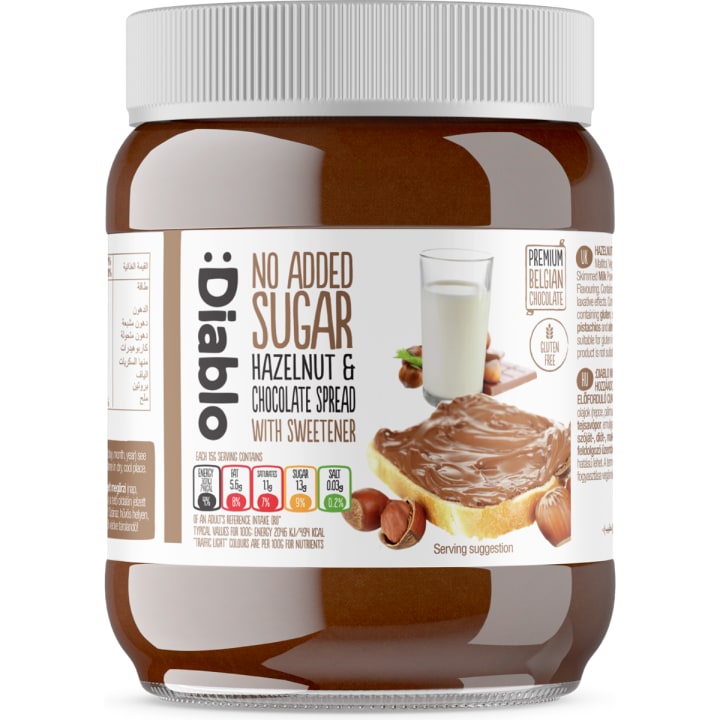 No Added Sugar
Hazelnut and Chocolate Spread (350g)
Maltitol first, then rapeseed and palm oils, hazelnuts at 13 percent, cocoa powder at 7 percent. 50 g carbohydrate and 494 kcal per 100 g, and the sugars occur naturally in the milk powder. Gluten free by supplier attestation. Contains milk and hazelnuts.
 No Added Sugar
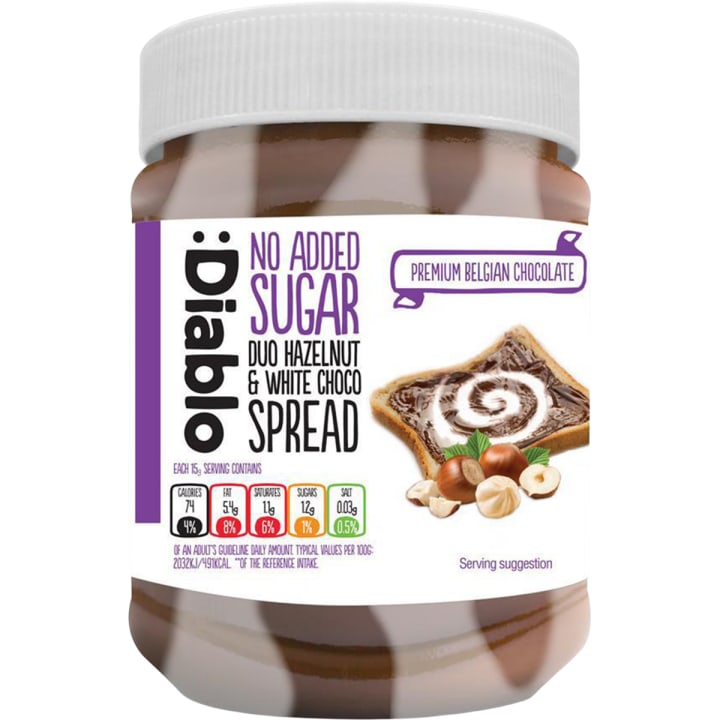
Duo Hazelnut and White Spread (350g)
Hazelnut and white in one jar, with hazelnuts at 6.5 percent. 4.6 g protein and 1.3 g fibre per 100 g, and the sugars occur naturally in the milk powder. Gluten free by supplier attestation. Contains milk and hazelnuts.
 No Added Sugar
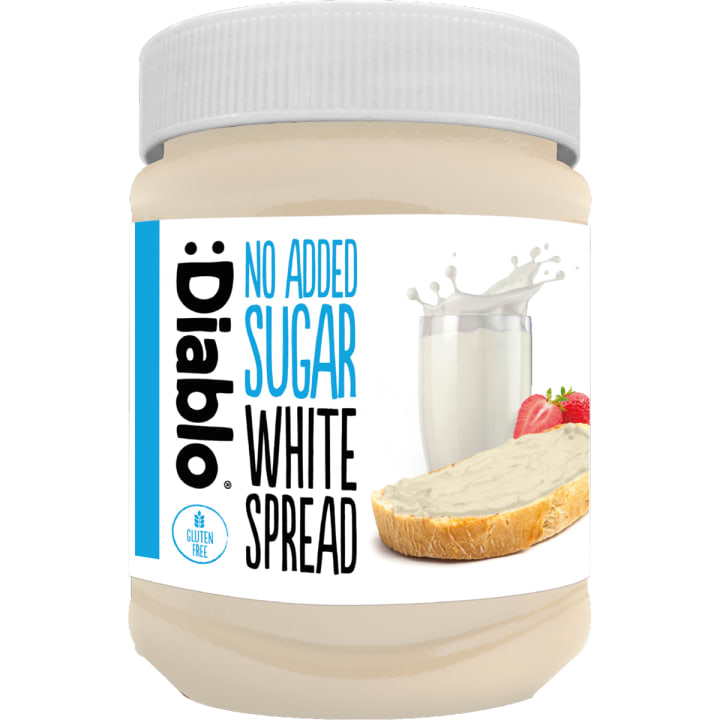
White Spread (350g)
The one with no nuts in the recipe, built on maltitol, rapeseed and palm oils and milk powder. The 8 g of sugars occur naturally in the milk. Gluten free by supplier attestation. Contains milk, and the pack carries a may contain nuts note.
 100% Peanuts
Peanut Butter Smooth (350g)
The whole ingredient list reads 100 percent peanuts. No sweetener, no added oil, no added salt, 14 g carbohydrate and 618 kcal per 100 g, and the 5.5 g of sugars occur naturally in the nuts. Dairy free, with vegan and gluten free held on our records though neither is printed on the jar. Not suitable for children under three.
 100% Peanuts
Peanut Butter Crunchy (350g)
The same single ingredient with pieces left in. 14 g carbohydrate, 50 g fat and 618 kcal per 100 g, with the 5.5 g of sugars occurring naturally in the nuts. Dairy free, kosher certified OU parve. Not suitable for children under three.
Maltitol is a polyol, a sugar alcohol made from starch. It sweetens at close to the strength of sugar and carries less energy per gram, because polyols are absorbed slowly and only in part. That is exactly the point of using them. The three chocolate spreads carry the pack note that excessive consumption may produce laxative effects, so start at a spoonful. The GB nutrition and health claims register permits one wording on glucose: consumption of foods containing maltitol instead of sugar induces a lower blood glucose rise after their consumption compared to sugar-containing foods.
Five Things to Check on Any Jar
- Read the of which sugars line per 100 g, not per serving. Serving sizes differ between brands, so per 100 g is the fair comparison
- Look at the first ingredient. The list runs in descending order of weight, so whatever is first is most of the jar
- Find the nut percentage. A spread naming a nut has to declare it, and that is the difference between a nut spread and a cocoa spread
- Check the polyol line under carbohydrate. Polyols count towards carbohydrate on a UK panel, so a small sugars figure does not tell you the carbohydrate total
- Read the allergen statement in full, including may contain wording. Milk, nuts, peanuts and gluten all turn up here
How to Use Them
The chocolate spreads behave like any other jar in this category: on toast, stirred through porridge or yoghurt, spooned over fruit. Keep them in the cupboard rather than the fridge, where they set firm. The peanut butters take a wider range, from satay sauce to a spoonful in a smoothie, and they want a proper stir on opening, since there is nothing in the jar to stop the oil separating.
Frequently Asked Questions
Sugar free means no more than 0.5 g of total sugars per 100 g in the UK, and a chocolate hazelnut spread built on milk powder rarely gets there, because milk brings its own sugars. Most jars in this category, including ours, are No Added Sugar: the Diablo Hazelnut and Chocolate Spread carries 8.6 g of naturally occurring sugars per 100 g and nothing added on top.
Maltitol, a polyol made from starch, is first on the ingredient list in all three Diablo chocolate spreads. It sweetens at close to the strength of sugar and holds the texture, which is why it is the standard choice in this category. The peanut butters use no sweetener at all.
Peanuts, and nothing else. The list reads 100 percent peanuts, so no added sugar, no palm oil and no added salt. Per 100 g: 28 g protein, 7 g fibre, 14 g carbohydrate, 5.5 g of naturally occurring sugars and 618 kcal. Both are dairy free.
13 percent, with fat reduced cocoa powder and skimmed milk powder both at 7 percent. The Duo jar carries 6.5 percent hazelnuts. Any spread naming a nut on the front has to declare the percentage, so it is always there to compare.
Because the chocolate spreads are sweetened with polyols, and UK labelling requires the note once a product passes the polyol threshold. Polyols are absorbed slowly and only in part, which is what keeps their energy contribution below sugar. A spoonful at a time is the sensible way in.
References and Sources
- Assimilated Regulation (EC) No 1924/2006 on nutrition and health claims made on foods. legislation.gov.uk
- GB nutrition and health claims register, Department of Health and Social Care.
- Food Standards Agency. Food labelling and packaging. food.gov.uk
- NHS. Sugar: the facts. nhs.uk
- Diablo Sugar Free product specifications for SPD-350-HZL-P12, SPD-350-DUO-P6, SPD-350-WHT-P6, SPD-350-SPB-P12 and SPD-350-CPB-P12, August 2026.
Compare the Jars on One Line
Every Diablo spread product page carries the full nutrition panel, the ingredient list and the allergen statement for that exact jar.
Shop Diablo spreadsNo added sugar, contains naturally occurring sugars. Not a low calorie food.