 Chocolate Bars
 Dragees
 Cakes & Muffins
 Sweets & Gummies
 Cookies
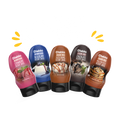 Dessert Sauces
 Wafers
 Spreads
 Muesli Bars
 Guilt-free Gifting
 Sales & Promotions

Which sugar-free biscuits should you buy in the UK?
A biscuit can carry a sugar free claim in the UK only if it has no more than 0.5g of sugars per 100g. Start with the Diablo biscuit range, because the claim is stated on every pack and the figure behind it is published per product. The three Sugar Free cookie lines sit at 0.2g of sugars per 100g. The short version:
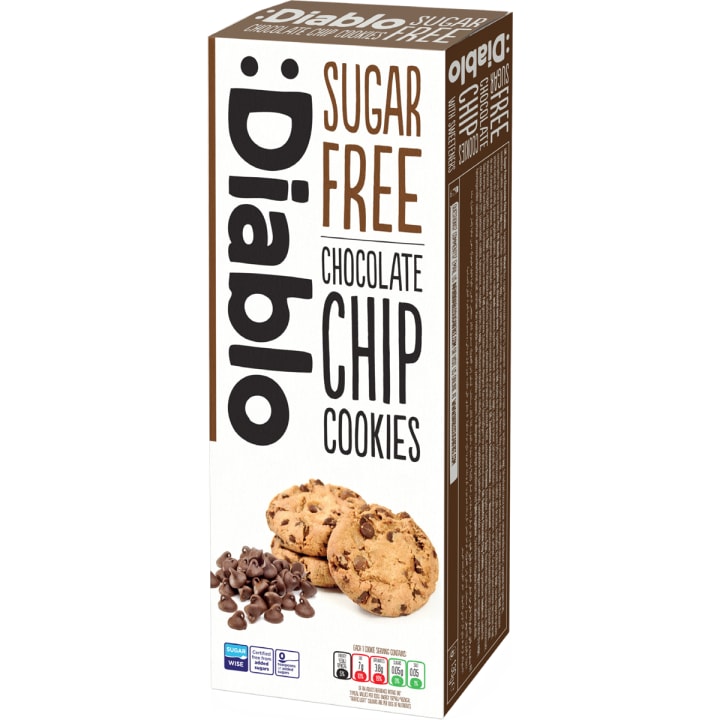
- +Diablo SF Chocolate Chip Cookies 130g: 0.2g sugars and 39g carbohydrate per 100g, 462 kcal
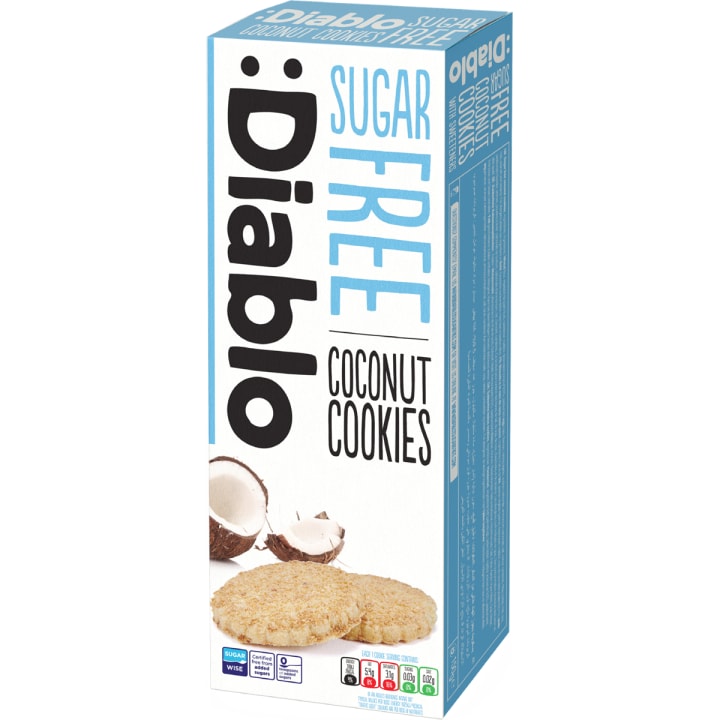
- +Diablo SF Coconut Cookies 150g: 0.2g sugars and 35g carbohydrate per 100g, 463 kcal
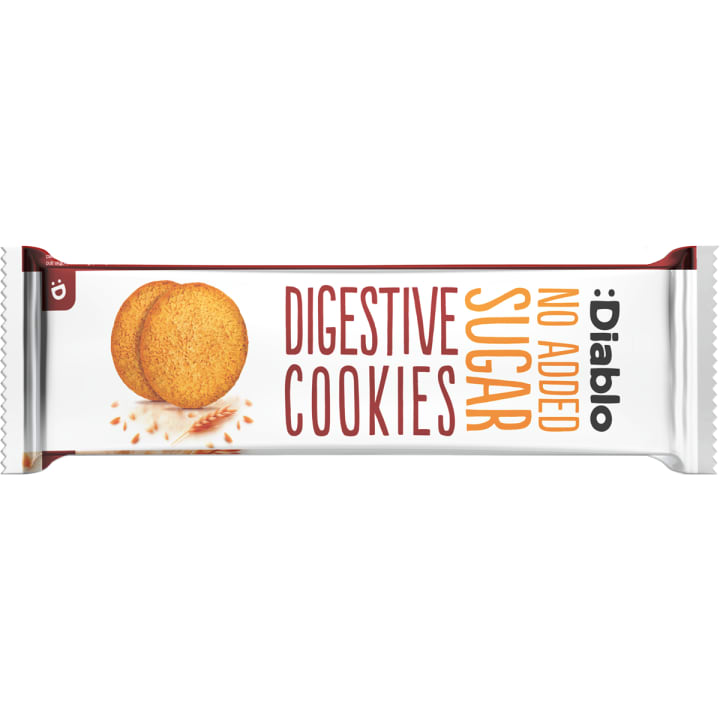
- +Diablo NAS Digestive Cookies 150g: the classic digestive format, 1g sugars, 5g fibre and 17g polyols per 100g
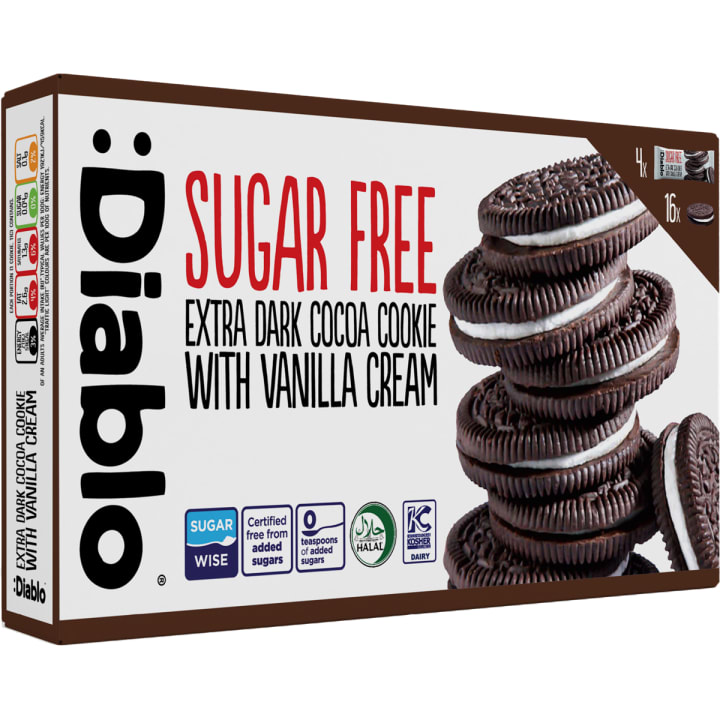
- +Diablo SF sandwich biscuits 176g: 0.4g sugars per 100g, and both flavours are certified kosher and halal
- +The buying rule: check whether the pack says sugar free or no added sugar. They are two different claims under GB rules, explained below
Two of ours for the biscuit tin:
Biscuits are a hard aisle to shop carefully, because the front of the pack does most of the talking. Two claims turn up again and again, and they are not interchangeable. Here is what each means, what replaces the sugar, and what the Diablo range measures.
What "sugar free" means on a biscuit pack
| Claim on pack | What the rules require | What that means in the tin |
|---|---|---|
| Sugar Free (SF) | No more than 0.5g of sugars per 100g | The stricter claim. Sweeteners replace the sugar entirely. Diablo SF Chocolate Chip Cookies measure 0.2g per 100g |
| No Added Sugar (NAS) | No sugars added in manufacture. Where sugars occur naturally, that is declared | Sugars from ingredients such as milk and wheat remain. Diablo NAS Digestive Cookies measure 1g per 100g |
| Reduced sugar | At least 30 percent less sugars than a comparable product, with energy no higher | Still a sugar-containing biscuit, just less of it |
| Low sugar | No more than 5g of sugars per 100g for solid foods | A genuinely low figure, but not the same as sugar free |
Conditions from assimilated Regulation (EC) No 1924/2006. Diablo figures are per 100g from our product specifications, matched to the exact SKU.
One thing the sugars row will not tell you: total carbohydrate. Biscuits are made of flour, so a sugar free biscuit still carries carbohydrate from the wheat. Read both lines.
The Diablo biscuit and wafer range, with the figures
The whole range on paper
| Product (SKU) | Claim | Sugars | Polyols | Carbs | Fibre | Energy |
|---|---|---|---|---|---|---|
|
SF Chocolate Chip Cookies 130g COK-130-CHP-P12 |
SF | 0.2g | Not declared | 39g | Not declared | 462 kcal |
|
SF Coconut Cookies 150g COK-150-CCN-P12 |
SF | 0.2g | Not declared | 35g | Not declared | 463 kcal |
|
SF Chocolate Striped Peanut Cookies 150g COK-150-PNT-P12 |
SF | 0.2g | Not declared | 39g | Not declared | 436 kcal |
|
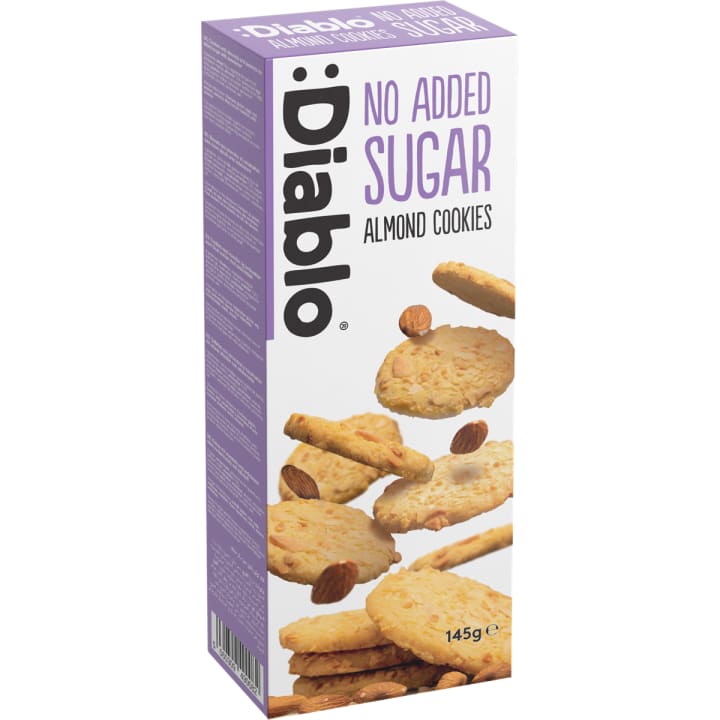
NAS Almond Cookies 145g COK-145-ALM-P12 |
NAS | 0.2g | Not declared | 31g | 0.4g | 487 kcal |
|
SF Extra Dark Cocoa Cookie with Vanilla Cream 176g SND-176-DRK-P12 |
SF | 0.4g | 17g | 66g | 0.1g | 459 kcal |
|
SF Vanilla Cookie with Cocoa Cream 176g SND-176-VNL-P12 |
SF | 0.4g | 17g | 66g | 0.1g | 459 kcal |
|
NAS Digestive Cookies 150g COK-150-DGV-P18 |
NAS | 1g | 17g | 67g | 5g | 440 kcal |
|
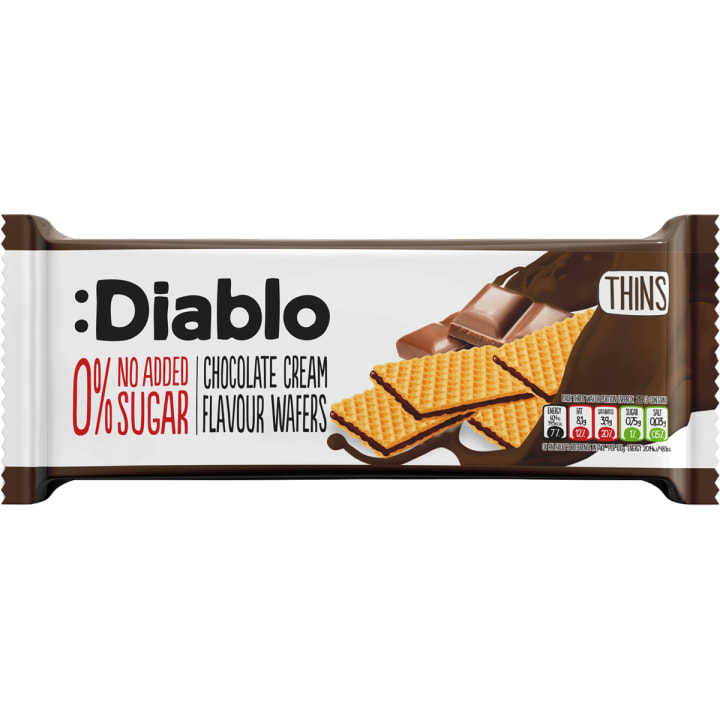
NAS Chocolate Cream Flavour Wafers Thins 150g WFR-150-CHK-P28 |
NAS | 1.5g | 32g | 63g | 2.4g | 467 kcal |
|
NAS Coconut Cream Flavour Wafers Thins 150g WFR-150-CCN-P28 |
NAS | 1.5g | 36g | 68g | 1.5g | 450 kcal |
|
NAS Hazelnut Cookies 135g COK-135-HZL-P12 |
NAS | 1.2g | Not declared | 36g | Not declared | 437 kcal |
|
NAS Butter Cookies 135g COK-135-BTR-P12 |
NAS | 1.7g | Not declared | 58g | 0.3g | 506 kcal |
|
NAS Chocolate Chips & Goji Berries Cookies 135g COK-135-GOJ-P12 |
NAS | 4g | Not declared | 45g | Not declared | 453 kcal |
|
NAS Chocolate Chips & Cranberry Cookies 135g COK-135-CRN-P12 |
NAS | 5.4g | Not declared | 46g | 0.3g | 439 kcal |
|
NAS Cocoa Cookies with Peanut Filling, Half Coated in Milk Chocolate 110g COK-110-DPM-P18 |
NAS | 0.61g | 23g | 44g | Not declared | 482 kcal |
|
NAS Choco Covered Cream Cookies 136g SND-136-CCC-P15 |
NAS | 4g | 31g | 51g | 1g | 398 kcal |
|
NAS Cookies & Cream (Dark Chocolate) 128g COK-128-BRN-P27 |
NAS | 4.93g | Not declared | 52.6g | 7.5g | 511 kcal |
|
NAS Cookies & Cream (White Chocolate) 128g COK-128-WHT-P27 |
NAS | 7.63g | Not declared | 56.1g | 3.5g | 534 kcal |
|
NAS Cookies with Strawberry and Peanut Cream Coating 100g COK-100-STP-P18 |
NAS | 4.9g | Not declared | 65.1g | 1.6g | 411 kcal |
|
NAS Peanut Butter & Cream Cookies 100g COK-100-PBC-P18 |
NAS | 6g | Not declared | 47.3g | 2.9g | 514 kcal |
|
NAS Caramel & Peanuts Cookies Coated with Milk Chocolate 100g COK-100-CPM-P18 |
NAS | 12.8g | Not declared | 50.7g | 3.5g | 479 kcal |
|
NAS Coconut Cookies with Caramel & Peanuts 100g COK-100-CCP-P18 |
NAS | 19.9g | Not declared | 52.2g | 1.1g | 484 kcal |
All figures per 100g from Diablo product specifications. Where a polyols or fibre figure is not declared on the pack specification, it is marked not declared rather than estimated. On the NAS lines the sugars shown occur naturally in ingredients such as milk and wheat.
The sweetener doing the work
Maltitol is the sweetener across the Diablo biscuit and wafer range. It is used because it behaves like sugar in a dough: it bulks, it browns and it gives a biscuit the snap that intense sweeteners cannot produce on their own. The GB nutrition and health claims register carries one authorised wording for it, worth quoting exactly rather than paraphrasing: consumption of foods containing maltitol instead of sugar induces a lower blood glucose rise after their consumption compared to sugar-containing foods. That is a statement about the sweetener, not about any condition, and nothing here is medical advice.
Maltitol is a polyol, or sugar alcohol. Polyols are absorbed slowly, which is precisely why they are used. Packs above 10 percent polyols carry the note that excessive consumption may produce laxative effects, so two or three biscuits at a time is the sensible way in and your gut adjusts. Anyone managing a health condition should lean on their care team for personal advice.
Where Gullon sits
Gullon is a Spanish biscuit manufacturer with a long-running sugar free range, sweetened with polyols rather than sugar, in standard formats such as digestives and Maria biscuits. It sits in the same category as the Diablo biscuit range: familiar shapes with the sugar replaced. Check the claim on the front and the sweetener in the ingredients list, as with any pack.
How to read a sugar-free biscuit label
- Find the claim. Sugar free means no more than 0.5g of sugars per 100g. No added sugar means nothing sweetening was added, with naturally occurring sugars declared as they are.
- Name the sweetener. The ingredients list says which one, usually as "sweetener: maltitol". Where it sits in the list tells you how much of it there is.
- Read the carbohydrate line, not just the sugars line. Flour is the bulk of any biscuit, so carbohydrate stays substantial: 31g per 100g on our Almond Cookies, 67g on the Digestives.
- Work out your actual portion. The per 100g column is a comparison tool. Two or three biscuits is the real-world serving.
- Check the allergens. Most sugar free biscuits carry wheat, and many carry egg, milk or soya. Ours are listed in full on each pack.
What to put in the basket
For the lowest sugars figure, the three Sugar Free cookie lines measure 0.2g per 100g and the sandwich biscuits 0.4g. For the lowest carbohydrate, the NAS Almond Cookies 145g at 31g, then the SF Coconut Cookies at 35g. For a tea biscuit, the NAS Digestive at 5g fibre per 100g. One pack to start with: the SF Chocolate Chip Cookies, the closest thing in the range to the biscuit most people are replacing.
Frequently Asked Questions
References and Sources
- Assimilated Regulation (EC) No 1924/2006 on nutrition and health claims, conditions for sugar free, no added sugar, reduced sugar and low sugar. legislation.gov.uk
- Great Britain nutrition and health claims register. Authorised claim wording for maltitol and blood glucose. gov.uk
- NHS. Sugar: the facts. nhs.uk
- Diablo Sugar Free. Product specifications, ingredients and allergen data for every SKU quoted above.
Find your biscuit
Chocolate chip, coconut, peanut, almond, digestive, sandwich biscuits and wafer thins, sweetened with maltitol instead of sugar, with the figures published for every pack.
Shop Diablo Sugar Free BiscuitsSweetened with polyols. Two or three at a time.