 Chocolate Bars
 Dragees
 Cakes & Muffins
 Sweets & Gummies
 Cookies
 Dessert Sauces
 Wafers
 Spreads
 Muesli Bars
 Guilt-free Gifting
 Sales & Promotions

What Does No Added Sugar Mean in the UK?
No added sugar means no sugar, syrup, honey or other sweetening food was added during manufacture. It does not mean the product is sugar free. Here is what the four UK sugar claims guarantee.
- No added sugarNothing sweetening was added in manufacture, under assimilated Regulation (EC) No 1924/2006
- Not sugar freeSugars occurring naturally in milk, fruit or cocoa can still be present, and the pack has to say so
- Sugar freeNo more than 0.5 g of total sugars per 100 g, the strictest of the four
- Low sugarNo more than 5 g per 100 g for solids, or 2.5 g per 100 ml for liquids
- Reduced sugarAt least 30 percent less sugars than a comparable product, with energy no higher
- Check the backThe of which sugars line under carbohydrate is the regulated figure. The front of the pack is a claim about it
No added sugar is one of the most misread phrases on a British shelf. It has a legal definition, and that definition covers what a manufacturer put in rather than what ends up in the pack. A no added sugar yoghurt can carry several grams of sugars per 100 g and still be entirely within the rules, because milk and fruit arrive with sugars of their own. This guide sets out the four claims, the sweeteners behind them, and the lines worth reading on the back.
This guide references UK food labelling law, Food Standards Agency guidance, NHS intake advice and Diabetes UK label guidance. It is general information rather than dietary advice, and anyone managing a health condition should lean on their care team.
No Added Sugar, Sugar Free, Low Sugar and Reduced Sugar
Four claims, four thresholds. Mixing them up is the main reason people eat more sugar than they intended.
| Claim | What UK law requires | What it actually tells you |
|---|---|---|
| Sugar free | No more than 0.5 g of total sugars per 100 g or 100 ml, from any source | The strictest claim, whatever the source of the sugars |
| No added sugar | No sugars or sweetening foods added in manufacture. Where sugars occur naturally, the pack must say so | Says nothing about the total, so read the panel |
| Low sugar | No more than 5 g per 100 g for solids, 2.5 g per 100 ml for liquids | A defined ceiling, ten times looser than sugar free |
| Reduced sugar | At least 30 percent less sugars than a comparable product, with energy no higher | Relative to something else. Ask what the comparison is |
Source: assimilated Regulation (EC) No 1924/2006 and the GB nutrition and health claims register.
Why the Front of the Pack Is Not the Whole Story
Diabetes UK makes the point plainly in its label guidance: a reduced sugar or no added sugar claim does not by itself tell you what a product contains, and a lighter version of one snack can still carry as much energy as a standard version of another.
Set the front of the pack aside until you have read the of which sugars line under total carbohydrate. That figure is regulated and comparable between brands at 100 g.
Where the Claim Shows Up in a UK Supermarket
The claim now runs through most aisles, and the reason differs by aisle. Chocolate and confectionery is the most developed part of the category, with maltitol replacing the sugar and isomalt doing the same job in boiled sweets. Biscuits and cakes follow the same logic, though wheat flour means most are not gluten free. Drinks are the most reformulated shelf in the shop, driven by the Soft Drinks Industry Levy, which since 2018 applies to drinks at 5 g or more of sugar per 100 ml. Cereals, jams and yoghurt are the clearest illustration of the rule, because fruit and dairy bring sugars of their own and the panel shows a figure well above zero.
The Sweeteners Behind No Added Sugar Products
What replaces the sugar shapes the taste, the texture and the carbohydrate figure.
| Sweetener | Type | What it does |
|---|---|---|
| Maltitol | Polyol, made from starch | Sweetens at close to the strength of sugar and sets and melts like it, the reason it is the standard in no added sugar chocolate |
| Isomalt | Polyol, made from beet sugar | Holds a clear, glassy structure, so it suits boiled sweets and toffees |
| Sorbitol | Polyol | Holds moisture, which keeps gummies and chews soft |
| Steviol glycosides | High intensity, from the stevia leaf | Sweetens at tiny doses with no energy of its own, so it works alongside a bulk sweetener |
Polyols count towards carbohydrate on a UK nutrition panel and appear on their own of which polyols line beneath it.
Polyols are absorbed slowly and only in part, which is exactly why they contribute less energy than sugar. Packs carrying enough of them note that excessive consumption may produce laxative effects, so a few pieces at a time is the sensible way in. The GB nutrition and health claims register permits one wording on glucose: consumption of foods containing maltitol instead of sugar induces a lower blood glucose rise after their consumption compared to sugar-containing foods.
The Diablo Range, and Which Claim Each Product Carries
Diablo runs both ranges and the pack says which. Sugar Free means no more than 0.5 g of sugars per 100 g. No Added Sugar means nothing sweetening was added, with the sugars on the panel occurring naturally in ingredients such as milk. Figures are per 100 g from our product specifications.
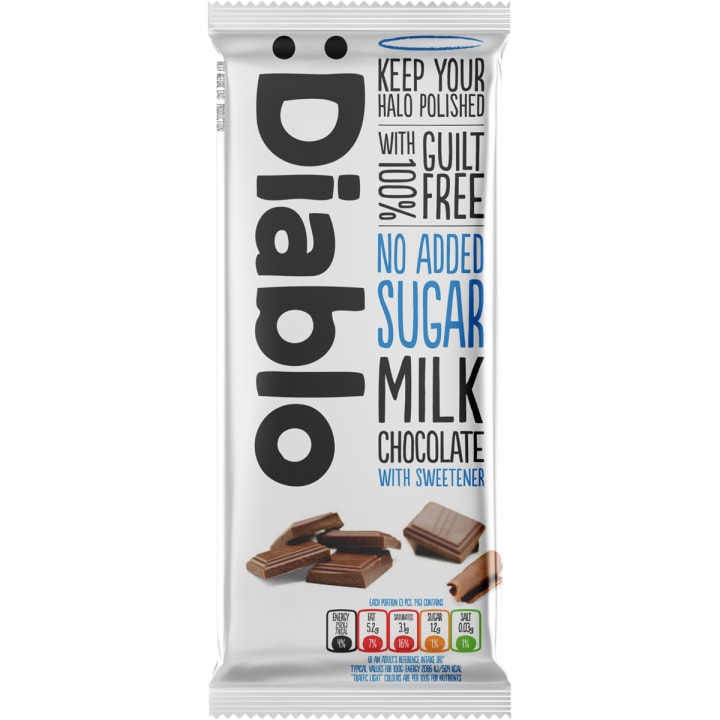 No Added Sugar
Milk Chocolate (85g)
A textbook example of the rule: all 6.7 g of sugars occur naturally in the milk powder. 58 g carbohydrate per 100 g. Contains milk and soya.
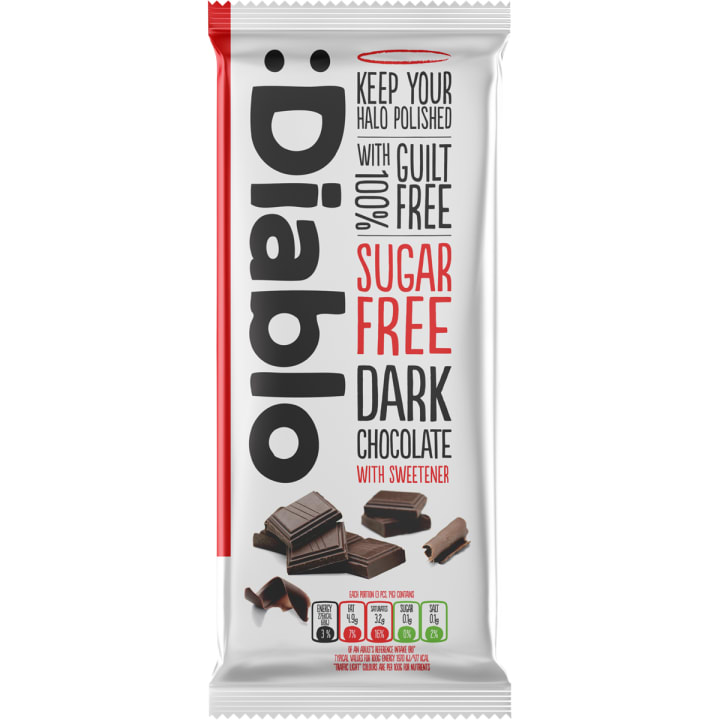 No Added Sugar
Dark Chocolate (85g)
Its sugars occur naturally in the cocoa, with maltitol first on the list ahead of cocoa mass. 47 g carbohydrate and 477 kcal per 100 g. Contains milk and soya.
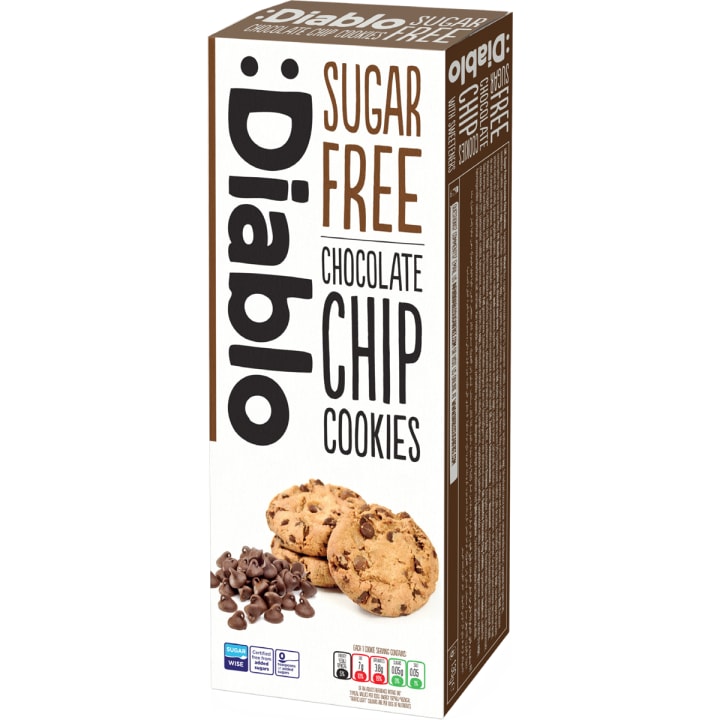 Sugar Free
Chocolate Chip Cookies (130g)
Maltitol sweetened chocolate drops at 20 percent through a wheat flour biscuit, so this one is not gluten free. Contains eggs, wheat and soya.
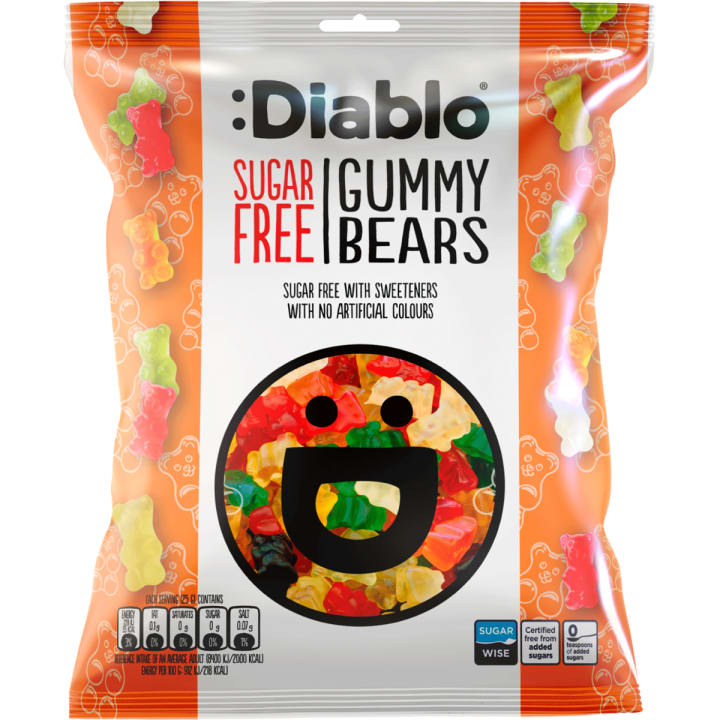 Sugar Free
Gummy Bears (75g)
Maltitol and sorbitol with steviol glycosides, coloured with fruit and vegetable concentrates. Contains gelatine. Dairy free and nut free by certificate.
How to Read a No Added Sugar Label in Three Steps
- Read the front claim, then park it. It tells you which rule the product is meeting, not what is in it
- Find the of which sugars line under total carbohydrate. Compare at 100 g rather than per serving, since serving sizes differ between brands
- Check the of which polyols line and the ingredients. Polyols count towards carbohydrate, and the ingredient list names the sweetener doing the work
A worked example. Two no added sugar yoghurts sit side by side. One lists 4.5 g of sugars per 100 g from milk and fruit, the other 0.4 g. Both are entitled to the words on the front. Only the panel tells you which is which.
Frequently Asked Questions
References and Sources
- Assimilated Regulation (EC) No 1924/2006 on nutrition and health claims made on foods. legislation.gov.uk
- GB nutrition and health claims register, Department of Health and Social Care.
- Food Standards Agency. Food labelling and packaging. food.gov.uk
- Diabetes UK. Understanding food labels. diabetes.org.uk
- NHS. Sugar: the facts. nhs.uk
- HM Revenue and Customs. Soft Drinks Industry Levy. gov.uk
- Diablo Sugar Free product specifications, August 2026.
Read the Panel, Then Choose
Every Diablo product page carries the full nutrition panel, the ingredient list and the allergen statement for that exact pack, in both ranges.
Shop Diablo Sugar FreeNo added sugar products contain naturally occurring sugars. Not a low calorie food.