 Chocolate Bars
 Dragees
 Cakes & Muffins
 Sweets & Gummies
 Cookies
 Dessert Sauces
 Wafers
 Spreads
 Muesli Bars
 Guilt-free Gifting
 Sales & Promotions

Monk Fruit vs Stevia: Which Sweetener Is Better?
Both are plant derived sweeteners hundreds of times sweeter than sugar, and on a UK shelf the choice is largely made for you: steviol glycosides from the stevia leaf are authorised for use in GB and EU food as E960, while monk fruit extract has not been authorised as a sweetener here. In the US both are permitted, so American labels carry the pair side by side.
That regulatory split is the single most useful fact in this comparison, and most write ups skip it. Here is how the two sweeteners actually differ, where each is allowed and where stevia shows up in our own range.
Stevia has carried the E number E960 on GB labels since 2011 and monk fruit extract has never been given one.
| Stevia (steviol glycosides) | Monk fruit (mogrosides) | |
|---|---|---|
| Sweetness compared with sugar | 200 to 400 times | 100 to 250 times, depending on mogroside content |
| Calories at the amounts used | Few or none | Few or none |
| E number | E960 | None |
| Status in GB and EU food | Authorised sweetener since 2011 | Extract not authorised as a sweetener. EFSA found the data insufficient to conclude on its safety as a food additive in 2019 |
| Novel food note | Covered by additive law as E960 | Non-selective water decoctions of the fruit are not a novel food in England and Wales (FSA, June 2024). The ruling stops at the decoction and authorises no sweetener extract |
| Acceptable daily intake | 4 mg per kg of body weight a day, as steviol equivalents | None specified by the FDA, and EFSA has set none |
| Authorised GB blood glucose claim | None | None |
| On a GB pack | Steviol glycosides or E960 in the ingredients, with ‘with sweetener(s)’ beside the name of the food | None, as it is not a permitted sweetener in GB |
| US status | High purity (95 percent minimum) steviol glycosides: GRAS notices the FDA has not questioned | Monk fruit extract: GRAS notices the FDA has not questioned |
| Where Diablo uses it | Gummy Bears, Cola Bottles and Gummy Drops (with maltitol and sorbitol); 75 g chocolate bars in 80 percent dark, white and milk with almonds, hazelnuts or crispy rice (maltitol with 0.02 percent steviol glycosides); also the Coated Milk Chocolate Buttons, Milk Chocolate Peanuts, Peanut Milk Chocolate Treats, Chocolate Delights Box and the 2026 advent calendar | Nowhere in the range |
Sources: sweetness, calories, intake note for monk fruit and US status from the FDA guide to sweeteners in food; stevia intake from the EFSA 2010 steviol glycosides opinion; monk fruit extract from the EFSA 2019 monk fruit extract opinion; decoction status from the Food Standards Agency determination; E960 from Regulation (EU) No 1131/2011; pack wording from Annex III of Regulation (EU) No 1169/2011.
What is stevia?
Stevia sweeteners are steviol glycosides, sweet compounds extracted from the leaves of Stevia rebaudiana, a South American plant. They are roughly 200 to 300 times sweeter than sugar, contribute no meaningful calories at the doses used and appear on UK ingredient lists as steviol glycosides or E960. Because a bar's worth of sweetness fits on the tip of a teaspoon, stevia is nearly always paired with a bulk ingredient in solid food, a partnership we unpack in what is stevia.
What is monk fruit?
Monk fruit, or luo han guo, is a small round gourd grown mainly in southern China. Its extract owes its sweetness to compounds called mogrosides, with mogroside V the headline act, and lands in a similar intensity band to stevia at a few hundred times the sweetness of sugar. In the United States, monk fruit extract has been used in food for years under GRAS status, the US system for ingredients generally recognised as safe, which is why American sugar free products feature it freely.
Why can you not buy monk fruit sweetened products in the UK?
Because the extract has never been authorised as a sweetener for the GB or EU market. Food additives here need a positive authorisation before use, and monk fruit extract is still working its way through that process. Until that changes, a monk fruit product you see online from a US seller is playing by American rules, not British ones. Stevia cleared the same hurdle back in 2011, which is why E960 is now routine on UK labels.
How do they compare in use?
In the kitchen the two behave similarly: intense sweetness, no bulk, so both need a partner ingredient to replace sugar's body in baking or chocolate. On taste, stevia can carry a liquorice edge at high doses, which good formulation keeps below the threshold you would notice, while monk fruit is often described as having a gentler, fruitier finish. Neither browns nor caramelises the way sugar does. On the label, stevia shows as E960 in the UK; monk fruit extract, where it is permitted, typically appears by name.
Where stevia appears in the Diablo range
We use steviol glycosides where they genuinely improve the recipe, always alongside a bulk sweetener that gives the product its body:
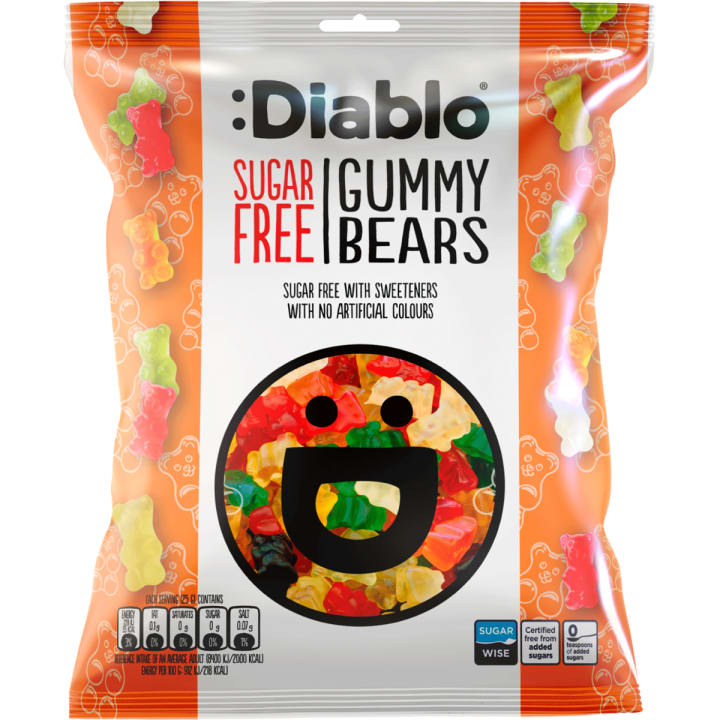
Steviol glycosides with maltitol and sorbitol: 0.1 g sugars per 100 g, with real fruit and vegetable concentrates for colour
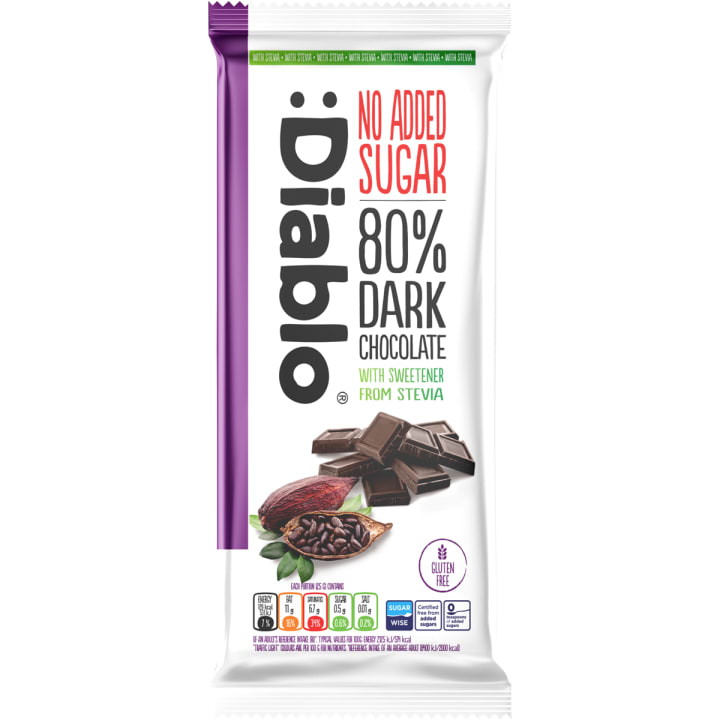
No Added Sugar 80% Dark Chocolate
Maltitol with steviol glycosides: 1.1 g sugars per 100 g, occurring naturally in all that cocoa
Not a low calorie food. See nutrition information for sugar and calorie content.
The pairing is the point. Stevia brings intensity. Polyols, the family of bulk sweeteners that maltitol and sorbitol belong to, bring body, and the nutrition table keeps the sugars line honest. The rest of the sweetener family is covered in our guide to sugar alcohols.
Try the stevia sweetened gummies
Frequently asked questions
Is monk fruit legal in the UK?
Monk fruit extract has not been authorised as a sweetener for GB or EU food, so UK made products do not use it. In the United States it holds generally recognised as safe (GRAS) status and is widely used. The fruit itself has a long history in Chinese cooking; it is the extract as a food additive that needs authorisation here.
Is stevia natural?
Steviol glycosides start in the leaves of the stevia plant and are extracted and purified before use in food, in the same way sugar is extracted from beet or cane. On a UK label they appear as steviol glycosides or E960.
Which one does Diablo use?
Stevia. Our gummies pair steviol glycosides with the bulk sweeteners maltitol and sorbitol, and our 80 percent dark chocolate blends maltitol with steviol glycosides. Monk fruit does not appear in the range because it is not an authorised sweetener for the UK market.