 Chocolate Bars
 Dragees
 Cakes & Muffins
 Sweets & Gummies
 Cookies
 Dessert Sauces
 Wafers
 Spreads
 Muesli Bars
 Guilt-free Gifting
 Sales & Promotions

How Much Sugar Is in a Candy Bar?
A full size American candy bar carries roughly 22 to 36 grams of total sugars, which works out at 5 to 9 teaspoons. The exact figure depends on the recipe and on how heavy the bar is.
- 01The lowest of the eight bars below is Reese's Peanut Butter Cups at 22 g of total sugars in a 42 g serving
- 02The highest is 3 Musketeers at 36 g of total sugars in a 54 g bar
- 03Peanuts, wafer and cookie layers take up room that would otherwise be sugar. Nougat and caramel centers do not
- 04The American Heart Association ceiling for added sugars is 25 g a day for women and 36 g for men
- 05Chocolate made with polyols instead of sugar reports different numbers. Diablo No Added Sugar Dark Chocolate lists 0.5 g of naturally occurring sugars per 100 g
A candy bar is gone in about a minute, and the wrapper rarely gets read. The figures below come off the Nutrition Facts panels of eight bars most Americans could name.
The gap between the lightest and the heaviest is 14 grams of sugar, roughly half a day's allowance for one adult.
Every figure in the table is taken from the current US Nutrition Facts panel for that product, at the serving size the panel states. Manufacturers reformulate, so the wrapper in your hand is the final word. This page is general nutrition information rather than medical advice.
Total Sugars and Added Sugars Are Two Different Lines
Since 2020 the US panel has carried both. Total sugars counts everything in the food, including the lactose that arrives with milk. Added sugars counts only what went in during manufacture: sucrose, corn syrup, dextrose and the rest.
In a milk chocolate bar the two lines sit a few grams apart, and that gap is the milk. In a nougat bar they are almost identical. The added sugars line is the one the daily limits are written against.
Sugar in Eight Well Known Candy Bars
Ranked from the least total sugars to the most, at the serving size printed on each panel.
| Candy bar | Serving on the panel | Calories | Total sugars | Added sugars | Total sugars per 100 g |
|---|---|---|---|---|---|
| Reese's Peanut Butter Cups | 2 cups, 42 g | 210 | 22 g | 20 g | 52 g |
| Kit Kat | 1 package, 42 g | 210 | 23 g | 22 g | 55 g |
| Hershey's Milk Chocolate | 1 bar, 43 g | 220 | 25 g | 21 g | 58 g |
| Twix | 2 cookie bars, 50.7 g | 250 | 25 g | 23 g | 49 g |
| Snickers | 1 bar, 52.7 g | 250 | 28 g | 26 g | 53 g |
| M&M's Milk Chocolate | 1 pack, 47.9 g | 230 | 31 g | 29 g | 65 g |
| Milky Way | 1 bar, 52.2 g | 240 | 32 g | 29 g | 61 g |
| 3 Musketeers | 1 bar, 54.4 g | 240 | 36 g | 35 g | 66 g |
Source: current US Nutrition Facts panels for each product. The final column is calculated from the panel figures so bars of different weights can be compared like for like. Recipes and pack sizes change, so check the wrapper.
What Moves the Number Inside the Bar
The pattern in that table is a physical one. Peanuts, wafer and a cookie layer occupy space and bring fat and protein with them, so the sugar share falls. Whipped nougat and caramel are mostly sugar by weight, so the bars built on them finish at the top.
How That Compares With the Daily Limits
| Authority | Daily limit for added sugars | Note |
|---|---|---|
| American Heart Association | 25 g for women, 36 g for men | About 6 teaspoons and 9 teaspoons |
| World Health Organization | Under 10 percent of daily energy, ideally under 5 percent | Roughly 50 g and 25 g on a 2,000 calorie day |
| Dietary Guidelines for Americans | Under 10 percent of daily calories | An upper limit rather than a target |
Sources: American Heart Association, World Health Organization guideline on sugars intake, Dietary Guidelines for Americans.
One 3 Musketeers bar carries 35 g of added sugars, which is close to the whole American Heart Association allowance for a man in a bar weighing under two ounces. The lightest entry, a Reese's two cup serving at 20 g, still uses four fifths of the allowance for a woman.
The Serving Size Line People Skip
The sugar figure only means something once you know what it is counting. Three checks take five seconds each.
- Read the serving size before the sugar number. A share size wrapper often prints two or three servings
- Count the pieces you will actually eat, then multiply. Fun size bars are printed per piece, and three of them is not a small portion
- Compare bars at the same weight. A per 100 g figure, as in the last column above, is the only way to see which recipe is sweeter
Where a No Added Sugar Bar Sits
Chocolate can be made with polyols, also called sugar alcohols, in place of sugar. Maltitol is the common one because it behaves like sugar in a mold: it sets hard, snaps cleanly and melts at body temperature. The sugars line on the panel then reads very differently.
Polyols are absorbed slowly and only in part, which is exactly why they contribute less energy than sugar. Diablo packs carry a note that excessive consumption may produce laxative effects, which is standard on polyol sweetened confectionery. Start with two or three squares and most people settle in quickly.
Figures below are per 100 g from our product specifications. Each pack states the same data per serving.
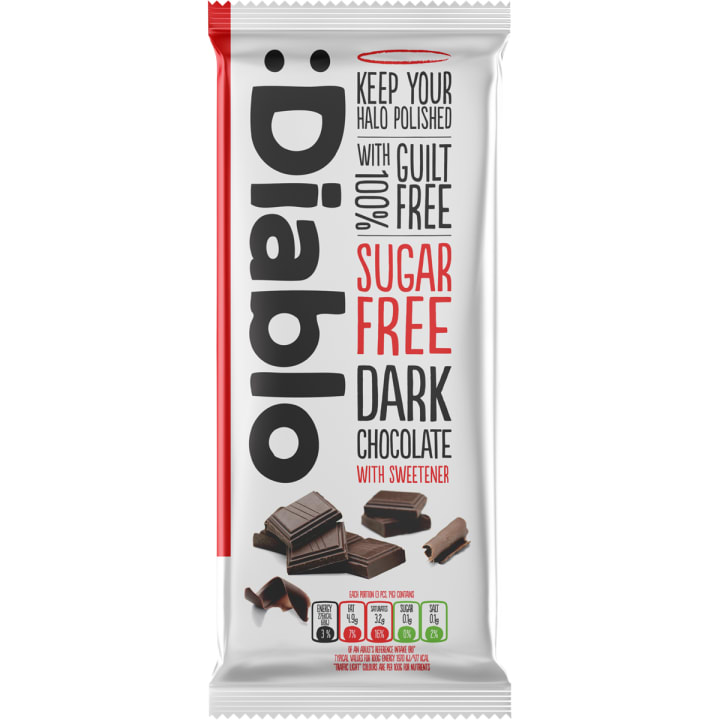 No Added Sugar
No Added Sugar Dark Chocolate 85 g
Maltitol first on the ingredient list, then cocoa mass and cocoa butter. 47 g total carbohydrate and 477 kcal per 100 g. The sugars occur naturally in the cocoa. Contains milk and soy.
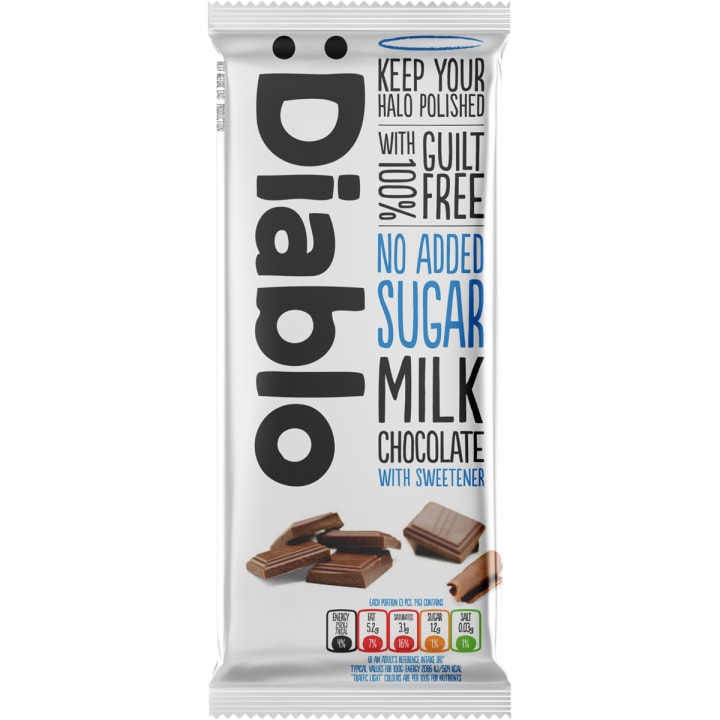 No Added Sugar
Milk Chocolate (85g)
All 6.7 g of sugars occur naturally in the milk powder, with nothing added on top. 58 g total carbohydrate per 100 g. Contains milk and soy.
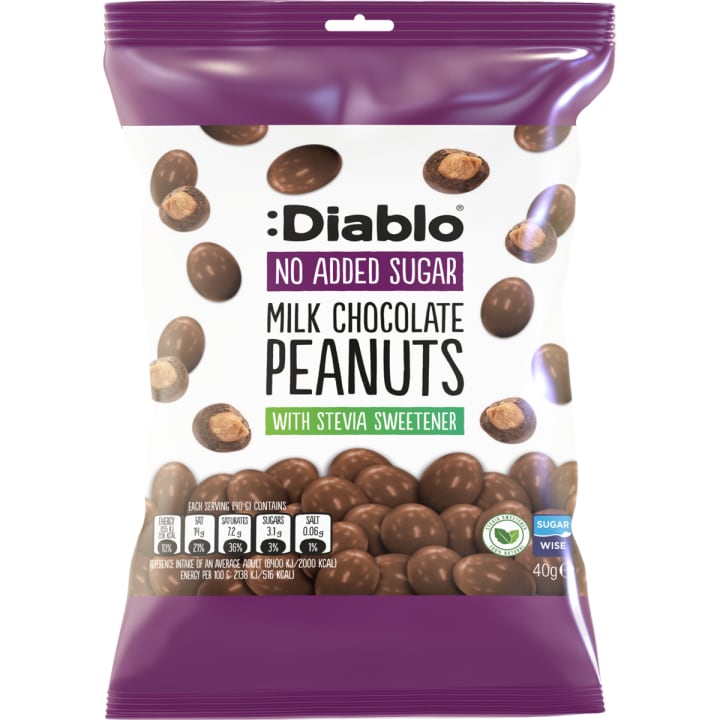 No Added Sugar
Milk Chocolate Peanuts (40g)
Roasted peanuts at 30 percent, coated in maltitol sweetened milk chocolate. 35 g total carbohydrate, 29 g polyols and 519 kcal per 100 g. Contains milk, peanuts and soy.
Put the two milk chocolates side by side at the same weight and the comparison is plain. The Hershey's bar works out at 58 g of total sugars per 100 g. The Diablo milk chocolate reads 6.7 g, all of it from milk powder, with 49.87 g of polyols doing the sweetening.
Frequently Asked Questions
References and Sources
- Current US Nutrition Facts panels for each product listed in the table.
- American Heart Association. Added Sugars. heart.org
- World Health Organization. Guideline: Sugars Intake for Adults and Children. who.int
- US Department of Agriculture and US Department of Health and Human Services. Dietary Guidelines for Americans. dietaryguidelines.gov
- USDA FoodData Central. Branded Food Products Database. fdc.nal.usda.gov
- Diablo Sugar Free product specifications, August 2026.
The Same Bar Shape, a Different Sugars Line
Diablo chocolate is made with polyols in place of sugar. Every product page carries the full panel, the ingredient list and the allergen statement for that exact bar.
Shop Diablo chocolate barsNot a low calorie food. See the nutrition information for sugar and calorie content.