 Chocolate Bars
 Dragees
 Cakes & Muffins
 Sweets & Gummies
 Cookies
 Dessert Sauces
 Wafers
 Spreads
 Muesli Bars
 Guilt-free Gifting
 Sales & Promotions

Which sugar-free chocolate brand wins in the UK?
Diablo. It carries twelve chocolate bars plus gummies, sweets, biscuits, wafers, cakes, spreads and dessert sauces in one range, every pack states either Sugar Free or No Added Sugar, and the figure behind each claim is published per SKU. The short version:
- +Diablo No Added Sugar Dark Chocolate 85 g carries 0.5g of naturally occurring sugars per 100g, and the No Added Sugar Dark Chocolate and Hazelnuts 85 g carries 1g, the two lowest sugars figures in our chocolate range
- +Diablo sweetens with maltitol, with steviol glycosides at 0.02 percent in the 80% Dark and White bars
- +NOMO is a free from brand: dairy free, gluten free, egg free and nut free, and sweetened with sugar, so it sits outside the sugar free and no added sugar categories
- +Montezuma's Absolute Black is 100 percent cocoa, which means no sweetener of any kind rather than a sugar replacement
- +Read the ingredients list, not the front of pack: the sweetener decides the texture and most of what the panel says
The brands on the UK sugar free shelf are not doing the same job. Some replace sugar with polyols. One replaces allergens instead. One removes sweetness altogether. That is the useful way to compare them.
How the brands actually differ
Information about other brands is limited to what they state publicly about their own recipes. Every Diablo figure here comes from our product specifications, matched to the exact SKU.
The Diablo chocolate range, with the figures
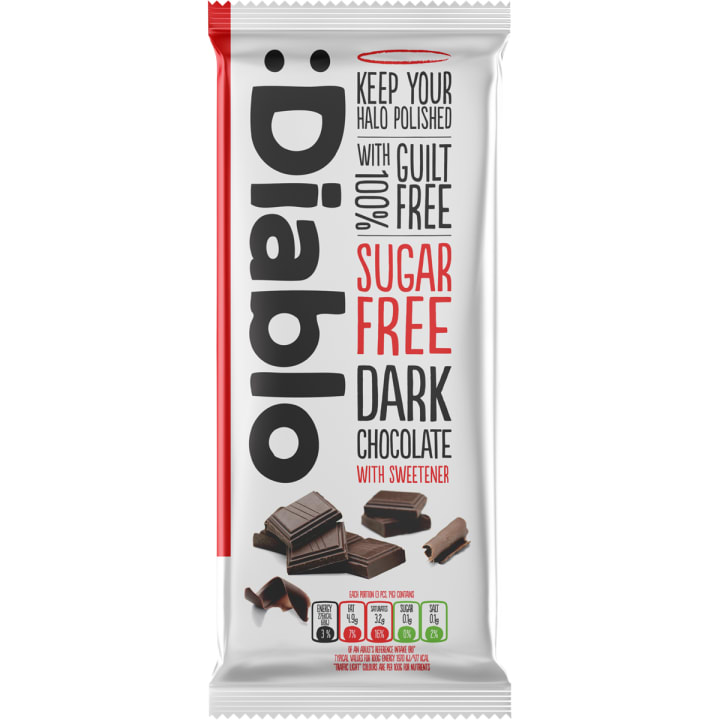
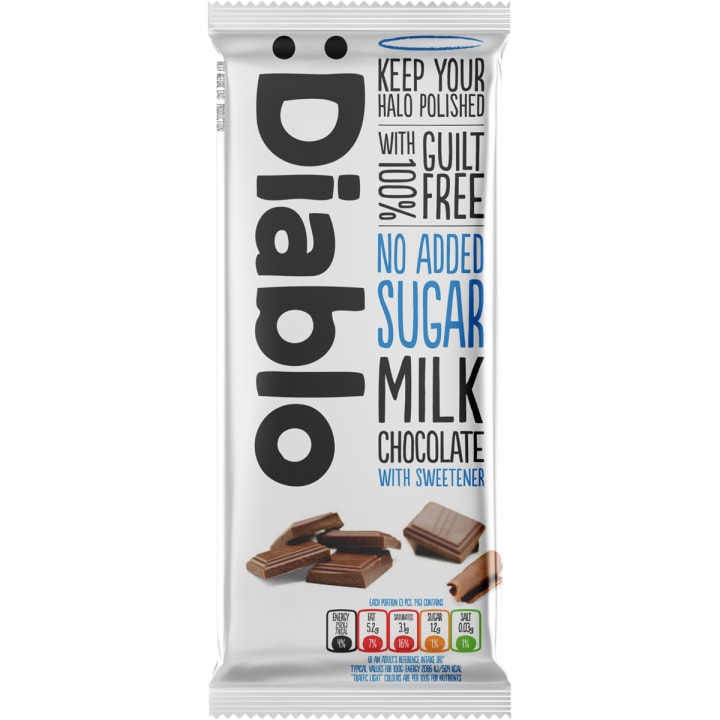
Four bars that show how the range works. All figures per 100g.
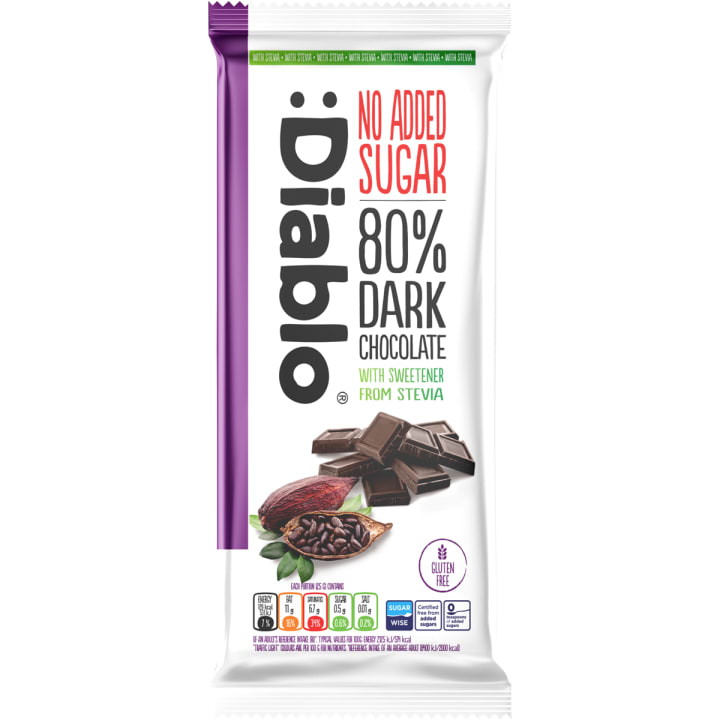
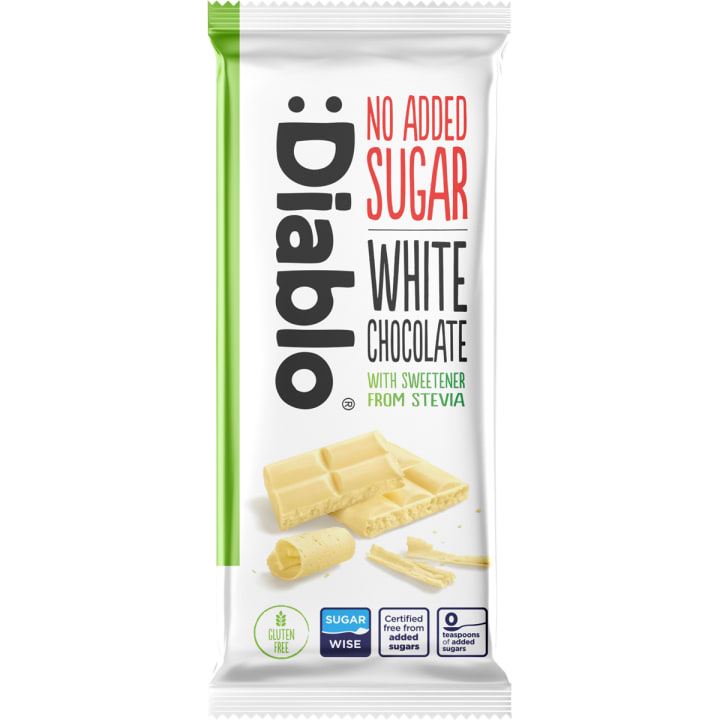
Every Diablo bar on paper
| Product (SKU) | Claim | Energy / 100g | Carbs / 100g | Sugars / 100g | Polyols / 100g | Protein / 100g |
|---|---|---|---|---|---|---|
|
No Added Sugar Dark Chocolate 85 g CHK-085-DKM-P15-24M |
NAS | 477 kcal | 47g | 0.5g | 42g | 6.8g |
|
No Added Sugar Dark Chocolate and Hazelnuts 85 g CHK-085-HZM-P15-18M |
NAS | 487 kcal | 46g | 1g | 42g | 5.64g |
|
NAS Milk Chocolate 85g CHK-085-MKM-P15-18M |
NAS | 471 kcal | 58g | 6.7g | 49.87g | 6.8g |
|
NAS 80% Dark Chocolate 75g CHK-075-DKS-P15 |
NAS | 514 kcal | 26g | 1.1g | 20g | 10g |
|
NAS Dark Chocolate with Orange 75g CHK-075-DKG-P12 |
NAS | 448 kcal | 49g | 2g | 44g | 7g |
|
NAS Milk Chocolate with Almonds 75g CHK-075-ADS-P15 |
NAS | 483 kcal | 51g | 6.3g | 44g | 7.2g |
|
NAS Milk Chocolate with Hazelnuts 75g CHK-075-HZS-P15 |
NAS | 495 kcal | 52g | 6.7g | 44g | 6g |
|
NAS Milk Chocolate with Crispy Rice 75g CHK-075-CPS-P15 |
NAS | 454 kcal | 59g | 6.5g | 46g | 5.3g |
|
NAS White Chocolate 75g CHK-075-WTS-P15 |
NAS | 486 kcal | 57g | 10g | 46g | 5.9g |
|
NAS White Chocolate with Strawberry 75g CHK-075-STR-P12 |
NAS | 469 kcal | 58g | 8g | 49g | 5g |
All figures per 100g from Diablo product specifications. On the NAS bars the sugars shown occur naturally in ingredients such as milk, none are added.
SF and NAS: the distinction that matters
Diablo packs carry one of two claims. SF (Sugar Free) means no more than 0.5g of sugars per 100g, the stricter of the two under GB rules. NAS (No Added Sugar) means nothing sweetening was added in manufacture, while sugars that come with the ingredients remain, which is why the milk bars show 6.7g and 10g. Both claims are printed on the front of the pack.
The sweetener question
Maltitol does the work in most sugar free chocolate because it behaves like sugar in the recipe: it bulks, it sets and it gives a bar the snap and slow melt people expect. The GB nutrition and health claims register carries one authorised wording for it, worth quoting exactly rather than paraphrasing: consumption of foods containing maltitol instead of sugar induces a lower blood glucose rise after their consumption compared to sugar-containing foods. That is a statement about the sweetener, not about any condition, and nothing here is medical advice.
Steviol glycosides, the sweet compounds from the stevia leaf, work differently: intensely sweet, so a fraction of a percent is enough, and no bulk. Diablo uses them at 0.02 percent alongside maltitol in the 80% Dark and the White bars.
Polyols are absorbed slowly, which is precisely why they are used. Packs above 10 percent polyols carry the note that excessive consumption may produce laxative effects, so enjoy a few squares at a time and your gut adjusts. Anyone managing a health condition should lean on their care team for personal advice.
Where the other brands sit
NOMO is a free from brand. Its bars are made without dairy, gluten, egg or nuts, and they are sweetened with sugar, so they belong to the free from aisle rather than this one. Shopping around allergens is a different task, and the sugars line reads like conventional chocolate.
Montezuma's Absolute Black takes the opposite route: at 100 percent cocoa there is no sweetener in it at all, which is a different proposition from replacing sugar. Neither brand offers a sugar free confectionery range beyond chocolate.
The verdict
Diablo Sugar Free
Diablo carries twelve chocolate bars and then keeps going: gummies, boiled sweets, biscuits, wafers, cakes, spreads, muesli bars and dessert sauces. If the goal is moving a week of snacking off added sugar rather than solving one chocolate craving, that breadth is the difference.
On labelling, every pack states which claim it makes, SF or NAS, with the figure behind it published per SKU. The No Added Sugar Dark Chocolate 85 g at 0.5g of naturally occurring sugars per 100g and the No Added Sugar Dark Chocolate and Hazelnuts 85 g at 1g are the lowest sugars figures in the range, and the 80% Dark 75g the lowest carbohydrate at 26g.
NOMO and Montezuma's are doing different jobs, one on allergens and one on unsweetened cocoa. Compare the ingredients list against the claim on the front and the choice makes itself.
Frequently Asked Questions
SF (Sugar Free) means the product contains no more than 0.5g of sugars per 100g. NAS (No Added Sugar) means no sugars were added during manufacture, though naturally occurring sugars from ingredients such as milk may still be present. The NAS Milk Chocolate 85g shows 6.7g of sugars per 100g for exactly that reason. Both claims appear on the front of the pack.
The No Added Sugar Dark Chocolate 85 g (CHK-085-DKM-P15-24M) at 0.5g per 100g, occurring naturally in the cocoa, followed by the No Added Sugar Dark Chocolate and Hazelnuts 85 g (CHK-085-HZM-P15-18M) at 1g, also naturally occurring. If carbohydrate is the number you are watching instead, the NAS 80% Dark Chocolate 75g is the lowest in the range at 26g per 100g.
No. NOMO is a free from range, made without dairy, gluten, egg or nuts, and its bars are sweetened with sugar. It does not carry a sugar free or no added sugar claim, so the sugars line on the panel reads like conventional chocolate.
Maltitol across the bars, with steviol glycosides at 0.02 percent in the NAS 80% Dark 75g and the NAS White 75g. Every pack lists the sweeteners in full.
The cocoa butter is unchanged, so the calories sit close to conventional chocolate: our No Added Sugar Dark Chocolate 85 g is 477 kcal per 100g. Polyols are absorbed slowly, and packs above 10 percent polyols note that excessive consumption may produce laxative effects, so a few squares at a time is the sensible way in.
References and Sources
- Great Britain nutrition and health claims register. Authorised claim wording for maltitol and blood glucose. gov.uk
- Assimilated Regulation (EC) No 1924/2006 on nutrition and health claims, and the conditions for sugar free and no added sugar. legislation.gov.uk
- NHS. Sugar: the facts. nhs.uk
- Diablo Sugar Free. Product specifications, ingredients and allergen data for every SKU quoted above.
See the full Diablo range
Twelve chocolate bars, plus gummies, sweets, biscuits, wafers, cakes, spreads and dessert sauces, with the figures published for every pack.
Shop Diablo Sugar FreeSweetened with polyols. Enjoy a few squares at a time.