 Chocolate Bars
 Dragees
 Cakes & Muffins
 Sweets & Gummies
 Cookies
 Dessert Sauces
 Wafers
 Spreads
 Muesli Bars
 Guilt-free Gifting
 Sales & Promotions

How to choose sugar free candy
Turn the bag over and read three things: the sweetener, the sugars figure and the carbohydrate figure, which includes any polyols. In the US a candy can only say sugar free at less than 0.5 g of sugars per serving. Hard candy, chewy candy and gummies behave differently, so match the format to the craving first. Here is where the Diablo bags land.
- +Hard candy. Mint and Cream Sweets, 0.4 g sugars per 100 g, built on isomalt
- +Filled hard candy. Butter Filled with Chocolate, 0.5 g sugars per 100 g, chocolate at 15 percent
- +Chewy. Sugar Free Toffees, 0.2 g sugars per 100 g
- +Gummies. Gummy Bears at 0.1 g and Cola Bottles at 0.2 g sugars per 100 g
Sugar free candy used to mean a harsh aspartame finish and a texture that gave the game away. Most of the category has moved on to polyols and plant sweeteners. The front of the bag has not, and it still tells you far less than the panel on the back.
Sugar free and no added sugar are claims about sugar, not about calories. Not a low calorie food. See nutrition information for sugar and calorie content. Every figure on this page comes from Certificate of Analysis data for that exact pack, stated per 100 g so bags of different sizes can be compared.
What counts as sugar free candy in the US?
The FDA allows the sugar free claim only where a food holds less than 0.5 g of sugars per serving, with no sugar ingredient added. That is a rule about sugars, not carbohydrate: most sugar free candy replaces the sugar with polyols, which still count inside the carbohydrate figure and are printed on their own line beneath it.
No added sugar is a different claim. It means nothing sweetening went in during manufacture, while naturally occurring sugars from milk, fruit or cocoa can remain.
What should you check before you buy?
The sweetener
Ingredients run in order of weight, so the first sweetener named is the one doing the work. Isomalt sets glassy for hard candy. Maltitol keeps chew in a toffee.
The sugars line
Read it per 100 g as well as per serving. Under 0.5 g per serving is the bar a candy has to clear to say sugar free.
The carbohydrate line
A hard candy is almost entirely sweetener, so carbohydrate figures near 90 g per 100 g are normal. Most of it is polyol, listed underneath.
Texture
Isomalt dissolves slowly and stays clear. Maltitol syrup gives chew. Gummies need gelatin or pectin, so check which one if that matters to you.
Price per 100 g
Compare per 100 g or per ounce rather than per bag. Bag weights across this category vary more than the shelf price suggests.
Polyols are the sugar alcohols that replace sugar in most sugar free candy: isomalt, maltitol, sorbitol. They are absorbed slowly, which is exactly the point, and the GB nutrition and health claims register carries this authorized wording for maltitol: "Consumption of foods/drinks containing maltitol instead of sugar induces a lower blood glucose rise after their consumption compared to sugar-containing foods/drinks." Packs over 10 percent polyols note that excessive consumption may produce laxative effects. A few pieces at a time and your gut adjusts.
Which Diablo candy suits which craving?
Five bags, five different jobs. All figures per 100 g.

A classic mint hard candy built on isomalt, with real cream at 6 percent to soften the edge. It dissolves slowly rather than shattering, so one piece lasts, and a 4.2 g piece works out at roughly 12 calories. Contains milk and soy.

A butter candy shell with a chocolate center at 15 percent of the piece, so it eats in two stages. Nothing sweetening is added, and the 0.5 g of sugars per 100 g occur naturally in the dairy. Contains milk and soy.

The chewy option, in orange, mandarin, strawberry and cherry. Maltitol syrup carries the chew that isomalt cannot, with sorbitol keeping the pieces soft in the bag. Made with gelatin, so it is not a vegetarian candy.
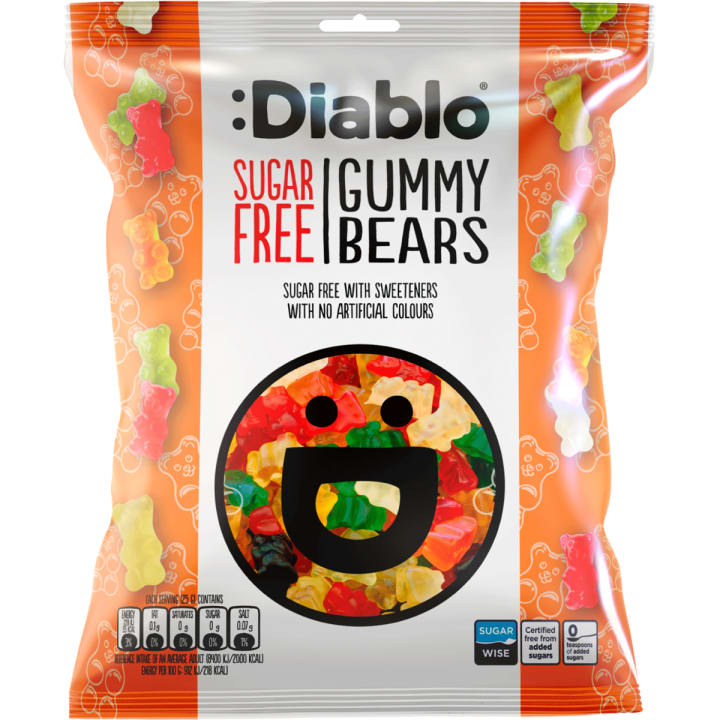
The lowest sugars figure in the Diablo candy range, and the lowest energy figure of any bag on this page. Maltitol and sorbitol do the sweetening, with a little stevia leaf extract, and the color comes from apple, carrot, pumpkin and blackcurrant concentrates. Made with gelatin.

The same gummy base in the shape everyone raided the pick and mix for, with carrot, apple and hibiscus concentrates doing the color. Firmer than a bear, so a handful lasts longer. Made with gelatin.
How does the Diablo candy range compare?
| Candy | Claim | First sweetener | Sugars | Carbohydrate | Energy |
|---|---|---|---|---|---|
| Gummy Bears 75 g | Sugar Free | Maltitol | 0.1 g | 78 g | 219 kcal |
| Cola Bottles 75 g | Sugar Free | Maltitol | 0.2 g | 78 g | 220 kcal |
| Toffees 75 g | Sugar Free | Maltitol syrup | 0.2 g | 84.1 g | 284 kcal |
| Mint and Cream Sweets 75 g | Sugar Free | Isomalt | 0.4 g | 87.5 g | 295 kcal |
| Strawberry and Cream Sweets 75 g | Sugar Free | Isomalt | 0.5 g | 87.4 g | 294 kcal |
| Lemon and Cream Sweets 75 g | Sugar Free | Isomalt | 0.5 g | 91.5 g | 269 kcal |
| Butter Sweets 75 g | Sugar Free | Isomalt | 0.5 g | 91.8 g | 269 kcal |
| Cappuccino and Cream Sweets 75 g | Sugar Free | Isomalt | 0.5 g | 91.1 g | 268 kcal |
| Butter Filled with Chocolate 75 g | No Added Sugar | Isomalt | 0.5 g | 84.4 g | 299 kcal |
Per 100 g, from Diablo Certificate of Analysis data. The cream candies contain milk and soy, and the cappuccino candy contains caffeine at 27 mg per 100 g.
What is actually sweetening your candy?
| Sweetener | What it is | What it does |
|---|---|---|
| Isomalt | A polyol made from beet sugar | Sets glassy and dissolves slowly, which is why it runs the hard candy category |
| Maltitol | A polyol made from starch | Closest of the polyols to sugar in behavior, so it carries chew in toffees and gummies |
| Steviol glycosides | Extract of the stevia leaf | Intensely sweet, so a trace finishes the sweetness in our gummies |
What else is on the US shelf?
Other brands sell sugar free versions of their classics, Werther's Original and Jolly Rancher among the names you will pass in the candy aisle. Their recipes differ, which is why the label reading above matters more than the front of the bag. Find the sweetener, the sugars figure and the carbohydrate line, then compare per 100 g.
Diablo makes candy, chocolate, cookies and wafers sweetened with polyols instead of sugar. Sugar Free products hold a maximum of 0.5 g of sugars per 100 g. No Added Sugar products have none added, with naturally occurring sugars remaining. Packs containing polyols note that excessive consumption may produce laxative effects.
Frequently Asked Questions
References and Sources
- FDA. Food labeling: nutrient content claims, sugar free and no added sugars. eCFR 21 CFR 101.60
- FDA. Aspartame and other sweeteners in food. fda.gov
- GB nutrition and health claims register. Authorized claim wording for maltitol and other polyols. gov.uk
- Diablo Sugar Free. Certificate of Analysis nutritional data for every SKU quoted on this page.
See the whole candy range
Every Diablo bag, with the sugars, polyols and carbohydrate figures on each product page.
Shop Diablo sugar free candySweetened with polyols. Excessive consumption may produce laxative effects.