 Schokoladentafeln
 Dragees
 Kuchen & Muffins
 Süßigkeiten & Fruchtgummis
 Cookies
 Dessertsaucen
 Pralinenschachteln
 Waffeln
 Aufstriche
 Müsliriegel
 Geschenkkörbe
 Verkauf & Sonderangebote

Isomalt is a polyol, a sweetener built from ordinary sugar in two steps. It tastes about half as sweet as sugar, the label counts it at 2.4 kcal per gram instead of 4 and it sets hard and clear. That last part is why it turns up in boiled sweets more than anywhere else.
Ours, if you would rather taste it than read about it:

What is isomalt made from?
Sugar. Beet sugar, usually. The first step swaps one of the bonds in the sucrose molecule using an enzyme, which gives a different sugar called isomaltulose. The second step adds hydrogen to that, and the result is isomalt, which is no longer a sugar at all in the eyes of the nutrition panel.
Because it started as sugar it still bulks, browns and pours like sugar. The hydrogenation step is what changes the rest: the body handles it slowly, and the label files it under polyols, one line below the sugars.
How sweet is isomalt compared with sugar?
Isomalt sweetens at roughly 45 to 60 percent of sugar's strength, depending on concentration and on what else is in the recipe. Call it half.
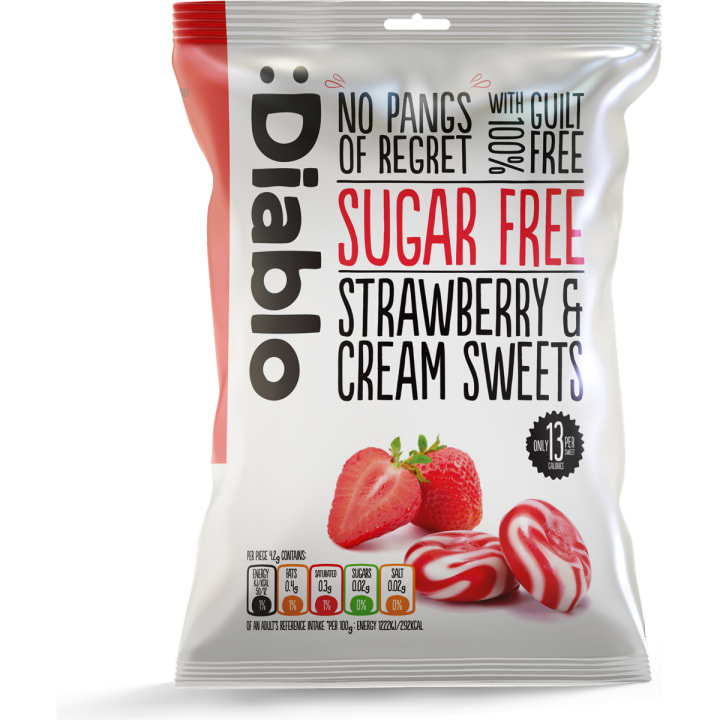
Half is not enough on its own, which is why isomalt almost never works alone. In our Butter Sweets the ingredient list reads isomalt, water, butter, milk cream, flavouring, salt, then near the end a second sweetener called acesulfame K, topping the sweetness back up to where a sweet should be. In the Strawberry and Cream sweets maltitol syrup sits alongside the isomalt from the start. Isomalt is there for body and set. The last of the sweetness comes from elsewhere.
Why does isomalt end up in hard sweets rather than chocolate?
Because of water, mostly. Isomalt picks up very little moisture from the air, which is the property a boiled sweet needs more than any other. A hard sweet that absorbs moisture goes tacky, then cloudy, then welds itself to the next one in the bag.
It also melts at around 145 to 150 degrees and does not brown on the way, so a clear sweet stays clear and a pale one stays pale. Our sweets are made in Greece and carry a 24 month shelf life. The storage line on the back asks for a cool dry place, ideally 15 degrees and no warmer than 25.
Chocolate has the opposite problem. It needs a sweetener that behaves in fat, not water, which is why our chocolate runs on maltitol instead. In our toffees maltitol syrup leads the recipe and isomalt comes second, because a toffee has to bend and a boiled sweet has to shatter.
What does isomalt do to the nutrition panel?
Isomalt moves almost all of the carbohydrate out of the sugars line into the polyols line underneath, and the polyols line is then counted at a lower energy value.
UK labelling law sets the conversion factors a manufacturer has to use. Carbohydrate other than polyols counts at 4 kcal per gram. Polyols count at 2.4 kcal per gram, a figure written into Annex XIV of the assimilated Food Information Regulation.
On our Butter Sweets that arithmetic lands at 91.3 g of polyols, 0.5 g of sugars and 269 kcal per 100 g. A UK sugar free claim needs sugars at or below 0.5 g per 100 g, and polyols are not counted as sugars for that test.
Is isomalt the same thing as maltitol?
Isomalt and maltitol are different sweeteners out of the same chemical family. Both come off a hydrogenation line, and after that they part company. Maltitol is sweeter, close enough to sugar to carry a chocolate on its own. Isomalt is less sweet and far more stubborn about moisture, which suits anything that has to set hard and stay that way.
Polyols as a family share one thing the body does with them: they are absorbed slowly and incompletely. That slow absorption is what makes the blood glucose rise after them lower than after sugar. It is also why a handful at a time suits them better than a whole bag at once. Great Britain has authorised one specific form of words for this, hung on the ingredient and not on the product:
Consumption of foods/drinks containing isomalt instead of sugar induces a lower blood glucose rise after their consumption compared to sugar-containing foods/drinks.
Authorised claim wording, GB nutrition and health claims register
Sugars in our sugar free sweets sit at 0.5 g per 100 g or below because the sweetening work is done by polyols. The butter sweets filled with chocolate sit in our No Added Sugar range instead, which is a separate claim with its own conditions. The Annex to the assimilated nutrition and health claims Regulation sets that 0.5 g threshold. It applies whichever sweetener a manufacturer reaches for.
Frequently asked questions
Is isomalt natural?
It starts as ordinary beet sugar and is changed by an enzyme and then by hydrogen. Small amounts of isomaltulose, the halfway stage, occur in honey and sugar cane juice. Isomalt itself is made in a factory, so it is best described as sugar derived rather than naturally occurring.
Does isomalt count towards the carbohydrate on a label?
Yes. It sits inside the carbohydrate total and then gets its own polyols line underneath, so a pack can show 91.8 g of carbohydrate and 0.5 g of sugars at the same time. The polyols line is where the rest of it has gone.
Why does the pack say excessive consumption may produce laxative effects?
UK law requires that line on any food with more than 10 percent polyols, so it appears on most sugar free confectionery. It follows directly from the slow absorption that also gives polyols their lower glucose rise. A few sweets at a time is the sensible way to enjoy them.
Is isomalt suitable if you avoid gluten?
Isomalt is made from sugar, so the ingredient carries no gluten. Whether a finished sweet is gluten free depends on the rest of the recipe and the factory, which is why our Butter Sweets are certified gluten free while our toffees state may contain gluten on the pack. Read the pack, not the sweetener.
Isomalt is the part of a sugar free sweet nobody tastes. It sets the thing hard, keeps the bag from turning into one lump and leaves the sugars line at 0.5 g. The flavour is somebody else's job.