 Schokoladentafeln
 Dragees
 Kuchen & Muffins
 Süßigkeiten & Fruchtgummis
 Cookies
 Dessertsaucen
 Waffeln
 Aufstriche
 Müsliriegel
 Geschenkkörbe
 Verkauf & Sonderangebote

Best Sugar Free Chocolate Bars in the UK: 2026 Guide
The best sugar free chocolate bar is the one whose panel backs its front label. In GB sugar free means 0.5 g of sugars per 100 g or under; no added sugar means no sugars or sweetening foods were added and any sugars come from milk or cocoa. Ten Diablo bars and seven others are compared on those figures below.
Ours, if you want to skip the label reading:

No Added Sugar Dark Chocolate 85 g
0.5 g sugars per 100 g, occurring naturally in the cocoa, sweetened with maltitol, with 8.1 g of fibre
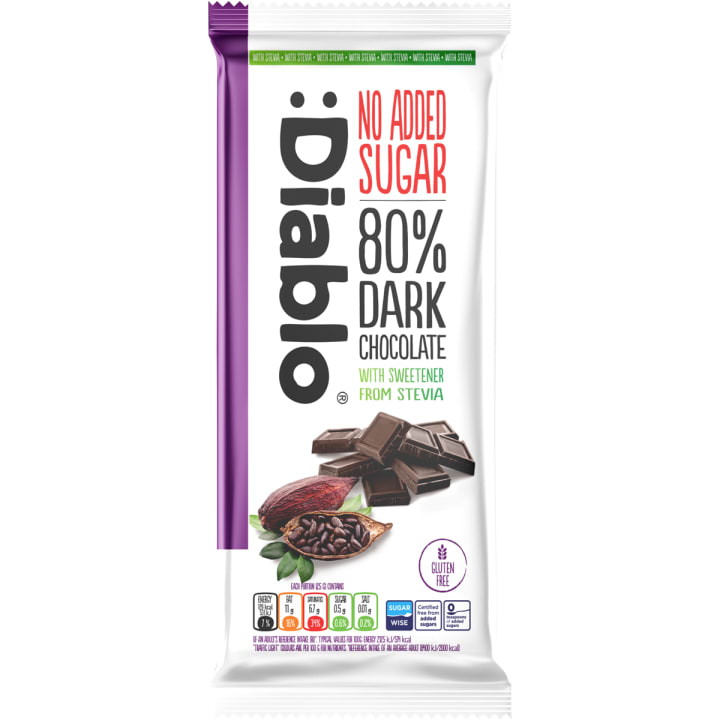
No Added Sugar 80% Dark Chocolate with Stevia 75 g
1.1 g sugars per 100 g, occurring naturally in the cocoa, sweetened with maltitol and steviol glycosides
On this page: how to pick · what to check on the pack · sugar free or no added sugar · which Diablo bar · the figures · what else is on the shelf · FAQ
How to pick the best sugar free chocolate bar
Three decisions cover it. The first is the claim on the front, because sugar free and no added sugar are defined differently in GB law and describe different panels, which the next two sections unpack. The second is the sweetener, since maltitol, erythritol, steviol glycosides and sucralose each bring a different sweetness, texture and calorie count to the bar, and the ingredients list names the one in your hand. The third is the cocoa level: a milk bar sweetened with maltitol will carry a few grams of sugars from its milk powder while a dark bar carries almost none, and the darker the bar the lower the sugars figure tends to run.
Diablo builds every bar on maltitol, a polyol made from starch that behaves like sugar in the recipe, so the chocolate tempers, snaps and melts the way you expect. Five of the 75 g bars add steviol glycosides at 0.02 percent alongside the maltitol. Polyols follow the recipe: 80 percent cocoa leaves little room for anything else, so the 80% dark shows 20 g per 100 g against 42 g in the 85 g dark.
What should you check before you buy a bar?
The sugars line
Find "of which sugars" in the per 100 g column. This is the figure the claim on the front has to answer to, and it counts every sugar whatever its source, so a milk bar's lactose shows here even when nothing was added.
The sweetener in the ingredients
It appears as "sweetener (maltitol)" or a similar phrase, and the polyol total shows on its own "of which polyols" line under carbohydrate. Two bars with the same sugars figure can carry very different amounts of polyol, which matters for both taste and how much you eat in one go.
The carbohydrate line
Polyols count towards carbohydrate, so a bar can show 47 g of carbohydrate next to 0.5 g of sugars and both figures are right. Read the three lines together and the panel makes sense.
The polyol statement
Any food over 10 percent polyols carries the words "excessive consumption may produce laxative effects" under the Food Information Regulations 2014. Polyols are absorbed slowly, which is exactly why the blood glucose rise after them is lower than after sugar, and it is also why a few pieces at a time is the comfortable way to enjoy them.
Sugar free or no added sugar: what is the difference?
Both are nutrition claims with fixed conditions in the GB nutrition and health claims register. Sugar free means no more than 0.5 g of sugars per 100 g, and polyols do not count as sugars, so a maltitol bar can qualify while still tasting sweet. No added sugar means no sugars or sweetening foods such as honey or fruit syrup were added, and where sugars occur naturally in the milk or cocoa the pack says so with the line "contains naturally occurring sugars".
The Diablo bars in this guide sit in the No Added Sugar range. On the dark bars the sugars figure runs from 0.5 g to 2 g per 100 g and comes from the cocoa; on the milk and white bars it runs from 6.3 g to 10 g and comes from the milk powder. Neither number is added sugar, and the table further down prints each one. For the full explainer, read sugar free vs no added sugar.
Which Diablo bar suits which taste?
You want dark with something in it
The No Added Sugar Dark Chocolate and Hazelnuts 85 g carries 10 percent hazelnuts. Its 1 g of sugars per 100 g occurs naturally in the cocoa and the nuts. The No Added Sugar Dark Chocolate with Orange 75 g brings freeze dried orange at 3 percent and inulin into the recipe. It shows 2 g of sugars per 100 g from the cocoa and the fruit.
You want a milk bar
The No Added Sugar Milk Chocolate 85 g is the closest thing to a standard milk bar. It shows 6.7 g of sugars per 100 g, occurring naturally in the milk powder. Among the 75 g bars the milk ones come with almonds at 12 percent (6.3 g), crispy rice (6.5 g) and hazelnuts at 12 percent (6.7 g). Each takes its sugars from the milk powder and the nuts.
You want white
The No Added Sugar White Chocolate 75 g shows 10 g of sugars per 100 g, all from the milk powder. White chocolate is cocoa butter and milk with no cocoa paste, so it carries the most lactose in the range. The No Added Sugar White Chocolate with Strawberry 75 g comes in at 8 g, from the milk powder and the freeze dried strawberry, with inulin in the recipe.
How do the Diablo bars compare on paper?
Every figure is per 100 g from the product's own panel. Every bar here is in the No Added Sugar range, with its sugars occurring naturally in the cocoa, the milk powder, the nuts or the fruit.
| Diablo bar | Sweetener | Sugars | Polyols | Carbohydrate | Energy |
|---|---|---|---|---|---|
| Dark Chocolate 85 g | maltitol | 0.5 g | 42 g | 47 g | 477 kcal |
| 80% Dark with Stevia 75 g | maltitol, steviol glycosides | 1.1 g | 20 g | 26 g | 514 kcal |
| Dark Chocolate and Hazelnuts 85 g | maltitol | 1 g | 42 g | 46 g | 487 kcal |
| Dark Chocolate with Orange 75 g | maltitol | 2 g | 44 g | 49 g | 448 kcal |
| Milk Chocolate 85 g | maltitol | 6.7 g | 49.87 g | 58 g | 471 kcal |
| Milk Chocolate with Almonds 75 g | maltitol, steviol glycosides | 6.3 g | 44 g | 51 g | 483 kcal |
| Milk Chocolate with Crispy Rice 75 g | maltitol, steviol glycosides | 6.5 g | 46 g | 59 g | 454 kcal |
| Milk Chocolate with Hazelnuts 75 g | maltitol, steviol glycosides | 6.7 g | 44 g | 52 g | 495 kcal |
| White Chocolate 75 g | maltitol, steviol glycosides | 10 g | 46 g | 57 g | 486 kcal |
| White Chocolate with Strawberry 75 g | maltitol | 8 g | 49 g | 58 g | 469 kcal |
Two patterns stand out. The dark bars sit at 2 g of sugars per 100 g or under. The milk and white bars sit between 6 g and 10 g, because milk powder brings lactose with it whatever the sweetener. And polyols follow the cocoa level, not the sweetener blend: 20 g in the 80% dark against 42 g in the 85 g dark, while the milk bars with steviol glycosides carry 44 g to 46 g. Every product page prints the full panel, including saturated fat and salt, so the comparison can be taken further from there. Maltitol itself is covered in what is maltitol.
What else is on the shelf?
A fair roundup names the other bars a UK shopper will see, so here are seven, with each figure taken per 100 g from that brand's own product page as read on 29 September 2026. These rows are published facts and nothing more: no scores, no prices and no links, because the point is to show how different recipes reach a low sugars figure, not to rank them.
| Bar, as the brand names it | Pack | Sweetener named in the ingredients | Sugars | Polyols | Cocoa solids, as stated |
|---|---|---|---|---|---|
| Torras Dark Chocolate 85% Sugar Free | 75 g | maltitol | 0.6 g | 14 g | 85% minimum |
| Torras Dark Chocolate 60% Stevia | 100 g | erythritol, steviol glycosides | under 0.5 g | 29 g | 60%, from the product name |
| Montezuma's Absolute Black 100% Cocoa | 90 g | none; cocoa mass only | 0.6 g | not shown | 100% |
| Lindt Excellence Dark 99% | 50 g | none; no sugar in the ingredients either | 1 g | not shown | 99% minimum |
| Lindt Excellence Dark 90% | 100 g | none; sugar is in the ingredients | 7 g | not shown | 90% minimum |
| Frankonia No Sugar Added Dark Chocolate | 80 g | maltitol | 1.0 g | 39 g | 52% minimum |
| N!CK'S Dark Chocolate | 25 g | erythritol, steviol glycosides, sucralose | 1.7 g | 16 g | at least 59% |
The table shows the two routes to a low sugars figure. One replaces the sugar with a polyol, a stevia blend or both. That is the route Diablo, Torras, Frankonia and the 25 g bar all take, and it keeps a familiar level of sweetness with the polyols showing on their own line. The other pushes cocoa so high that there is almost no room left for anything sweet. That is how a 99 percent or 100 percent bar reaches 1 g or under with nothing sweet in the recipe at all. A 90 percent bar sits between the two: sugar is still an ingredient, and the panel shows 7 g per 100 g.
Frequently Asked Questions
Which sugar free chocolate bar has the lowest sugars figure?
Of the ten Diablo bars here, all in the No Added Sugar range, the lowest is the No Added Sugar Dark Chocolate 85 g at 0.5 g of sugars per 100 g, occurring naturally in the cocoa, with 42 g of polyols and 8.1 g of fibre on the same panel. The Dark Chocolate and Hazelnuts 85 g follows at 1 g.
Is sugar free chocolate really free of sugar?
Almost. In GB the sugar free claim is allowed at 0.5 g of sugars per 100 g or under, so a trace can remain. Polyols such as maltitol are not sugars and are printed on their own line, which is why the bar still tastes sweet.
Does sugar free chocolate affect blood glucose?
It depends on the sweetener. For maltitol the authorised GB wording is that consumption of foods/drinks containing maltitol instead of sugar induces a lower blood glucose rise after their consumption compared to sugar-containing foods/drinks.
How much sugar free chocolate is comfortable in one sitting?
Polyols are absorbed slowly, which is the reason for the lower glucose rise, and every pack over 10 percent polyols says that excessive consumption may produce laxative effects. A few pieces at a time is the comfortable pattern, and a bar keeps well in a cool cupboard for the next evening.
See the whole range in one place
Every Diablo bar, with the sugars, polyols and carbohydrate figures printed on each product page.