 Chocolate Bars
 Dragees
 Cakes & Muffins
 Sweets & Gummies
 Cookies
 Dessert Sauces
 Wafers
 Spreads
 Muesli Bars
 Guilt-free Gifting
 Sales & Promotions

Sugar-Free Candy and Your Teeth:
What the FDA Actually Allows Brands to Say
A research-referenced guide to how sugar alcohols behave in the mouth, the one dental claim federal regulation permits, and how to read a US sugar-free label properly.
What the FDA Lets a Brand Say About Sugar-Free Candy and Teeth
Federal regulation sets out one dental claim, the conditions a food has to meet before it can carry it, and the wording it has to use. Here is what the rule says.
- ClaimFDA authorizes a dental caries health claim under 21 CFR 101.80. The permitted short form is: "Does not promote tooth decay"
- YesIsomalt, maltitol, sorbitol, xylitol, erythritol, mannitol and lactitol are all eligible noncariogenic sweeteners under that rule
- RuleThe claim is conditional: the food must meet the FDA "sugar free" definition, contain an eligible sweetener, and pass a product-level plaque pH test. Diablo does not carry this claim on any pack
- LabelIn the US, "sugar free" means less than 0.5 g of sugars per serving and per reference amount, not per 100 g as in the UK and EU
- NoteSugar alcohols are not calorie free, and sugar-free candy is not a substitute for brushing, flossing or regular dental visits
You have been told for years that candy is bad for your teeth. So you cut back, you brush a little harder after dessert, and the craving never quite goes away.
Here is the part that rarely gets explained properly: it is not sweetness that drives tooth decay, it is fermentable carbohydrate. Plaque bacteria metabolize sugars and starches and produce acid as a byproduct, and it is that acid that demineralizes enamel. That mechanism is why federal regulation treats sweeteners and sugars differently on a label, and it is worth understanding before you read any pack.
This guide covers what sugar alcohols are, which ones Diablo uses, what the FDA lets a brand claim about them, and how to read a US Nutrition Facts panel on a sugar-free candy without being misled. It is a guide to the regulation, not a dental claim for any Diablo product.
This article is educational. It references federal regulation and peer-reviewed research. It is not medical or dental advice, and no Diablo product is formulated to treat, prevent or manage any medical condition. Always talk to your dentist or physician for advice about your own situation.
Why Sugar Causes Cavities
Sugar does not dissolve enamel directly. The mechanism is more specific, and understanding it is the key to understanding what sugar alcohols change.
The Bacteria, Acid, Enamel Cycle
Your mouth hosts bacteria, particularly Streptococcus mutans, that live inside dental plaque. When you eat sugar, these bacteria ferment it and excrete acid. That acid lowers plaque pH and gradually pulls minerals out of enamel.
The cycle runs in four steps: you eat sugar, plaque bacteria ferment it, the bacteria excrete acid, and that acid demineralizes enamel. The more often this cycle repeats across a day, the greater the cumulative damage, largely independent of how much sugar was eaten in any single sitting. Federal dietary guidance has long made the same point: frequent between-meal snacking on foods high in sugars and starches is harder on teeth than eating the same foods at a meal and then brushing.
Sticky, Hard and Sour Candy
Sticky candies such as caramel and taffy, along with slow-dissolving hard candy and acidic sour gummies, extend contact time. That means a longer window in which bacteria have access to fermentable carbohydrate, and in the case of sour products, a direct acid load on top of the bacterial one.
Eating a small amount of sugary candy five times across a day produces more cumulative acid exposure than eating a larger amount in one sitting followed by brushing. How often matters more than how much.
What the FDA Rule Actually Covers
Sugar-free confectionery replaces sucrose and corn syrup with sugar alcohols, and in some cases with high-intensity sweeteners such as steviol glycosides or acesulfame potassium. The FDA has authorized one narrow dental claim covering some of those sweeteners, on strict conditions, and the wording of the rule is worth reading in full.
Under 21 CFR 101.80, a qualifying food may carry a dental caries health claim. One of the model full claims reads:
"Frequent between-meal consumption of foods high in sugars and starches promotes tooth decay. The sugar alcohols in [name of food] do not promote tooth decay."
For small packages, the authorized short form is "Does not promote tooth decay" or "May reduce the risk of tooth decay."
Conditions attached to the claim: the food must meet the FDA definition of "sugar free," it must contain at least one eligible noncariogenic sweetener, and where other carbohydrates are present it must not lower plaque pH below 5.7 during consumption or for 30 minutes afterward, measured by the indwelling plaque pH test the rule incorporates. The claim also may not attribute any specific degree of risk reduction, and may not imply that eating these foods is the only way to reduce cavity risk.
Diablo does not make this claim. The plaque pH testing sits at finished-product level, we do not hold that data for our range, and nothing in this article should be read as a dental claim for any Diablo product.
Phrases such as "cavity fighting," "protects your smile," "good for your teeth" or "dentist approved" are not the authorized claim. They go beyond what 21 CFR 101.80 permits and are separately exposed under FTC truth-in-advertising rules, which require competent and reliable scientific substantiation for any express or implied health representation. Use the authorized wording or describe the mechanism factually, as this article does.
Isomalt, the Sweetener Behind Diablo Hard Candy
Isomalt is a sugar alcohol derived from beet sugar. It dissolves slowly, holds its shape under heat, and is the reason sugar-free boiled and cream candies can be made at all. It is one of the sweeteners named on the FDA eligible list at 21 CFR 101.80(c)(2)(ii)(A), which is a property of the sweetener and not a claim about any finished candy.
Across the Diablo cream and butter candy range, isomalt is the first ingredient by weight, and total sugar alcohols run from roughly 83 g to 91 g per 100 g of product.
Maltitol and Sorbitol
Maltitol and maltitol syrup appear in the Diablo gummy range and in several of the cream candies, often alongside sorbitol as a humectant. Both are named on the same FDA eligible list. Maltitol carries more sweetness and body than the other sugar alcohols, which is why it does the work in a gummy. Polyols are absorbed slowly, which is the point of using them, so enjoy a few pieces at a time and your gut adjusts.
Xylitol and Erythritol
Xylitol and erythritol have the largest published research base on oral bacteria, and both are eligible under 21 CFR 101.80. Neither is currently used in the Diablo range, so they are covered here for completeness rather than as a product claim. If you specifically want xylitol, note that it is toxic to dogs and should be kept well away from pets.
Steviol Glycosides and Acesulfame Potassium
These are high-intensity sweeteners, not sugar alcohols. They are used in tiny quantities to round out sweetness and are not fermented by oral bacteria, but they are not on the FDA eligible list for the dental caries claim. Sucralose is the only high-intensity sweetener the rule covers. Content should not attribute dental benefits to stevia or acesulfame potassium.
UK and EU packs must carry "excessive consumption may produce laxative effects" whenever a food exceeds 10 percent polyols. There is no equivalent blanket rule in the US. Federal requirements attach to two specific sugar alcohols: sorbitol, where reasonably foreseeable consumption could reach 50 g per day (21 CFR 184.1835), and mannitol, at 20 g per day (21 CFR 180.25). Both require the statement "Excess consumption may have a laxative effect."
Diablo cream candies are built on isomalt and maltitol, which carry no federally mandated statement. That does not change the physiology. Sugar alcohols still ferment in the large intestine, and tolerance varies widely between people, so the practical advice below still applies.
Sugar Alcohol Comparison
| Sweetener | Type | Energy | FDA tooth decay claim eligible | Used by Diablo | Key notes |
|---|---|---|---|---|---|
| Isomalt | Sugar alcohol | ~2 Cal/g | Yes | Yes, lead sweetener | Backbone of the Diablo cream and butter candy range. Slow dissolving, heat stable. |
| Maltitol / maltitol syrup | Sugar alcohol | ~2.1 Cal/g | Yes | Yes, gummies and some candies | Carries the sweetness and body a gummy needs. Absorbed slowly, like all polyols. |
| Sorbitol | Sugar alcohol | ~2.6 Cal/g | Yes | Yes, as humectant | Laxative statement required if foreseeable intake reaches 50 g/day. |
| Xylitol | Sugar alcohol | ~2.4 Cal/g | Yes | No | Largest published research base on oral bacteria. Toxic to dogs. |
| Erythritol | Sugar alcohol | ~0.2 Cal/g | Yes | No | Best tolerated sugar alcohol at higher intakes. Not in the Diablo range. |
| Mannitol | Sugar alcohol | ~1.6 Cal/g | Yes | No | Laxative statement required at a lower threshold, 20 g/day. |
| Sucralose | High-intensity sweetener | Zero | Yes | No | The only high-intensity sweetener named in 21 CFR 101.80. |
| Steviol glycosides | High-intensity sweetener | Negligible | No | Yes, gummies | Not fermented by oral bacteria, but carries no authorized dental claim. |
| Acesulfame potassium | High-intensity sweetener | Zero | No | Yes, candies | Used at trace level for sweetness balance. No authorized dental claim. |
| Sucrose (table sugar) | Sugar | 4 Cal/g | Not applicable | No | Readily fermented by plaque bacteria. |
Eligibility per 21 CFR 101.80(c)(2)(ii). The full eligible list also includes lactitol, hydrogenated starch hydrolysates, hydrogenated glucose syrups, D-tagatose and isomaltulose. Eligibility is a property of the sweetener under the rule, not a claim about any finished product: the dental caries claim also requires finished-product plaque pH testing, and no Diablo product carries that claim. Calorie values are the conventional US figures for sugar alcohols and vary slightly by source. Diablo usage verified against ingredient declarations.
Diablo Sugar Free Candy: Verified Product Data
Every figure below comes from the certificate of analysis for that SKU. All qualify as sugar free under the FDA definition by a wide margin, and all are made with sweeteners in place of sugar.
Diablo certificates of analysis for this range are issued in EU format, with a per 100 g column and a per piece column. The per piece and per 100 g values below are taken directly from those documents. Sodium values are converted from the declared salt figure and are shown for orientation only. A finished US Nutrition Facts panel must be generated from a US-format certificate of analysis, with the serving size set from the FDA reference amount and every value rounded to the increments in 21 CFR 101.9.
Diablo SF Mint & Cream Sweets 75 g

- Calories per piece (4.2 g)12 Cal
- Total sugars per piece0 g
- Sugar alcohols per piece3.6 g
- Total carbohydrate per piece3.7 g
- Sodium per 100 g (derived)228 mg
- Lead sweetenersIsomalt, maltitol syrup
- Net weight75 g (2.65 oz)
Diablo SF Lemon & Cream Sweets 75 g
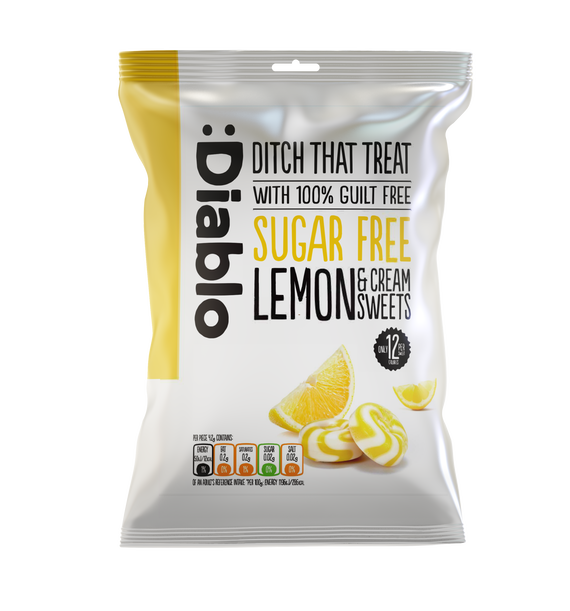
- Calories per piece (4.2 g)11 Cal
- Total sugars per piece0 g
- Sugar alcohols per piece3.8 g
- Total carbohydrate per piece3.8 g
- Sodium per 100 g (derived)148 mg
- Lead sweetenerIsomalt
- Net weight75 g (2.65 oz)
Diablo SF Strawberry & Cream Sweets 75 g
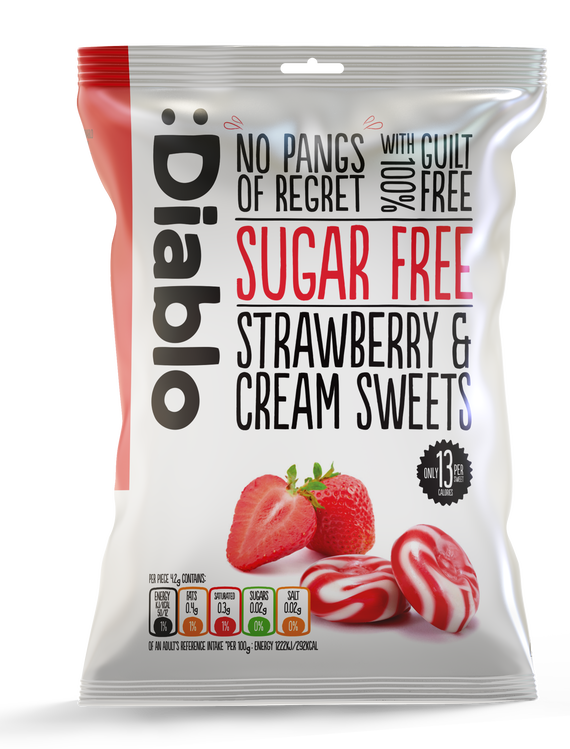
- Calories per piece (4.2 g)12 Cal
- Total sugars per piece0 g
- Sugar alcohols per piece3.6 g
- Total carbohydrate per piece3.7 g
- Sodium per 100 g (derived)228 mg
- Lead sweetenersIsomalt, maltitol syrup
- Net weight75 g (2.65 oz)
Diablo SF Cappuccino & Cream Sweets 75 g
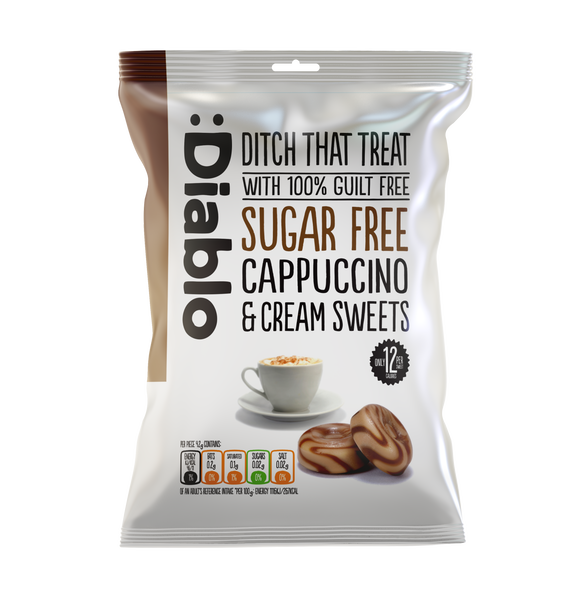
- Calories per piece (4.2 g)11 Cal
- Total sugars per piece0 g
- Sugar alcohols per piece3.8 g
- Total carbohydrate per piece3.8 g
- Sodium per 100 g (derived)148 mg
- Lead sweetenerIsomalt
- Net weight75 g (2.65 oz)
Diablo SF Butter Sweets 75 g
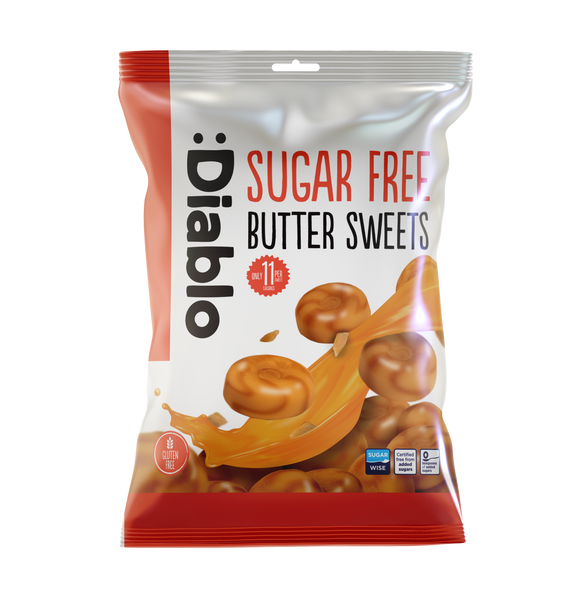
- Calories per piece (4.1 g)11 Cal
- Total sugars per piece0 g
- Sugar alcohols per piece3.7 g
- Total carbohydrate per piece3.8 g
- Sodium per 100 g (derived)152 mg
- Lead sweetenerIsomalt
- Net weight75 g (2.65 oz)
Diablo SF Gummy Bears 75 g

- Calories per 100 g219 Cal
- Total sugars per 100 g0.1 g
- Total carbohydrate per 100 g78 g
- Total fat per 100 g0.2 g (0.2 g sat)
- Protein per 100 g4 g
- Lead sweetenersMaltitols, sorbitols, steviol glycosides
All figures verified against certificate of analysis data. The Gummy Bears certificate declares per 100 g only, with no per-serving column, and does not break out sugar alcohols separately. Always check the pack for the current declaration.
What a US Nutrition Facts Panel Looks Like: Diablo SF Mint & Cream Sweets 75 g
The table below shows the certificate values alongside an illustrative US panel. FDA sets the reference amount for hard candy at 15 g, and for products in discrete units the labeled serving is the number of whole pieces closest to that amount, which works out at 4 pieces.
| Nutrient | Per 100 g (COA) | Per piece (4.2 g, COA) | Illustrative US serving (4 pieces, 16.8 g) |
|---|---|---|---|
| Calories | 295 | 12 | 50 |
| Total Fat | 9.3 g | 0.4 g | 1.5 g |
| Saturated Fat | 7.5 g | 0.3 g | 1.5 g |
| Sodium (derived from salt) | 228 mg | 10 mg | 40 mg |
| Total Carbohydrate | 87.5 g | 3.7 g | 15 g |
| Dietary Fiber | 0 g | 0 g | 0 g |
| Total Sugars | 0.4 g | 0 g | 0 g |
| Includes Added Sugars | 0 g | 0 g | 0 g |
| Sugar Alcohol | 87.1 g | 3.6 g | 15 g |
| Protein | 0.1 g | 0 g | 0 g |
Ingredients: Sweetener: isomalt, sweetener: maltitol syrup, water, coconut oil, cream 6%, salt, flavoring, emulsifier: soy lecithin, coloring: E141, sweetener: acesulfame potassium. The final column is an illustrative conversion for editorial purposes, not a certified label value.
The sugar-free disclaimer. A "sugar free" claim triggers a disclosure requirement under 21 CFR 101.60(c). If the food is not also low calorie or reduced calorie, the claim must be accompanied each time it appears by a statement such as "not a low calorie food," "not a reduced calorie food" or "not for weight control." Sugar-free candy in this calorie range typically needs one.
Sugar alcohols become mandatory. The Sugar Alcohol line on a US Nutrition Facts panel is normally voluntary. It becomes mandatory as soon as the label makes any claim about sugar alcohols or about sugars, which a "sugar free" claim does.
Sugar-Free Versus Regular Candy
| Factor | Regular sugar candy | Diablo sugar-free candy |
|---|---|---|
| Sugars per serving | High | Under 0.5 g per serving |
| Calories per 100 g | Typically 380 to 400 | 268 to 295 |
| Calories per individual piece | Around 20 to 25 | 11 to 12 |
| Added Sugars on the Nutrition Facts panel | Typically the full carbohydrate load | 0 g |
| Counts toward Total Carbohydrate | Yes, as sugars | Yes, as sugar alcohol |
| Sugar alcohol content | None | 83 to 91 g per 100 g |
Regular candy figures are typical category values. Diablo figures come from certificate of analysis data for the SWT range.
"Net carbs" is not an FDA-defined term and does not appear on a Nutrition Facts panel. The common convention is total carbohydrate minus dietary fiber minus sugar alcohols. Applied to a Diablo cream candy, that puts a single piece close to zero by that convention, while the regulated Total Carbohydrate line still reads 3.7 g. Both numbers are accurate. They are measuring different things, and different sugar alcohols are absorbed to different degrees, so treat net carb math as a rough guide rather than a precise one.
Who Sugar-Free Candy Suits
People Cutting Back on Added Sugar
If you are reducing added sugar for any reason, sugar-free candy lets you keep a sweet moment in the day without the sugar load. This is a lifestyle choice rather than a clinical one, and no sugar-free product is formulated for or directed at any medical condition.
Households Watching Portion Size
An individually wrapped Diablo piece is 11 to 12 calories. The wrapper acts as a natural portion boundary, which is often the practical difference between one piece and a handful.
Parents Choosing Occasional Treats
Sugar-free options give kids a sweet moment without the added sugar. Check the Contains statement carefully, since most Diablo cream candies declare milk and soy, and start with a small portion, since children are smaller and a few pieces go further.
Anyone Who Actually Reads the Panel
"Sugar free," "no sugar added" and "zero sugar" are not interchangeable, and the Total Sugars line is not the whole story. The section below covers how to tell them apart.
How to Read a US Sugar-Free Label
- Look at the sweetener at the top of the ingredient list. Isomalt, maltitol, sorbitol, xylitol, erythritol, mannitol and lactitol are named on the FDA eligible list for the dental claim, though a finished product also has to pass plaque pH testing before it may carry it. Steviol glycosides and acesulfame potassium are not on that list
- Check which claim is on the front. "Sugar free" and "zero sugar" both require less than 0.5 g of sugars per serving and per reference amount. "No sugar added" is a different claim and permits naturally occurring sugars
- Read the Added Sugars line, not just Total Sugars. Added Sugars became mandatory on US panels with the 2016 label update and is the more useful number for most people
- Find the Sugar Alcohol line under Total Carbohydrate. It is voluntary in general but required whenever a sugars or sugar alcohol claim appears on the package
- Watch for the disclaimer. A sugar-free product that is not low calorie must say so, usually as "not a low calorie food" or "not a reduced calorie food"
- Check the Contains statement every time. US law covers nine major allergens, with sesame added in January 2023. Most Diablo cream candies declare milk and soy, and list peanuts, tree nuts and sesame as may-contain
- Treat it as candy. Sugar-free confectionery is a sweet treat, and it is no substitute for brushing, flossing and regular dental visits
Is Sugar-Free Candy Safe?
The common objection is that sugar-free simply swaps one problem for another. Here is a straight answer.
Sugar alcohols are approved food ingredients with a long safety record. They are absorbed slowly, which is the point of using them, and in larger amounts that slow absorption can be noticeable, so enjoy a few pieces at a time and your gut adjusts. Individual tolerance varies, and there is no single threshold that applies to everyone. Sugar-free candy is still candy: lower in sugar and somewhat lower in calories, and it is not a diet food.
Frequently Asked Questions
References and Sources
- 21 CFR 101.80, Health claims: dietary noncariogenic carbohydrate sweeteners and dental caries. US Food and Drug Administration.
- 21 CFR 101.60(c), Nutrient content claims for the calorie content of foods, sugar content claims.
- 21 CFR 101.9, Nutrition labeling of food, including declaration and rounding of sugar alcohols and added sugars.
- 21 CFR 101.12, Reference amounts customarily consumed per eating occasion.
- 21 CFR 184.1835 (sorbitol) and 21 CFR 180.25 (mannitol), laxative effect labeling conditions.
- FDA, Guidance for Industry and FDA: Dear Manufacturer Letter Regarding Sugar Free Claims.
- Food Allergen Labeling and Consumer Protection Act, as amended by the FASTER Act of 2021, effective January 1, 2023 for sesame.
- Riley P. et al. (2015). Xylitol-containing products for preventing dental caries in children and adults. Cochrane Database of Systematic Reviews. DOI: 10.1002/14651858.CD010743.pub2
- ALHumaid J. et al. (2022). Meta-analysis on the effectiveness of xylitol in caries prevention. Journal of the International Society of Preventive and Community Dentistry. PMC9022379.
- Product nutritional and allergen data: Diablo Sugar Free certificates of analysis, SWT and GMY ranges.
Sweet Moments, Made With Sugar Alcohols Instead of Sugar
Diablo Sugar Free makes hard candy, cream candy and gummies using isomalt, maltitol and other sugar alcohols. Sugar free, individually wrapped, and honest about what is on the label. Free US shipping on orders over $49.
Shop Diablo Sugar Free CandySugar free, sweetened with sugar alcohols. Not a low calorie food.