Diablo vs Lily's vs ChocZero
vs Russell Stover
Which sugar-free brand fits your shopping list once sweeteners, price, taste and product range are compared side by side?
Which Sugar-Free Brand Fits You?
There is no single winner for every shopper, because each brand is built around a different priority. Here is how the four compare at a glance:
- 1Diablo covers the widest product range, with chocolate, gummies, cookies, wafers, muffins, cakes, spreads and dessert sauces in one lineup
- 2Lily's is the easiest to find in US grocery stores, is sweetened with stevia and erythritol, and has been owned by The Hershey Company since 2021
- 3ChocZero uses monk fruit and soluble corn fiber and deliberately avoids sugar alcohols altogether, which suits shoppers who dislike polyols
- 4Russell Stover has the broadest big-box shelf presence and the lowest typical price per ounce, with a maltitol-based sugar-free line
- 5The sweetener matters more than the brand name on the wrapper, so read the ingredients panel before the front of pack
Sugar-free chocolate has moved from a small specialist shelf into a mainstream grocery category, and Lily's, ChocZero, Russell Stover and Diablo are four of the names US shoppers run into most often. All four are sold in the US, all four replace sugar with sweeteners, and all four taste noticeably different once you compare them properly.
So which one deserves a spot in your cart? We compared all four on sweetener type, taste, nutrition, product range and price per ounce, so you can pick the one that fits your goals rather than guessing from the packaging.
Most reviews look at these brands one at a time, usually from a keto blog. This guide puts all four side by side, with a full sweetener breakdown, a taste and texture comparison, verified nutrition panels for the Diablo products mentioned, and a decision framework based on what you are actually shopping for.
Why This Comparison Matters
The Rise of Sugar-Free Snacking in the US
Sugar reduction has moved firmly into the mainstream grocery aisle. Major manufacturers have invested in sugar-free and no-added-sugar lines because demand has grown well beyond the low-carb communities that built the category. Hershey's purchase of Lily's in 2021 is the clearest signal of that shift: a $425 million deal for a brand that started with four stevia-sweetened bars in 2012.
What "Sugar Free" Actually Means on a US Label
Under FDA labeling rules, a "sugar free" claim generally means less than 0.5 grams of sugar per labeled serving. "No added sugar" is a different, broader claim: it means no sugars were added during manufacturing, even though the product may still contain naturally occurring sugars, such as the lactose in milk chocolate.
That distinction is the single most useful thing to understand before comparing brands, because all four use both claims across different parts of their ranges. A milk chocolate bar made without added sugar will still show a few grams of sugar on the panel, and that is normal rather than a labeling error.
If you are comparing a US pack against a European one, the thresholds are written differently. In the UK and EU, "sugar free" is measured as no more than 0.5g of sugars per 100g, not per serving. Diablo packs sold in the US carry both formats across the range, so check the panel on the pack in front of you.
Meet the Four Brands
Diablo Sugar Free
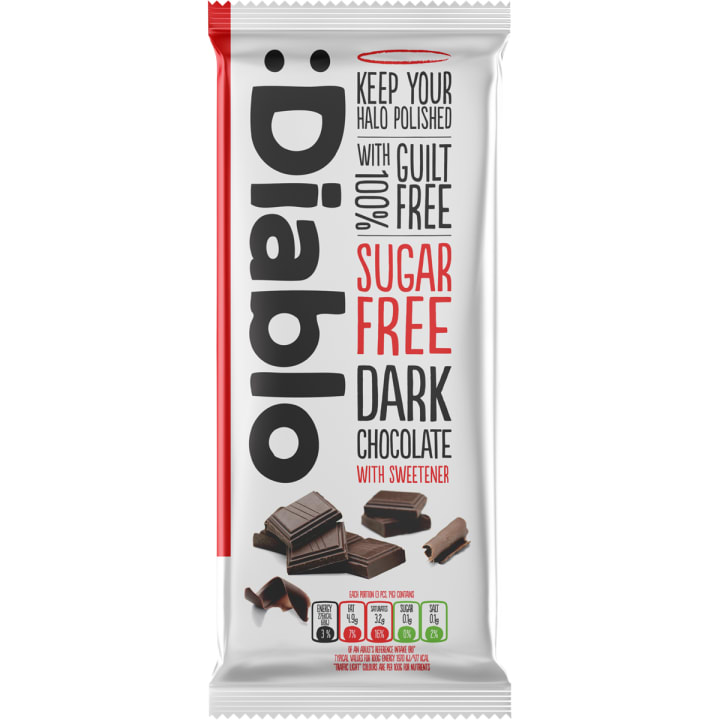
Diablo makes confectionery and bakery products for people cutting back on sugar, and the range is one of the broadest in the category: chocolate bars and boxes, gummies, hard candies and toffees, cookies, sandwich cookies, wafers, muffins and cakes, spreads, muesli bars, and dessert sauces. The range splits into two claim types, marked clearly on pack. SF lines are sugar free. NAS lines are made with no added sugar, and any sugars shown on the panel come naturally from ingredients such as milk. Sweetening is mainly maltitol and maltitol syrup, with isomalt, sorbitol and acesulfame K in some lines, and steviol glycosides in the gummies and the Chocolate Delights box. Diablo ships direct across the US, with free shipping on orders over $49, and also sells through Amazon.
Lily's Sweets
Lily's was founded in 2012 and debuted nationally in Whole Foods, and The Hershey Company completed its acquisition of the brand in June 2021 for $425 million. It is one of the most widely distributed sugar-free chocolate brands in US grocery, including Target and Walmart. Its dark, milk and white "chocolate style" bars are built on stevia and erythritol alongside fiber ingredients such as inulin and dextrin, and the brand is known for chocolate that reads as close to conventional.
ChocZero
ChocZero is a family-run Southern California chocolate maker that started in late 2016. Its defining choice is a formula built on monk fruit extract plus soluble corn fiber, with sugar alcohols left out entirely: the company states publicly that it does not use maltitol, erythritol or xylitol in any product. The range covers chocolate bars and squares, baking chips, syrups, jams and spreads, sold mainly direct and through Amazon.
Russell Stover
Russell Stover is a long-established American confectionery brand whose sugar-free line is stocked in most major US retailers, including Walmart and drugstores, usually at the lowest price point of the four. Its sugar-free candies are sweetened mainly with maltitol, with stevia extract appearing in newer lines. It is the easiest of the four to buy on a physical shelf, particularly around gifting seasons.
Head-to-Head Comparison Table
| Feature | Diablo Sugar Free | Lily's Sweets | ChocZero | Russell Stover |
|---|---|---|---|---|
| Where to buy | Direct site, Amazon | Target, Walmart, grocery, Amazon | Direct site, Amazon | Walmart, drugstores, direct site |
| Product range | Widest: chocolate, gummies, cookies, wafers, cakes, spreads, sauces | Chocolate bars, baking chips, peanut butter cups | Chocolate bars, syrups, spreads, baking chips | Boxed assortments, chocolate candy |
| Primary sweetener | Maltitol and maltitol syrup; isomalt, sorbitol, acesulfame K and steviol glycosides in some lines | Stevia and erythritol, with inulin and dextrin | Monk fruit extract and soluble corn fiber | Maltitol, with stevia in some lines |
| Uses sugar alcohols? | Yes | Yes (erythritol) | No | Yes |
| Claim used on pack | Sugar free (SF) and no added sugar (NAS), by line | Mostly no added sugar | No added sugar | Sugar free |
| Typical price point | Mid-range, around $6 per 85g bar | Premium per ounce | Premium, smaller serving sizes | Lowest typical price per ounce |
| Shipping | Free over $49 direct, or Amazon Prime | Grocery pickup or Amazon | Direct or Amazon | Widely stocked in stores |
Sources: brand websites and published ingredient statements, Hershey corporate filings, and FDA labeling guidance. Pricing and availability checked July 2026.
The Diablo Range: Verified Panels
Because the SF and NAS distinction changes what you see on the nutrition panel, here are six Diablo products across different categories with the figures taken straight from the pack. Values are per 100g, with per-serving figures where the pack declares one.
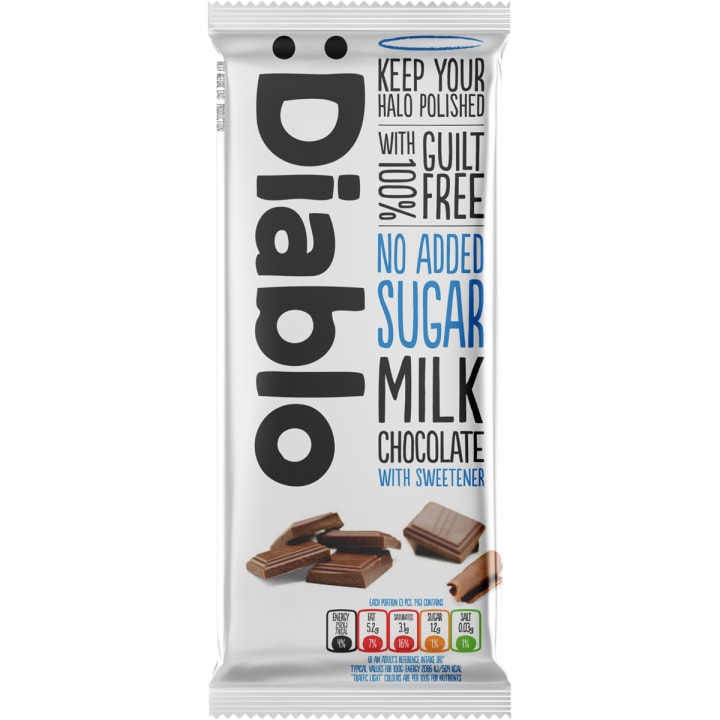
Diablo NAS Milk Chocolate 85g
- Energy / 100g504 kcal
- Per serving (16.5g)71 kcal
- Sugars / 100g8.9g
- Polyols / 100g38g
- Protein / 100g8.0g
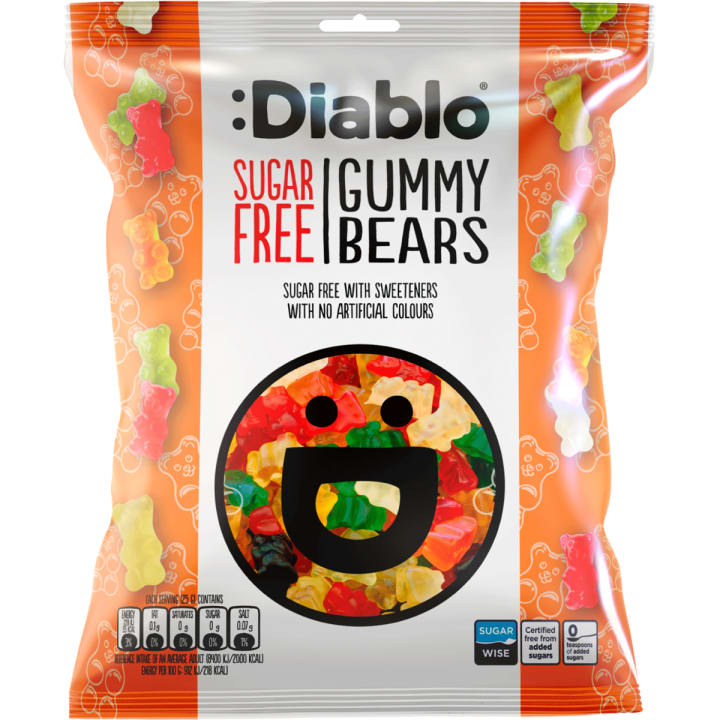
Diablo SF Gummy Bears 75g
- Energy / 100g219 kcal
- Sugars / 100g0.1g
- Fat / 100g0.2g
- Protein / 100g4g
- Salt / 100g0.3g
Diablo NAS Hazelnut Cookies 135g
- Energy / 100g437 kcal
- Per serving (22.5g)98 kcal
- Sugars / 100g1.2g
- Fat / 100g29g
- Protein / 100g6.8g
Diablo NAS Cream Filled Milk Chocolate Wafers 150g
- Energy / 100g485 kcal
- Per serving (18.6g)45 kcal
- Sugars / 100g5.2g
- Polyols / 100g32g
- Protein / 100g5.6g
Diablo SF 6 Vanilla Muffins 270g
- Energy / 100g387 kcal
- Per muffin (45g)174 kcal
- Sugars / 100g0g
- Polyols / 100g19.5g
- Fiber / 100g5g
Diablo Sauce
- Energy / 100g167 kcal
- Sugars / 100g<0.5g
- Polyols / 100g53g
- Fat / 100g2.1g
- Protein / 100g2g
Diablo products are sweetened with polyols (sugar alcohols). Excessive consumption may produce laxative effects. Stick to the serving size shown on pack, and introduce polyol-sweetened products gradually if you are new to them.
Sweeteners Explained: What Is Really Replacing the Sugar
Almost every sugar-free snack on a US shelf relies on one of two families of sweetener: polyols, also called sugar alcohols, or high-intensity plant-derived sweeteners such as steviol glycosides and monk fruit extract. Understanding the difference matters more than the brand name on the wrapper.
Maltitol
Maltitol is the workhorse of sugar-free chocolate manufacturing. It behaves like sugar in a recipe, which is why brands such as Russell Stover and most of the Diablo range use it for chocolate that needs to snap and melt properly. It carries roughly 2.1 calories per gram against sugar's 4, and its glycemic index is around 35 compared with about 65 for table sugar. In larger quantities, maltitol and other polyols can have a laxative effect, which is why packs carry a digestive advisory once polyol content passes the regulatory threshold.
Stevia
Steviol glycosides come from the leaves of the Stevia rebaudiana plant and are roughly 200 to 300 times sweeter than sugar by weight. Because so little is needed, they contribute effectively no calories or carbohydrate. Lily's leans on stevia paired with erythritol, and Diablo uses steviol glycosides in its gummies and Chocolate Delights box. The trade-off is a licorice-like note at higher concentrations that some tasters pick up more than others.
Monk Fruit and Erythritol
ChocZero pairs monk fruit extract with soluble corn fiber and skips sugar alcohols entirely, which is its main point of difference. Erythritol, used by Lily's, is itself a polyol, but it is absorbed differently from maltitol and is generally tolerated in larger amounts, though it carries a cooling mouthfeel that not everyone likes.
What You Can Say About Sweeteners and Blood Glucose
There is one authorised way to describe this, and it is worth quoting precisely rather than paraphrasing: sugar replacers such as maltitol and xylitol produce a lower blood glucose rise after their consumption compared to sugar. That is a statement about the sweetener, not a claim about any medical condition, and nothing on this page should be read as dietary or medical advice. If you are managing a health condition, talk to your doctor or a registered dietitian about how any product fits your plan.
Diablo's chocolate bars, gummies and cookies are made with sweeteners instead of sugar, with the SF or NAS claim stated clearly on every pack and the full ingredients panel published for each product. Free US shipping on orders over $49.
Product Range: The Category Most Reviews Skip
Chocolate bars get most of the attention in sugar-free reviews, but these four brands are not competing on the same footprint. Lily's and ChocZero are both built almost entirely around chocolate, whether as bars, baking chips or spreads. Russell Stover centres on boxed chocolate candy assortments. Diablo covers a noticeably wider set of categories, including muffins and cakes, cookies, sandwich cookies, wafers, dessert sauces, spreads and muesli bars alongside its chocolate and gummy lines. If you are trying to cut sugar across a whole snacking routine rather than a single chocolate craving, that breadth matters as much as any one bar's taste.
Taste and Texture
Independent taste comparisons consistently describe Lily's as rich and creamy with a crisp snap that reads close to conventional chocolate. ChocZero is usually described as smooth and sweet-forward from the monk fruit, with a cleaner finish than sugar-alcohol-based bars, though servings run small. Russell Stover's maltitol bars are familiar and straightforward, which matches the price. Diablo spans several formats rather than one flagship bar, and the gummies, wafers and cookies in particular are built to mirror mainstream candy and biscuit flavours closely, which matters most if you are switching over from full-sugar snacks rather than starting from a specialist diet.
Price Per Ounce Compared
Price comparisons depend heavily on where you shop and which format you buy. Diablo's direct pricing runs mid-range, with an 85g chocolate bar around $6 and a meaningfully lower unit price in multi-packs. Lily's and ChocZero both sit at a premium per ounce against mainstream chocolate, reflecting smaller batch sizes and speciality sweeteners, and ChocZero's serving sizes run smaller than a standard bar. Russell Stover is generally the cheapest per ounce, reflecting its scale and long-standing retail relationships.
Which Brand Fits Your Shopping List
If You Want to Avoid Sugar Alcohols
ChocZero is the only one of the four that leaves polyols out entirely, using monk fruit and soluble corn fiber instead.
If You Track Net Carbs
Compare the fiber and polyol lines on the panel rather than the sugar line alone, since that is what changes your net carb math.
If You Want Variety
Diablo is the practical pick when you want more than chocolate, covering gummies, cookies, wafers, muffins and sauces in one order.
If You Shop on Price
Russell Stover has the lowest typical price per ounce and the widest in-store availability at big-box retailers.
Sugar-Free Snack Ideas Beyond Chocolate
A sugar-free snacking routine does not have to start and end with chocolate. A rotation worth building:
- Two squares of sugar-free dark chocolate with a small portion of mixed nuts, portioned in advance rather than eaten from the box
- Sugar-free gummies in familiar flavours as a swap for standard gummy candy
- A cookie or wafer alongside black coffee or unsweetened tea for an afternoon break
- A small handful of chocolate-covered nuts for something portable
- Whole foods such as berries, plain yogurt or a handful of nuts on days you want to keep sweeteners out of it altogether
How to Read a Sugar-Free Label
- Check the claim. Sugar free means under 0.5g of sugar per serving under FDA rules. No added sugar is a different, broader claim, and the pack can still show naturally occurring sugars.
- Identify the sweetener. Look past the front of pack and find the actual ingredient: maltitol, isomalt, sorbitol, erythritol, steviol glycosides, monk fruit extract, or a blend.
- Check for a digestive advisory. Polyol-heavy products carry a note about possible laxative effects when eaten in excess.
- Check net carbs, not just sugar. Total carbohydrate minus fiber and sugar alcohols is the more useful number if you are tracking.
- Check the allergen panel. Sugar-free bakery and chocolate products commonly contain wheat, milk, soy, egg, peanuts or tree nuts.
- Compare price per ounce, not per pack. Pack sizes vary widely between mass-market and speciality products.
Frequently Asked Questions
References and Sources
- US Food and Drug Administration. Guidance on sugar and sugar-free labeling claims. fda.gov
- The Hershey Company. Hershey completes acquisition of Lily's confectionery brand, 25 June 2021. thehersheycompany.com
- Lily's Sweets. Brand and ingredient information. lilys.com
- ChocZero. About and ingredient information. choczero.com
- Russell Stover. Brand and product information. russellstover.com
- Diablo Sugar Free. Product specifications and ingredients and allergens data. diablosugarfree.com
Ready to Build Your Sugar-Free Snack Lineup?
Diablo makes chocolate, gummies, cookies, wafers, cakes, spreads, and dessert sauces with sweeteners instead of sugar, shipped across the US with free shipping on orders over $49.
Shop Diablo Sugar FreeFree US shipping over $49. Contains sweeteners. Excessive consumption may produce laxative effects.
Chocolate Bars
Dragees
Cakes & Muffins
Sweets & Gummies
Cookies
Dessert Sauces
Chocolate Gift Boxes
Wafers
Spreads
Muesli Bars
Hampers
Sales & Promotions